


MORE to follow.



MORE to follow.

Oh.
Tonight.
Sligo. County Sligo.
Thanks The Q47


Behold: the 1973 Ferrari Dino 246GTS convertible: originally Giallo Fly yellow over a grey interior, refinished in black, with the original motor replaced by a period-correct block from another 246 and complete with the all important Ferrari Classiche certification.
Yours for €400,000+.


From top: human rights lawyer Waleed Abu al-Khair, jailed since 2014; A Free Raif poster outside the Saudi Embassy, Fitzwilliam Square, Dublin 2 in 2015
Free this Thursday [February 6]?
Do you blog?
Grace Dyas writes:
Raif Badawi Raif was jailed & publicly flogged for 10 years in 2012 after starting a website for social and political debate in Saudi Arabia Waleed Abu al-Khair, is a human rights lawyer arrested in 2014.
We have learned that Raif and Waleed are now in critical condition on hunger strike in Prison in Saudi Arabia.
On February 6, we’re having a live blogathon at the Saudi Embassy calling on King Salman and Saudi authorities to free Raif, Waleed and all other human rights defenders immediately and unconditionally.
The ask would be that you pop along for a few minutes with your laptop and write a blog post highlighting Raif and Waleed’s condition there and then and the crackdown on protest and freedom of expression in Saudi Arabia.
We hope that images of Irish bloggers taking part in this action outside the embassy will be a powerful act of solidarity and hope for people in Saudi Arabia which has one of the largest Twitter using populations in the world.
We hope that your readers will be inspired to take action for Raif Badawi & Waleed Abou al-Kheir, to hopefully save their lives.
Outside the Saudi Embassy, Fitzwilliam Square, Dublin 2.
Between 1-3pm.
Previously: Saudi Arabia on Broadsheet


From top: Katherine Zappone, Minister for Children and Youth Affairs and Pat Rabbitte, chair of Tusla, the child and family agency
This morning.
Via The Irish Times:
People under investigation for child abuse, including sexual abuse, will be permitted to personally interview their alleged victims in certain circumstances under new Tusla investigatory procedures.
…If direct questioning is judged inappropriate, other forms of “stress testing” should be considered, including allowing the suspect to write out questions to be put to the complainant, allowing their solicitor to question the complainant or allowing the suspect to ask questions via video link.
In some cases a suspect may be allowed to be in the room while questions are put by a social worker, the guidelines state. “Consider using a screen to separate the complainant or witness who is being questioned.”
Tusla staff are instructed that the identity of the alleged victim should be disclosed to the suspect at an early stage, even in cases where the “complainant is at serious risk from the [alleged abuser].”
Meanwhile…
Last October, Fianna Fáil TD Anne Rabbitte asked Minister for Children and Youth Affairs Katherine Zappone several questions about Tusla’s new Child Abuse Substantiation Procedures, including when they would be made public, how the procedures would work and how they would be managed by Tusla. Ms Zappone said she would ask Tusla to contact Ms Rabbitte directly.
Update: Yes, They’re Serious


From top: Elaine Byrne’s column in the Business Post; Anthony Sheridan
Anthony Sheridan writes:
Elaine Byrne believes Mary Lou McDonald and her party are lacking in moral courage and are therefore unfit to govern.
Sinn Féin does not deserve a pass until Mary Lou and her leadership demonstrate genuine moral courage.
Ms Byrne is not alone in holding such an intolerant, undemocratic and hypocritical view.
The entire horde of establishment journalists have been scrambling around in panic ever since polls indicated that Sinn Fein have become a major force in Irish politics.
This development comes as no surprise to ordinary citizens who have suffered catastrophe after catastrophe as a direct result of political corruption in Fianna Fáil and Fine Gael.
The very fact that Ms Byrne obviously believes that these two parties are in possession of any semblance of moral courage destroys her credibility as an objective commentator.
But Ms Byrne may not recognise this criticism because, like all establishment commentators, she operates from within the extremely restricted realm of the political establishment.
Looking out from that bubble Ms. Byrne can see and is indeed very angry at the massive damage inflicted on Ireland and its people by the disease of political corruption.
We know this because she wrote a book outlining in great detail every major incident of political corruption perpetuated principally by Fianna Fail and Fine Gael since the formation of the state.
Unfortunately, Ms. Byrne does not, for whatever reason, possess the moral courage to actually name Fianna Fáil/Fine Gael as the guilty parties.
Instead, she falls in with the rest of the baying mob of ‘journalists’ in passing judgement on those, such as Sinn Féin, who challenge the power and privilege of our corrupt ruling political class
Anthony Sheridan is a freelance journalist and blogs at PublicEnquiry.
Sinn Féin must show moral courage on modern issues (Elaine Byrne, Business Post – behind paywall)
Elaine Byrne: Lacking moral courage to name names (Anthony Sheridan, Public Enquiry)
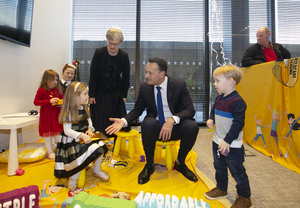
 From top: Minister for Children and Youth Affairs Katherine Zappone and Taoiseach Leo Varadkar launching the National Childcare Scheme in the Department of Children and Youth Affairs last December; Michael Taft.
Tomorrow (Wednesday, February 5) there will be an unprecedented protest by childcare professionals in Dublin, organised by the Early Years Alliance.
With crèches closing down, workers from around the country will descend on the capital to protest not only their working conditions but the very system of childcare that exists today – a system that penalises workers, parents, providers and children.
Childcare in Ireland is a fragmented, exploited sector made up almost entirely of women. When other European countries were developing childcare and early years’ provision as a public service in order to promote women’s participation in the labour force, childcare was an afterthought among Irish policy-makers.
Employees were subjected to low pay and poor working conditions – precarious contracts, lack of in-work benefits, etc. They still are.
Over the last decade greater official attention has been paid to childcare and the Early Years Sector. Free early years education was established; programmes to professionalise the sector were rolled out; means-testing provided greater access for low-income households while subsidies to providers were increased.
However, these measures did not address the fundamental flaws in the childcare model. This has resulted in the highest childcare fees in the EU and some of the worst-paid employees in the economy.
Simply put, the current model of childcare is broken.
Broken and unsustainable: staff turnover rates in full-time childcare are over 40 percent. In a SIPTU/Big Start survey of early years’ professionals, two-thirds of employees stated they would not be working in the sector in five years’ time if things don’t change, while over 40 percent are actively seeking other work.
The providers’ organisation – Early Childhood Ireland – reports that over a third of providers are unable to recruit employees, with half unable to retain staff. If these trends persist, there will be severe labour shortages leading to fewer providers.
These problems are due to treating childcare as a ‘market’.
This model means that providers must raise at least as much revenue as they spend (like any other business). This places an impossible burden on providers. If they want to improve wages and working conditions (and, so, attract and retain staff), they will have to raise fees, making childcare even more unaffordable.
If, however, they want to reduce fees they will have to reduce expenditure and, since labour makes up over 70 percent of providers’ expenditure, this means squeezing labour. This would only exacerbate low pay and poor working conditions.
It is against this backdrop that the protest is taking place – a protest being driven by the childcare professionals themselves.
They have joined the SIPTU trade union in their thousands; they have collectively begun to put forward their own analysis. The key to unlocking the potential of the sector, to transforming it into a modern public service, is the workers themselves.
When the protest was first announced, some elements in the media and officialdom attempted to turn the story into how protesting employees were burdening parents by closing down childcare provision for a day.
However, even the most cursory review of what was happing on the ground showed substantial support for the one-day action from across the community.
The workers have made alliances with many providers – both in the community and private sectors.
And the parents themselves know there is a major problem; they are aware of workers’ poor working conditions, and are asking themselves why fees are so high. The interests of the childcare professionals, the providers and the parents coincide.
The workers, therefore, are protesting not only their own conditions; they are also mounting a fundamental challenge to the childcare system itself on behalf of all stakeholders.
Political parties have picked up on this and, for the most part, have made significant resource commitments to the sector. That is good. But the modernisation of the sector rests on three principles:
1) The state – through whatever mechanism – will have to subsidise the overwhelming proportion of the operating costs of providers.
2) This will have to be accompanied by a fees cap – once the subsidies, investment and provider sustainability are put in place
3) Wages will have to rise significantly, accompanied by an improvement in working conditions (e.g. permanent contracts, in-work benefits, etc.). Currently, over 60 percent of childcare professionals are paid below the Living Wage
Starting from where we are now, it is a matter of supporting private and not-for-profit providers as deliverers of this public service. Even in countries where there is a large public sector component to childcare provision, the state still supports private and not-for-profit providers.
That childcare is now becoming a major issue in this election is due to one development – the entry of childcare professionals themselves into the public debate.
Quite simply, workers have found their voice and now, speaking out on behalf of a new model of childcare, they are helping us to find our own voice. We can use that voice, in our hundreds of thousands, when we go to vote next Saturday.
Michael Taft is a researcher for SIPTU and author of the political economy blog, Notes on the Front. His column appears here every Tuesday.
Protest Details: Wednesday, February 5, Parnell Square, Dublin at 11.30am.

First Class & Coach – 2014
Who dares to speak of 2014?
Not this indie quartet who suavely walk the line between The Velvet Underground and The Fall.
Based in Ballydehob, County Cork, the band comprises Reuben Maher, Geraldine Thomas, Jonathan Parson and Andrew McNeilage.
The video is by Jonathan Parson and the song features on their new album The Truth About Honey which is released on vinyl on February 14 and digitally on March 13.
Catch First Class & Coach live in-store at Tower Records, Dawson Street, Dublin 2 on February 14 and later that evening in The Thomas House basement on Thomas Street, Dublin 8.
Nick says: It was a very good year.


This morning.
Dundrum, Dublin 16.
Leader of Fianna Fáil Michael Martin canvessing in Dundrum Town Centre shopping emporium.
Meanwhile….

‘It’s Ireland’s largest lingerie shop, I understand‘
Meanwhile…

Nope.
Nothing in there.
