


AAAAAAAAAAAGGGGHHHHH-dorable.



This morning.
Temple Bar, Dublin 2.
Sarah Durcan and Gary Gannon, Social Democrats candidates in Dublin Bay South and Dublin Central respectively, launch the party’s Arts and Culture manifesto for General Election 2020.
Sarah Durcan, a member of the Waking The Feminists movement and former board member of the Abbey Theatre, says that Ireland has an international reputation for a rich and vibrant arts and cultural sector “yet it suffers as a result of a lack of investment and the foresight to encourage creativity”.
The party has committted to increasing Arts and Culture spending to the EU average over the next five years – double the present spend.
Plus:
The party also is proposing drama and theatre studies as a Leaving Certificate subject.
And special commercial rates for creative and art spaces as well as ‘rates holidays’ for new projects are also part of the plans.
Affordable living spaces for artists should also be encouraged, say the party, while it wants an expansion of tax breaks for low income artists….
Social Democrats propose tax breaks for artists in latest manifesto (Irish Examiner)


We will continue to support families.
✔️ Extend free GP care to under 18s
✔️ Extend parental leave
✔️ Introduce free school books
✔️ Reduce childcare costs
For more, visit https://t.co/AcPpTZ7fQE. #LookForward pic.twitter.com/lPnZ4bMqIJ— Fine Gael (@FineGael) January 29, 2020
From top: Minister for Finance Paschal Donohoe; Minister for Business Heather Humphreys; Tánaiste Simon Coveney, Ms Humphreys, Minister for Employment Affairs and Social Protection Regina Doherty and Mr Donohoe at City Assembly House, Dublin; Fine Gael tweet
Earlier today.
Fine Gael held a press conference at City Assembly House in Dublin to explain how the party will “support working families”, including their plans for childcare.
In Fine Gael’s manifesto, the party says the following in regards to childcare:
We know the pressures parents are under because of childcare costs. We have made progress – increasing investment from €265m in 2015 to €638m for 2020, up 141% – but we know people are still paying too much. We will reduce childcare costs further, increase quality and support the childcare sector.
Fine Gael has doubled the number of children benefiting from subsidies, doubled the number of places and doubled the free pre-school (ECCE) scheme through a significant investment.
In 2019, 175,000 children received average subsidies of €64 per week. More than 9,000 children are receiving the highest weekly subsidy of €145. Over the next five years, we will invest an extra €400 million, as we reduce childcare costs for parents and increase quality and accessibility. This will bring annual investment in childcare to more than €1 billion in 2025.
Meanwhile…

Minister for Employment Affairs and Social Protection Regina Doherty
Last night
on RTÉ’s Late Debate, hosted by Katie Hannon, the panel included Minister for Employment Affairs and Social Protection Regina Doherty; former RTÉ broadcaster Valerie Cox, who is standing as an Independent candidate in Wicklow; Fianna Fáil’s John Lahart; Labour’s Kevin Humphreys and Daniel McConnell, of the Irish Examiner.
During the show, Ms Doherty repeated the above electoral promises.
Valerie Cox pointed out that many childminders cannot avail of State subsidies because of particular rules in regards to registering for these subsidies.
From the exchange:
Valerie Cox: “The Government are dealing with creches and making them the centre of childcare whereas I met Childminding Ireland the other day and these are people who mind children in their own homes.
“But what the Government has done to them is quite extraordinary really because they want to be vetted by gardai, they want to have all of the supports that the creches would have. But instead of that, the Government has decided that people who have children in their own home cannot be vetted and cannot register with Tusla, unless they’re minding a minimum of four children. And many people are only minding, you know, one, two, three.
“So that’s a very difficult thing for them. Yes, it’s very expensive, but probably better for children in many ways to be in somebody else’s home. Because if you’re commuting from Wicklow and you’re regularly commuting to Dublin or North Wicklow, the children are going to be there for a longer time. So probably the home environment is a very useful one for them to be in.”
Katie Hannon: “Is that the case, Regina?”
Regina Doherty: “No. So if you look at the manifesto, the National Childcare Scheme that was announced and commenced last November is only for registered creches and registered childminders.
“But the pathway is to try and find a fine balance between what you just described, which is in the common good, of children being in a home, a family home, a home from home setting. But also ensuring that the governance that’s required by Tusla, that the certain standards and settings are required for. So we’re not going to pay taxpayers’ money without ensuring that the quality of care is of a standard that it needs to and we need to find a mechanism to be able to do that.”
Hannon: “Ok, but as it stands…”
Doherty: “That potentially is inviting those people to become registered because, at the moment…”
Cox: “But they want to be registered, but they can’t be registered…”
Doherty: “At the moment, we only have 81 registered providers in the country and that’s why Fianna Fáil want’s tax incentive to those registered providers is a real misnomer because it’s not going to work.”
Talk over each other
Hannon: “It’s not going to be a misnomer if, if, if…you’re saying that, as it stands, you have to be registered, you have to be Garda vetted, obviously, all of these things. But you’re saying that’s not the case? But in the next breadth you say, ‘well, it is now, but we’ve a pathway that we want to take’.”
Doherty: “No, so it’s not the case right now for the National Childcare Scheme that was announced in November.”
Hannon: “Yeah.”
Doherty: “What we’re going to ensure that we do over the course of the coming year is that with the extra €400m subsidy, is that we get it to the places that it’s needed the most which is into the pockets of the people who are paying the childcare fees to whomever they’re paying it for. But it has to be with a level of governance and a minimal acceptable standard…”
Hannon: “So are you saying that those people, that Valerie is talking about, the people who are minding two and three children, maybe taking in an extra child because they’re stay-at-home parents themselves. That they will be…”
Doherty: “Invited to be registered, if that’s the way we want to go in the future. You know, so there’s. What we want to make sure is that we get the available money that’s earmarked in our budget, the extra €400million that we’re going to spend on subvention to the parents of the families that are spending this extra mortgage every month.”
Hannon: “Ok.”
Doherty: “No, if that means we have to invite people who are registered, or who are unregistered at the moment, to become registered, well, we need to find a mechanism for brining those people into the system.”
Hannon: “But you haven’t found that mechanism yet?”
Doherty: “No, we will be inviting them to become registered. At the moment, the restrictions are that they have to have a minimum number of children in order to be registered. Who says we just can’t change that?”
John Lahart: “But you’re the minister.”
Hannon: “So, you’re in Government. That’s what….the Government you’re a member of hasn’t changed it.”
Cox: “But that’s what Government does though, doesn’t it?”
Doherty: “Absolutely indeed and we were the Government that…”
Listen back to Late Debate in full here

We’re looking for 2 charming men who are up for a double blind date in The Vintage Kitchen this Friday. 🍷 My friend and I have had some pals drop out so are looking at this as an opportunity to break away from dating apps and try something new! Anyone keen?! 😉 #BetterThanBumble
— Lisa Filgas (@LisaMFil) January 29, 2020
This afternoon.
Anyone?
Thanks Dee King
Pic Nina Policano
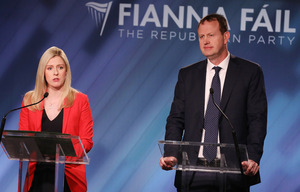

This morning.
Fianna Fáil General Election 2020 HQ, Dublin
Fianna Fáil Justice spokesman Jim O’Callaghan, top with Lisa Chambers TD, said that should his party come to power he would be “disappointed” if…
…a gaming regulator were not in place before the end of the year ( funded by a levy on the industry)
“This is an industry that capitalises on an illness,” his colleague, Mayo TD Lisa Chambers, said.
Gambling advertising would be confined to the post-watershed hours, Mr O’Callaghan said, with the issue of online adverts to be “tackled”.

Emmet Scanlon & What The Good Thought – Superstore Flowers
If you like the soundtracks to spaghetti westerns you’ll be curious to hear the new single from County Limerick-born Emmet Scanlon (top) and his compadres.
Superstore Flowers has got a twang thing going on. It’s a taster for their forthcoming album Hands.
The video was shot by Liam Delahunty in London’s Dream Machine Music Lab.
Nick says: Say it with flowers.


This morning.
Buswells Hotel, Dublin 2.
Solidarity/People Before Profit launch their Environment Policy – Planet Before Profit – with above from left: Richard Boyd Barrett TD, Paul Murphy TD, Bríd Smith TD and Ruth Coppinger TD.
Including promises to:
introduce a free public transport system by tripling investment and subsidising journeys… it would do this by adding 500 electric buses every year
and reduce the dairy herd by 50% and compensate farmers with a New Green Payment.
Solidarity-People Before Profit pledges free transport in climate action plan (Independent.ie)


A short by London based artist and motion designer Theodore ‘mustardcuffins’ John in which the characteristic rust coloured mesas of the American desert extend up though the clouds, throwing long shadows across the land and bisecting the night sky.
*thud*
Peyote. One hell of a drug.

This afternoon.
Details were announced of RTÉ Sport’s coverage of the Women’s, U20s and Men’s Six Nations rugby coverage this year.
Which will Include live coverage of all of Ireland Women’s Six Nations matches on RTÉ2 and RTÉ Player.
In fairness.

From top left to right: Sinn Féin leader Mary Lou McDonald, Social Democrats joint leader Roisin Shortall, Fine Gael leader, Taoiseach Leo Varadkar, Green Party leader Eamon Ryan, Fianna Fail leader Micheal Martin, Solidarity People Before Profit politician Richard Boyd Barrett and Labour Party leader Brendan Howlin, at the RTÉ leaders’ debate at the National University of Ireland Galway on Monday night; Eamonn Kelly
During a televised debate the Christmas before last, Fr Peter McVerry said, that there was no urgency in the government to address the homelessness crisis.
This official complacency was a feature of the conservative attitude during the leaders’ debate, a complacency that seemed to be echoed by the mainstream media pundits.
The media punditry began on RTÉ immediately after the debate and, like much of the attitude of the conservative parties, was characterised, not by urgency, but by a sense of novelty, of a happy late-night knees up as a “winner” was sought.
The message being that the debate was a bit of harmless sport staged for everyone’s amusement. Not to be taken too seriously. A contest the pundits in the main were happy to declare had not produced a “winner” and had therefore failed to produce anything of interest.
But there was a winner. It was the audience, who showed a clear preference for progressive ideas that are normally associated with the left. Ideas that are usually casually denigrated by the right for just that reason.
Two Ideas of Fiscal Management
What was on show during the leaders’ debate, in embryonic form, was a conflict between two competing ideas of fiscal management.
The view held by the established parties FF and FG, was firmly rooted in ideas of the past, of a Sean Lemass type of approach to economics that involves obsequiously pleasing multi-nationals who will “give” us jobs, and then later, when the books are balanced and good old-fashioned (not to mention discredited) trickle-down economics begins to do its thing, the poor can be housed in the new houses and bandaged up in the new hospitals. Until then, however, some will have to sleep and die on the street.
A by-product of this approach has been the neglect and often penalising of local indigenous business start-ups and a continued dependence on foreign capital to “help” us. Like as if we suffer from some kind of national learned helplessness. It’s awful, and it’s probably why we became such marks when the bubble burst in 2008. Everyone apparently made money out of us, except us.
This now dated approach to fiscal management involves slow, tedious plodding in a situation where the plodders themselves are never likely to be burned by their own policies.
Leo and his merry men won’t be pitching tents down by the canal any time soon, to wait in vain for the promised fruits of trickle-down.
The other view on show, taken mainly by the left of centre parties, is a recognition of changed times, the very thing the conservatives don’t seem to get, or if they do get it they view the challenges in the same plodding manner of “meeting targets” until everything magically aligns, a process that takes leisurely time for granted, the very thing unavailable at this time, particularly with climate change breathing down everyone’s necks, sometimes in the form of a big wind and floods, sometimes in the form of fire.
Changed times call for fresh ideas across the board, and to their credit, the ramshackle left are at least engaging in progressive ideas that take cognisance of the realities of climate change and late stage capitalism, and all that these twin challenges entail in their impact on jobs and wealth creation and distribution. Not to mention life and the survival of the species. Little things like that.
Though the left know they have to be careful with their “wild” ideas, because the Irish electorate, the older ones especially, are quite conservative.
So, for instance, Eamon Ryan of the Greens couldn’t come right out and say “basic income” for fear of causing a scare, even though all progressives realise by now that basic income is a real policy option to deal with a host of problems like climate change, job creation, crime prevention, trickle-down economics (since the tap was turned off by gush up economics), not to mention the timely prevention of out and out revolution and the possibility of your privileged complacent head ending up in a basket.
But the established parties continue to rely on old ideas way past their sell-by date. Ideas which are actually damaging to society, rather than progressive, not only in the effect of the destructive out-dated policies, but also, and perhaps especially, in the determination at all costs to close down fresh thinking in favour of doing things in the safe “old ways”. The ways that created homelessness and hospital waiting lists.
But the enthusiastic response from the Galway audience to the progressive ideas coming from Richard Boyd Barrett in particular, made it clear that a new, young Ireland is emerging that has a far greater grasp of fiscal realities than Leo Varadkar and Fine Gael would give anyone credit for.
Maybe it’s because the young, robbed of a future by the banks, are familiar with the fiscal realities of having to pay an over-inflated rent from a low-paid job because government policy has been to look after the top tier while everyone else stands in line waiting for trickle-down.
Maybe that’s why all the urgency is at the bottom and all the complacency is gathered like thick cream at the top.
Deaths by Policy Omission
One of the high points of the debate was [Social Democrat co-leader] Rosin Shortall’s revelation that in 2011 she had witnessed Fine Gael ministers deciding to cull a range of community projects, as part of an austerity drive, creating inequality as a by-product, which had the effect, in disadvantaged areas in particular, of creating seed-beds for crime. This from a party who present themselves as champions of law and order.
She went on to say that in 9 years Fine Gael had cut garda services by 40%, again causing negative outcomes in social inequality, while providing opportunities for crime.
In other words, Fine Gael policy, as predicted by economists Joseph E. Stiglitz and others, was causing the inequality that was giving rise to the social problems, including crime, which Fine Gael, architects of the growing social rot, were now talking about addressing as the party of “law and order”.
Given that over 200 homeless people have died over the last 4 years, according to statistics from the Dublin Regional Homeless Executive, and given that Fine Gael policy in particular has often amounted to an attack on community, creating social inequality, as described by Roisin Shortall during the debate, it is surely only a matter of time before the accepted legal distinctions between lies of commission and lies of omission, are also applied to policy-making and their outcomes.
With outcomes resulting in deaths, as in the case of the clash between Fine Gael’s outmoded privatisation ideology and homelessness, these homeless deaths are, arguably, killings by policy omission.
The Great Appropriators
Micheál Martin, sensing blood being drawn by Shortall, attempted to appropriate Shortall’s attack by saying that Fine Gael undermined community groups.
This was a feature of Micheál Martin’s play throughout the debate and something of a characteristic of Fianna Fail down the years, which can be summed up with, if you don’t have a good idea yourself, grab someone else’s good idea and flog away.
Micheál Martin seemed ever watchful for ideas from elsewhere and brazen about immediately appropriating anything which seemed to be playing well with the audience, so long as it wasn’t too outrageously leftie, such as some of the remarks coming from Richard Boyd Barrett.
When Mary Lou McDonald talked about homeless families living in the box-rooms of parents’ houses as a consequence of Fine Gael housing policy, Micheál grabbed that one too and even had the neck to re-present the story, only moments later, word for word, as his own original thought.
This kind of thing, while it might seem cute, only succeeds really in keeping the non-thinker stuck, because they will never think for themselves so long as they believe that stealing ideas is clever. If they happen to be running the country, well then everyone is in trouble.
By the way, there is a cosmic law of creativity that idea stealers never get. The more you give away the more you get.
Stealers think ideas are one-off commodities found elsewhere, and so they always leave themselves idea impoverished, apparently unaware that if they would just stop and think the ideas would arrive, the first law of creativity being, There’s nothing you can do that can’t be done.
Speaking of idea borrowers, Leo Varadkar is interesting in the way he endeavours to cast himself as a visionary of the future, despite his ideas being mainly of the past, even down to the rudimentary idea that anyone who doesn’t agree with his dated right-wing views is “hard-left” and possibly Stalinist in intent who’ll have us all in gulags before you can say “fiscal prudence”.
Again, there can be no room for fresh thinking with this kind of lazy commie bashing that comes direct from the U.S of A., where Leo, incidentally, did his political interning under Republican tutelage.
It’s all just another way of shutting down free thought at a time when fresh ideas are needed urgently. The closing down of ideas under such circimstances is a disservice to the public
Conclusion
The second debate was ultimately a contest of ideas. What was revealed was a total absence of fresh thinking from the government parties, against a sense of urgency and an exploration of fresh ideas from the opposition leaders.
Ideas which were welcomed by an audience clearly more up to speed with the issues at stake than the complacent government parties, whose leaders seem to be going through the motions with the expectation of just breezing back into power in some slightly inconvenient rearrangement of the present Dáil.
It remains to be seen whether or not the Galway audience was a fair reflection of the national electorate. It could be that Galway audiences may be a bit more progressive in the type of crisis creative thinking that is now required.
Life on the West coast of Ireland, due to weather conditions and the rocky terrain, has always offered something of an ongoing climate crisis, often requiring advanced creative thinking to remain balanced under extreme circumstances.
Eamonn Kelly is a freelance Writer and Playwright.
Previously: Eamonn Kelly on Broadsheet
Top pic: Niall Carson/PA Wire