


More to follow.



More to follow.


United States House Speaker Nancy Pelosi (centre), flanked by Rep. Jerry Nadler and Rep. Adam Schiff holds a press conference as Democrats unveiled articles of impeachment against US President Donald Trump, listing abuse of power and obstruction of Congress.
The House judiciary committee will vote on the articles, followed by the full House. As Democrats control the lower chamber, a trial in the Senate is likely to follow in January. Republicans are in control there, making Trump’s conviction and removal unlikely.
‘Solemn step’: Democrats unveil articles of impeachment against Trump
Getty
Meanwhile…
7 Democrats just stood on stage
To introduce 2 articles of impeachment
Over 8 meaningless lines in a phone call
All to overturn the votes of 63 MILLION Americans in 2016
Just because they’re afraid they can’t win in 2020
This is a partisan sham
It’s time to fight back
— Charlie Kirk (@charliekirk11) December 10, 2019
FIGHT!


A new stop motion short by the excellent Kirsten Lapore, proving that if you wait long enough, you (or your kind) will end up as an exhibit in someone else’s natural history museum.
Previously: Move Mountain

before and after: Kildare Street Hotel, 47-49 Kildare Street, Dublin 2
Incredible Before+Afters for the proposed demolition of the former Kildare Street Hotel, comprising a fine terrace of late Georgian houses, described by the applicant as having a “dishevelled and functional appearance”. Ref: 4414/14. Last date for observations Thurs 12th Dec. pic.twitter.com/FHhRSpXUlZ
— Dublin Civic Trust (@dubcivictrust) December 10, 2019
Gulp.
Previously: Developer plans to demolish Georgian terrace on Kildare Street


‘sup?
This afternoon.
Christchurch Cathedral, Dublin 8.
Scenes from the annual Peata Therapy Dog Carol Service.
Peata provides a pet therapy service to caring institutions.
Arf.
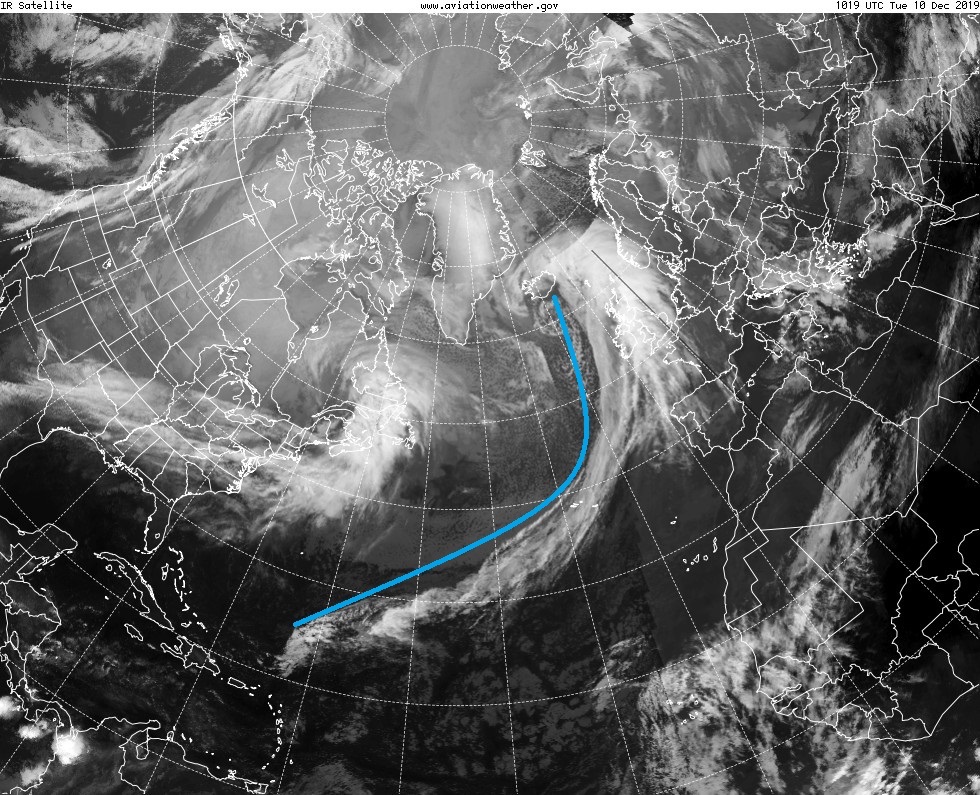
WeathEir tweets:
Puerto Rico is literally getting the tail-end of the frontal system impacting Ireland and Britain as this infrared satellite image shows. Colder air follows North and West of the denoted blue line.

Ryanair CEO Michael O’Leary
So it seems the storm but mainly @Ryanair have defeated my valiant attempt to join @faizashaheen‘s campaign in Chingford tomorrow. Flight cancelled. No alternative flight. No other flights available until Weds. I must retreat @HelenWatsonx #JC4PM https://t.co/91NE4GglZa
— Kevin Higgins – poet (@KevinHIpoet1967) December 8, 2019
For Michael O’Leary
(after Primo Levi)
You are everywhere and, when it matters, nowhere
oh Lord of this cancelled flight.
All across a continent the bodies pile up
at Ryanair help desks while you are home
talking to your horses who are grateful
they, at least, will never have to travel
Ryanair. I don’t want you taken to the termination chamber
some here are building for you, or pulled apart before
a jeering crowd by the four of your own racehorses
with the most unresolved anger management issues.
May you live to be a thousand years old
and spend your remaining nine hundred and forty two
years sweating in a queue to speak to a red faced girl
at a Ryanair help desk. Let your every night be Sunday
and it always be December. May you be late
to the death bed and cremation
of your favourite uncle and his remains
be delivered to you
while you’re still here in this queue,
in a clear plastic bag with a hole in it,
for which you will, naturally, be charged.
And when you open your mouth
and a complainy word shoots out
may the Chilean secret police instantly appear
and tell you with their eyes,
and their drooling Alsatians’ eyes,
to cut that out or your slug tongue
will no longer be yours to wiggle.
And when your time here is done
may you be peeled, tied,
and spread-eagled across your own help desk
and two fat blokes from Chipping Ongar
be paid to sprinkle pollen
all over you, and then release
the bees.

‘sup?
You may recall the mysterious paddler and his trusty hound photographed last month on the Grand Canal at Dolphin’s Barn, Dublin 8 and featured here.
But who were they?
Well..


Eoghan and Ted in Kerry (above) and Wexford (above)
Eoghan (above left) writes:
The dog is Ted… a rescue from Gorey [County Wiexford] . Loves getting out on the board. We get out about twice a week since the Summer….. Never fell in… Yet..
He’s also an honorary member of Kevin’s Hurling Club also…. Loves the small ball and will play all day.
In fairness.
Previously: Grrnarly
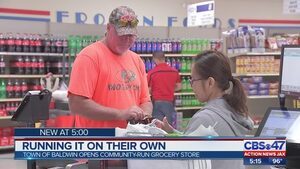

From top: news coverage of the community-run grocery store in Trump-voting Baldwin, Florida; Michael Taft
People had a problem in Baldwin, Florida – a small rural town of 1,600. Their only grocery store closed down.
The town tried in vain to find another tenant, but the premises were too small for a big chain like Walmart, and too big for smaller grocery firms.
And the town didn’t have the resources (and didn’t want to raise property taxes) to incentivise retailers with generous incentives.
People drove to nearby Macclenny or even further to battle Jacksonville’s sprawling suburbs. However, for many, especially the elderly, this wasn’t an ideal situation.
So they came up with a plan.
The City Council opened up a new grocery store. The eight employees are on the public payroll (i.e. public sector workers) and the store is publicly owned.
The Mayor, Sean Lynch, said:
“We’re not trying to make a profit. We’re trying to cover our expenses, and keep the store running. Any money that’s made after that will go into the town in some way.”
It’s not that people in Baldwin were striking out on a new ideological strategy of collectively-owned, government-run enterprises.
Indeed, in the last presidential election, 68 percent voted for one Donald J. Trump.
But as Mayor Lynch stated:
“We take the water out of the ground, and we pump it to your house and charge you. So what’s the difference with a grocery store?“
Not a whole lot really.
Baldwin is not unique. Some time ago I wrote about a similar experiment in another small town in the American south – Somerset, Kentucky – which set up a publicly-owned petrol station to fight the cartel of petrol stations that was strangling the town’s potential tourist industry and charging residents above-average petrol prices.
Throughout the US, local governments own and operate businesses in the market sector. In Minnesota, municipal owned liquor stores (off-licenses) are highly profitable. Similarly in Pennsylvania. Other cities and states benefit from this trade.
From grocery stores to cinemas to professional sports, retail merchandising, training and consulting, fertilizer and soil enhancer production, venture capital provision, methane recovery/energy production, equity investment in commercial development, bottling tap water for sale, and auto-towing: there is a rich tradition of local public enterprises.
The logic for these activities is many:
Fill gaps in the market where private capital is unable or reluctant to participate (such as Baldwin)
Provide competition against monopolies or cartels (such as Somerset)
Act as revenue-raising streams which obviates the need for taxation or provide additional spending
Promote employment and incomes, especially in disadvantaged areas
Serve as benchmarks on a range of economic and social issues
An example of this latter point: there has been considerable commentary on the poor wages and working conditions in the hotel sector. What if a local authority started up a hotel and collectively bargained efficiency wages – wages that exceeded the market rate?
If it could survive commercially, it would compete with other hotels for staff and skills, driving up wages in those traditional businesses. In this way, local public enterprises can act as market benchmarks, creating a virtuous cycle upwards.
Such enterprises could foster greater employee participation. Indeed, this would be necessary if it wanted a competitive edge given that greater employee participation raises productivity and firm performance. They could partner with local private and/or community capital and buy in managerial expertise.
All such enterprises would have to be commercially competitive. However, in that context, there is little cost implication. State and local enterprises that engage in market activities are considered ‘off-the-books’ for the purposes of fiscal rules. All they have to do is act like any other market operator.
But being a market operator doesn’t mean they act like private companies.
Local public enterprises would have a different mission – eschewing private profit (though profit is necessary to pay for the cost of capital and re-investment), encouraging worker and community participation, seeing the environment as a partner, rather than something to exploit. There are many ways to operating in the market – and one of those ways is the high road.
Local public enterprises are common throughout Europe. There are over 15,000 local public companies in the EU, employing over one million people, with a combined turnover of €130 billion. And every year more and more public companies are being set up.
Many of these companies would be in the infrastructural sectors (electricity, transport and water companies) but many would be in market sectors. Ireland is at a disadvantage here given the weakness of local government. Indeed, a progressive rural strategy would devolve greater power and resources to local government and regional agencies to start up enterprises in disadvantaged areas.
This could be applied to areas such as the Midlands in pursuit of a Just Transition in areas facing closures related to decarbonisation. An entrepreneurial, rather than a grant-aiding, approach would achieve better results.
Of course, none of this can be considered ‘socialist’ in the strict sense of the word (though Somerset officials were accused of Bolshevism for setting up a public petrol station). Local public enterprises easily fit into capitalist markets and must operate with market rules.
However, they have potential to be more democratically accountable and more flexible in addressing local economic and social concerns.
Most of all, it provides cities, towns and small communities an alternative strategy to relying on foreign capital, domestic private interests and government subsidies. It is about mobilising public capital and local skills into enterprising activities that produce goods and services that people want to buy.
In this respect, it is the most pragmatic thing to do.
Michael Taft is a researcher for SIPTU and author of the political economy blog, Notes on the Front. His column appears here every Tuesday.
