https://www.youtube.com/watch?v=siyW0GOBtbo

This afternoon.

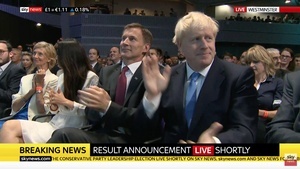
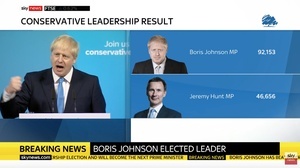
Boris Johnson has been elected as the new Conservative leader with 92,153 votes compared to Jeremy Hunt’s 46,656.

After he was announced as the winner of the leadership contest, Mr Johnson said:

“I say to all the doubters: Dude, we are going to energise the country, we’re going to get Brexit done on October 31. We’re going to take advantage of all the opportunities that it will bring in a new spirit of ‘can do’ and we’re, once again, going to believe in ourselves and what we can achieve.

“And like some slumbering giant, we’re going to rise and ping off the guy-ropes of self-doubt and negativity with better education, better infrastructure, more police, fantastic full-fibre broadband sprouting in every household. We are going to unite this amazing country and we’re going to take it forward. I thank you all very much for the incredible honour that you’ve just done me.

“I will work flat out from now on with my team that I will build, I hope, in the next few days…the campaign is over and the work begins.”

LIVE: Boris Johnson wins race to become next PM (Sky News)

Earlier:

Simon Coveney with then British Secretary of State for Foreign Affairs and the Commonwealth Affairs Boris Johnson in the Department of Foreign Affairs and Trade, in Dublin, November 2017

This morning.

The outcome of the ballot of about 160,000 Tory members will be revealed at just before midday in London with the victor officially becoming prime minister on Wednesday.

Jeremy Hunt was in a positive mood when he arrived home from a run this morning despite Boris Johnson remaining the clear favourite to take over from Theresa May.

A Johnson win could spark more government resignations after Sir Alan Duncan quit as Foreign Office minister on Monday in protest at his expected victory, predicting a “crisis of government”.

Chancellor Philip Hammond and justice secretary David Gauke have given notice that they will resign rather than serve under Johnson.

Tory leadership Contest Live (The Guardian)

Rollingnews

From top:  Kate Bush fans in Fairview Park, Dublin last weekend  celebrating ‘The Most Wuthering Heights Day Ever’. Eamonn Kelly.

David Attenborough told the UK parliament that radical thinking was needed to tackle climate change. Unfortunately, most people don’t do radical thinking.

They do safe thinking. They do thinking as it has always been done, and then they vote for politicians who do the same and then you end up with an imagined future world of private electric cars, a slight tweak on the present scenario because most people don’t do radical thinking.

Artists do radical thinking. That’s what makes them artists. That’s what makes them outsiders, and that’s what makes them in the present system “worthless”, because the non-radical thinkers can’t put a price on what they do.

Some argue that it was radical thinkers; artists, creatives, who created all the goodies that the non-radical thinkers now squabble about. I believe this.

And for every invention created by a radical thinker, you can be certain that a majority laughed and scorned and called the inventor “mad”. That’s the bulk of humanity, now swanning around empowered by the inventions of “mad” radical thinkers.

Everyone agrees that radical thinking is needed to tackle climate change, but unfortunately, the world is ruled by safe people who don’t do radical thinking. They do the opposite. They do safe thinking. They think what has already been thought.

I believe it was Edward de Bono who said that companies have two states: the initial creative state that establishes the company, and then the maintenance state that keeps the company going.

The people who create and establish the company generally move on and create something else, because that’s what they do; they make things.

The people who maintain the company are generally seen as a safe pair of hands. The main thing is that they don’t change anything, because if they do the company might collapse. Their role is to maintain the thing. They are generally not radical thinkers. They don’t make things. Their strength is maintenance.

Capitalism is a kind of company. It served everyone at one stage but has now become stagnant because it is run as it was always run, by the functionaries, despite the fact that it is in dire need of radical thinking to adapt to change.

But it can’t do that.

The great machine lumbers on, oblivious to the destruction it is causing to people and to the environment. It is run by people who don’t do radical thinking and so they can’t see the problem.

That’s why David Attenborough told the UK parliament that climate change needs radical thinking.

But the problem is not a shortage of radical thinkers. The problem is an abundance of safe thinkers occupying powerful positions and actively blocking the emergence of radical thinkers, even though everyone professes awareness that radical thinking is needed now more than ever.

By chance I caught a video of hundreds of people dancing to Kate Bush’s Wuthering Heights. A celebration, a commemoration of the artistry of the record and the dance that went with it.

This is done all over the world. This one was being done in Fairview Park in Dublin.

But the interviewer seemed intent on mining for Kate Bush’s oddity as a person. She was a “bit special”, he says at one point, a term that is often used to kindly remark on a person’s perceived mental deficiencies.

Later he observes “She’s kind of kooky though, isn’t she?” As if this were a problem to be shied away from, to be managed. Something questionable.

This is a wonderful example of a righteous square attempting to label a creative mind, a radical thinker, as odd and mad and ultimately pointless.

And the square’s righteousness is validated by faith in the economy and the great capitalist machine run by squares with eyes fixed on the bottom line who believe that radical thinking is “mad”.

Though everyone agrees that radical thinking is needed to tackle climate change.

Radical thinking is a wasted resource, its value unrecognized by the safe thinkers that run the world and who, by their lack of imagination and vision, risk running the whole planet into the ground.

That’s your future, my future and everyone’s future. End of story, game over.

Simply because some safe thinkers in power are blocking the human ingenuity required to modify the great machine of capitalism, designed by radical thinkers, which has served us so well but which now needs modification, because the damn thing is running wild, driven by people who can’t see the damage in their wake.

Radical thinking is needed to tackle climate change, but conservative non-thinking freezes in resistance, because it finds radical thinking a bit “odd”. The truth is, it finds creative thinking a bit challenging. A danger to their power base.

The ethos of the normalton also skews the definition of work into a kind of hard graft slavery, achieving little or no end – except perhaps a perceived statistical improvement to the abstract “economy” – while thinking and creativity, the very activities at the root of human progress, are generally regarded as being out of touch with reality.

Though everyone is agreed that radical thinking is needed to tackle climate change.

The problem is that so many people not only don’t get radical thinking, they think there is nothing to get. That radical thinking is simply a “madness”.

That’s the difference between the person dancing in Fairview Park to Kate Bush’s Wuthering Heights, and the interviewer trying to tarnish the artist as a freak. The dancers get it, though they admit they can’t do it.

The interviewer, on the other hand, seems to believe that there is nothing to get, and seems determined to get the dancers to admit to the perceived “nothing” of it all. To prove that the artist and the artist’s followers are all equally “mad”.

Though everyone is generally agreed that radical thinking is needed to tackle climate change.

Eamonn Kelly is a freelance Writer and Playwright.

Rollingnews

From top: Bob Geldof at the National Library of Ireland in 2017 when, as Chairman of the Band Aid Trust, he handed over the trust’s archive to the library; video explaining Mauritius Leaks 

This morning.

The International Consortium of Investigative Journalists published details of its latest tax avoidance investigation, Mauritius Leaks.

Among those under the spotlight is a hedge fund led by Bob Geldof.

Will Fitzgibbon reports:

Bob Geldof’s firm wanted to buy a chicken farm in Uganda, one of the poorest countries on earth.

But first, an errand.

After soaring to fame in the 1980s for organising Live Aid and other anti-famine efforts, the former Boomtown Rats rocker had shifted to the high-powered world of international finance.

He founded a U.K.-based private equity firm that aimed to generate a 20% return by buying stakes in African businesses, according to a memorandum from an investor.

The fund’s investments would all be on the African continent.

Yet its London-based legal advisers asked that one of its headquarters be set up more than 2,000 miles away on Mauritius, according to a new trove of leaked documents.

The tiny Indian Ocean island has become a destination for the rich and powerful to avoid taxes with discretion and a financial powerhouse in its own right.

One of the discussion points in the firm’s decision: “tax reasons,” according to the email sent from London lawyers to Mauritius.

Treasure Island: Leak Reveals How Mauritius Siphons Tax From Poor Nations To Benefit Elites (ICIJ)

Rollingnews

The Break-Up.

A poetic meditation on splitting up by The Poet Geoff.

Geoff says:

My aim was to write a piece that didn’t lay blame, but rather to highlight the turmoil experienced in the aftermath and to show the vulnerabilities that some of us feel.

The Poet Geoff

Previously: Letter To Leo

Last weekend.

Blessington Lake, County Wicklow.

Scenes from the KnockanStockan Festival 2019, a gorgeous showcase for indie acts from home and ‘abroad’.

They say:

Wow…what an unbelievable weekend, thank you for being you, thanks for being deadly and the best collection of people in a field. We have always said it’s everyone that makes KnockanStockan so special and this year you all shined like absolute diamonds. From the bottom of our hearts we love you all.

Knockanstockan

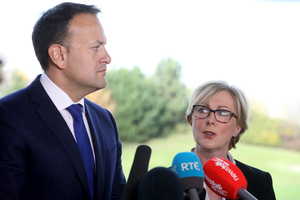
From top; Taoiseach Leo Varadkar and Minister for Social Protection Regina Doherty; Michael Taft

Give everyone €75 a week. All adults regardless of whether they are in employment or not, regardless of their income, irrespective of their household circumstances.

This is the pathway to a more rational and efficient social protection and income tax system, to reducing in-work poverty and precariousness, to boosting living standards and to a more efficient productive economy.

In one respect, there is nothing new in this proposal. We already spend a lot on cash transfers to households: billions through the social protection system, tax expenditures (i.e. tax reliefs, allowances and exemptions) and targeted supports such as education maintenance grants.

The €75-per-week proposal is not in addition to these payments. Rather, it is a reform intended to create a more progressive and efficient transfer system – especially for those in low-paid work.

This is not a Basic Income proposal but it does borrow certain principles; namely, the unconditionallity (everyone gets the €75). However, unlike Basic Income, it does not cover all the basics needed for an adequate income.

For instance, the Vincentians estimate the minimum essential living standard for a single person in urban areas to be €245 per week (higher in rural areas due to the need for a car). €75 is a long way from that.

Most of the benefit of this proposal would go to the low-paid or those below the income tax threshold. For those fully in the income tax net, the state pays a single PAYE employee €3,300 a year in tax credits (€1,650 personal credit, €1,650 PAYE credit). This is a flat-rate payment, regardless of earnings. In that sense it is progressive.

However, there is a flaw in the system.

Below the income tax threshold, the lower your income, the less subsidy you get.

By making the payment directly, all income groups at work would receive the same payment. In that sense, the €75 per week (or €3,900 per year) is merely an extension of the personal tax credits to everyone in the workforce.

The €75 a week would also be paid to those reliant on social protection payments. However, it would be a matter of policy whether this would increase a recipient’s income.

The new universal €75 payment could be offset by a similar reduction in the social protection rate. For instance, a Jobseekers’ Assistance recipient could receive the guaranteed €75, and a social protection rate of €128, leaving them with €203 per week – the same amount they receive today.

However, this provide an opportunity to increase social protection payments towards the Minimum Essential Standard of Living which the Minister for Social Protection recently discussed.

Estimating the cost is difficult as we don’t have an accessible database of earnings for those at work. Revenue Commissioners data includes those on occupational pensions.

Further, there would be complex cost estimates for couples with both earning, couples with one earner, and the interaction between social protection and tax for temporary, casual or part-time workers.

Given that, let’s see if we can come up with a (big) ballpark figure for 2016, the last year we have full data for.

There were 2.1 billion people at work. A payment of €75 per week (€3,900 a year) would cost approximately €8.1 billion.

There were about 450,000 adult dependents (married persons’ or civil partners’ tax credit). Extending the €75 per week to this group would cost €1.8 billion.

The total cost would be €9.9 billion. This would be recouped through the abolition of personal tax credits.

Total savings would be €8 billion. Therefore, the net cost would be €1.9 billion. The Government has already set aside €3 billion over the next five years for tax cuts.

This would be a far more progressive approach – and less expensive.

The abolition of the tax credits would mean that workers would receive €75 per week, but after that all income from work would be taxed. For example, someone earning €10,000 a year pays no tax.

Under this proposal, they would pay €2,000 in tax but would receive €3,900 – leaving a net gain of €1,900 per year, or €36 per week. This would mean a sizeable 19 percent increase in income.

The above does not take into account any net gains for those on social protection payments. However, moving towards the Minimum Essential Standard of Living would still not exceed the costs of the Government’s proposed tax cuts.

What are the advantages to this system?

First, most of the benefits would go to the low-paid, or those below the income tax threshold. Not only would this boost living standards and reduce inequality, it would also help in our Brexit-fevered times. These income groups would be likely to spend almost all the additional income they receive, helping to maintain consumer demand.

Second, it could help reduce some of the complexities that occur when social protection payments meet working income (impacting on the low-paid).

For instance, means-tested unemployment payments can vary depending on how many days work you might get; some of this complexity (and reliance) could be reduced if you receive a weekly guaranteed income.

Third, depending on the impact of such a guaranteed income, it could be expanded into a more full-blown Basic Income. The point is that we would have some evidence on which to base any decision to increase the guaranteed income.

This would not revolutionise the tax/welfare system – but it could make it better. It is only one brick. We need several more. But it’s something we can start in the upcoming budget.

Michael Taft is a researcher for SIPTU and author of the political economy blog, Notes on the Front. His column appears here every Tuesday.

Rollingnews
Broadsheet.ie