

‘sup?
Yesterday.
Sandymount Strand Dublin 4.



This morning.
Inchicore, Dublin 8.
Queue for the covid vaccine booster at the HSE clinic in Richmond Barracks.
Meanwhile…
🇪🇺🇮🇪IRELAND🇮🇪🇪🇺
At least 1 dose:
████████████░░░
77.8%[+0.0]Fully:
████████████░░░
76.7%[+0.0]Boosters:
███████░░░░░░░░
44.0%[+0.3]Total: 9,701,092 [+16,376]
Boosters: 2,204,047 [+15,245]
7 days avg.: 0.53 [+0.01]— 🇪🇺 COVID-19 Vaccination (@VaccinationEu) January 4, 2022
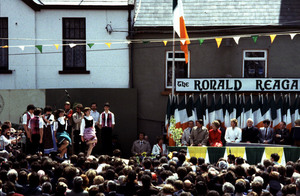
 From top: US President Ronald Reagan in Ballyporeen, county Tipperary during his 1984 visit. State papers reveal White House officials were unimpressed by accommodation arrangements for the presidential enourage; Eamonn Kelly
The week that was.
Post-Christmas is that time of year when old news archives are opened. Bertie Ahern, Charlie Haughey, Jack Lynch, John Major, and all the other politico stars of yesteryear are back in the saddle for a few days as state papers are released as per the 30-year rule.
Haughey’s contribution to the peace process appears to have been retirement. Once he was gone the wheels started moving.
Padraig Flynn’s contribution was deciding not to take insult on behalf of himself, Fianna Fáil and Eamon DeValera, in the interests of peace. Instead of tearing off his jacket and wading into unionists with flailing fists, he held his counsel and did nothing, as was his wont when in office. And the rest, as they say, is history.
Ravers
In other news, a Co Meath farmer was alerted on St Stephen’s night to the fact that dozens of taxis were pulling up onto his land and delivering party revellers by the score to nearby Skryne Castle, close to the legendary hill of Tara. On closer inspection there was a pumping rave afoot in the castle.
Concerned for his livestock, particularly his horses, (farmers are ambivalent about cows,) the farmer rang the guards and then single-handedly stormed the castle, bursting in on the invaders, yelling of impending drug squad arrivals. It was a bluff, but it worked. The ravers panicked and fled.
The guards soon arrived, and on the premises they found a “massive” bar, as in a drinks bar, not a Yorkie Bar, and a number of large canisters of nitrous oxide, or “laughing” gas. There were volatile scenes as new revellers arrived by taxi, becoming irate when confronted by the garda presence and the fact of no rave tonight lads. Gardai used the laughing gas to pacify the disgruntled party animals.
Blarney
Earlier, in Blarney Castle, a woman, presumably elderly, suffered a non-life-threatening injury when she fell at the top of the 90-foot tower prior to kissing the Blarney stone. The unfortunate woman couldn’t be brought back down the narrow stone stairway.
Instead, a Shannon Rescue Helicopter, which happened to be in the air at the time, for the craic, was summoned to the scene and the woman was airlifted from the top of the tower to the relative safety of Cork University Hospital where she was placed on a trolley in a draughty corridor until the New Year.
Ballyporeen
In older news, White House officials were unimpressed by accommodation arrangements in the Galway area for staff accompanying Ronald Reagan on his mythical return to Ballyporeen in 1984.
The White House entourage were to be split up across the West of Ireland into 41 different hotels and guest houses, all offering full Irish breakfasts, since Galway lacked a hotel large enough to accommodate the entourage.
Galway has since built several huge hotels, many now lying empty, just in case the issue should ever arise again. At the time, Bord Failte, ever alert to costs, warned the US Embassy that they would be responsible for costs incurred by diverting people from the Great Southern and Flannery’s Hotels to God knows where to make room for the Reagan entourage.
Costs in Ireland being what they are, added to the inevitable price hikes for tourists, the Reagan administration was forced to sell some guns to Iran to cover the hotel bills.
Plague-Spreader
Meanwhile in Covid news, an Italian man, described as a “proud plague-spreading anti-vaxxer” died of Covid-19 complications to the unabashed delight of many, proving that while we may have lost a degree of general empathy, we haven’t lost our sense of irony.
The man apparently enjoyed working up a fever and then going maskless to supermarkets to spread the fever around, possibly costing lives in the process. Apparently, he worked up a fever too many and found one that did for him. RIP.
By week’s end the infection rate in Ireland was past 20,000 per day with experts warning that it could be higher, since these were only tested and confirmed cases. Since Omicron appears to be not as severe as earlier varieties this could be a signal for the beginning of the end, or the end of the beginning. Though with mutations, it could be worse, and be only the beginning of the beginning with no end in sight.
Prince
Finally, in New York, Ghislaine Maxwell was convicted of sex trafficking, leading to speculation that some similar outcome might yet await Prince Andrew. Now that would be awkward for the Royals.
If push comes to shove, they might consider making a deal to house Andrew in the Tower of London, as a merciful close-to-home incarceration, doubling as a tourist attraction. It’s high time we had a royal in the Tower again, for the razzmatazz, with maybe a Big Brother production thrown in, to keep an eye on him.
Eamonn Kelly is a Galway-based freelance Writer and Playwright.
Previously: Eamonn Kelly on Broadsheet
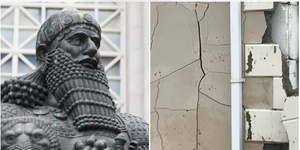
Babylonian king Hammurabi (left) and mica damage in Donegal
Anthony Sheridan writes:
Nearly 4,000 years ago Hammurabi, king of Babylon, wrote a code of laws.
Here’s one of his laws for builders:
‘If a builder constructs a house for a man but does not make it conform to specifications so that a wall then buckles, that builder shall make that wall sound using his own silver.’
If our government adopted this law the estimated €3.2 billion cost of the Mica redress scheme would fall on the builders responsible and not on the taxpayer.
But for that to happen the government would also have to adopt Hammurabi’s principle motive for writing his code of laws:
‘To prevent the strong from oppressing the weak and to see that justice is done to widows and orphans.’
For so long as the current political class remain in power the weak will never receive protection from the strong.
FIGHT!
Anthony Sheridan is a freelance journalist and blogs at Public Enquiry.
Getty/RTE

Ah now.
At the weekend.
Carlosfandango writes:
Possibly a tad risky using the M-fiddy to deliver dem chicken wings…
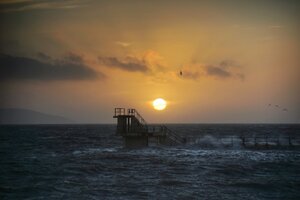
Last night.
Blackrock Diving Tower, Salthill Road, Galway.
Via Chaosheng Zhang
Meanwhile…
Colder but another beautiful morning in dublin pic.twitter.com/my5B3IUVW1
— Conor Nelson (@conchurmac) January 4, 2022
This morning.
Exact location unidentified.
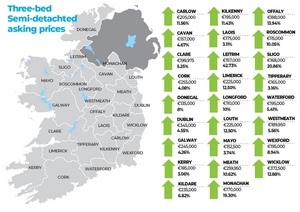
Gulp.
This morning.
Via MyHome.ie:
The Q4 2021 report, in association with Davy, found that annual asking price inflation rose by 9.7% nationwide, by 7.4% in Dublin and by 10.6% elsewhere around the country.
Meanwhile, quarterly asking price inflation also rose slightly throughout Ireland – by 1.3% nationally, by 1.7% in Dublin, and by 1.1% elsewhere around the country.
This means the mix-adjusted asking price for new sales nationally is now €311,000, while the price in Dublin is €421,000 and elsewhere around the country it is €263,000. Newly listed properties are seen as the most reliable indicator of future price movements.
The author of the report, Conall MacCoille, Chief Economist at Davy, said that the findings of the report painted a grim picture for prospective homebuyers…
Property Report – 2021 – Q4 (MyHome.ie)
Meanwhile…
1965.
Dublin’s ‘luxury’ housing market.
Featuring heavily-lunched developer ‘Mr Black’.

There were 30,000 registrations on the first day that the Covid-19 vaccine portal opened for all children aged 5-11, according to Damien McCallion. The HSE’s vaccination lead said they are ‘very happy’ with this figure | Read more Covid-19 coverage: https://t.co/Jn8JMrG9GD pic.twitter.com/lmiDs6Bcgb
— RTÉ News (@rtenews) January 4, 2022
This morning
Meanwhile…
…via RTÉ News:
Minister for Education Norma Foley will meet public health officials, teachers’ unions and school management to discuss the reopening of schools.
Government ministers have said they expect schools to reopen as planned on Thursday.
However, the Association of Secondary Teachers, Ireland has called for a delayed and staggered reopening of schools, saying it would be an “unacceptable risk” for schools to reopen, without additional Covid-19 safety measures being put in place.
ASTI says union committed to reopening schools in ‘coherent, sensible fashion’ (RTE)
BBC
Meanwhile…
Masks in schools are as pointless as they are cruel. Some would say a form of child abuse. https://t.co/JcNFhw4T3W
— Dr Anthony Hinton (@TonyHinton2016) January 3, 2022
Meanwhile…
Ireland are now vaccinating 5 to 11 year olds.
In Ireland there has been a total of 8 deaths in under 25 age group from 1st March 2020 to 21st December 2021.
This equates to 0.1% of deaths.
Young people do not need the vaccine. pic.twitter.com/ky8uOAsqit
— Zoe (@ZoePrecious2020) January 4, 2022
👀🧐
British heart foundation has a new advert. Showing a girl collapsing on a football pitch. pic.twitter.com/9HmArPvp5M— Suzanne Seddon (@suzseddon) January 4, 2022

 From top: Tanaiste and Fine Gael leader Leo Varadkar (left) with Taoiseach and Fianna Fáil leader Micheál Martin; Derek Mooney
Political commentators hailing a minister who was on maternity leave for half of 2022 as their politician of the year tells you a lot about the state of Irish politics.
Not that I particularly object to their choice of Minister Helen McEntee. Her absence from the cabinet table at a challenging time did nothing to diminish her public profile, while the positive media treatment of her return, did much to enhance it.
Minister McEntee is one of the few recognisable names and faces around the Cabinet table. She has become a political figure in her own right, albeit one who is still untested – a point I made here last February.
This is not something you can say about all her colleagues. While some do stand out as individuals with thoughts and ideas of their own, most come across as either politically shapeless or just innocuous. Mercifully the Taoiseach and Tánaiste have not required certain ministers wear nametags at meetings, if What’s My Line ever returns to our TV screens, the panel would have some trouble discerning precisely what the Minister for Children or the Minister for Agriculture do for a living.
(Disclosure: that gag about ministers wearing nametags at meetings is a shameless recycling of a joke I wrote for a Fianna Fáil Árd Fheis warm up speech almost two decades ago. The original, a put-down of the Fine Gael front bench, went: “The FG front bench is so anonymous that Enda Kenny has insisted they wear nametags at meetings.”
Slightly fuller disclosure: This was the cleaned-up version. The original was: “The FG front bench team are so unknown that they spend two hours together every Tuesday trying to figure out which one of them is Olwyn Enright*.” (*Olwyn became a spokesperson within weeks of her election as a FG TD. She quickly proved herself an effective communicator).
Looking at the current cabinet line-up could almost make one yearn for such colourful or animated characters as Shane Ross, Katherine Zappone or even Charlie Flanagan.
Stop. I see what I did wrong there. I went too far… way too far. Let me go back a step or two.
Throwing a Shane Ross type figure in to this Cabinet would not help matters. Though he understood political communications and had a greater penchant for attracting attention than some of the current crew, this cabinet’s problem is not just one of communications. It is the direction, or lack of, of the government as a whole.
Blame for this lack of cohesion and direction lays with the ones at the top of the three parties… the ones who decided which ministers should sit around the table and what portfolios they should hold.
The fact that political pundits are now openly touting Minister McEntee as a possible next leader of Fine Gael, is instructive. Where it may be due in part to her youth, her gender, or her being clearly identifiable, it has probably more to do with her being one of the few ministers not immediately associated with either failure or ineptitude – her association with the Justice Woulfe appointment saga notwithstanding.
It is a sad reflection of the state of centrist Irish political leadership that simply not being associated with failure could be perceived as a qualifier for the top job.
So, while we wait for the two main government parties to come to their senses and tackle their leadership issues, it is interesting to see those same two leaders trying to turn the tables.
Over the past few weeks both the Tánaiste and Taoiseach have both spoken about the chances of a reshuffle. The Tánaiste got the ball rolling in mid-December telling his parliamentary party that he intends to reshuffle the Fine Gael team when he becomes Taoiseach again next December.
“Leo has put the ministers on warning that if they don’t deliver their agendas for next year, decisions will be made next December,” a most helpful Fine Gael source told the Irish Examiner.
While Varadkar may have framed it as a strong leader pushing back against Paschal Donohoe’s alternative vision for Fine Gael, as set out in his Irish Independent interview, others saw it differently. What they heard was a hollow threat from a leader whose own survival seems in increasing doubt as the #leotheleak investigation rumbles on without conclusion or exoneration.
Not content to stand idly by and watch the Tánaiste do a solo reshuffle fumble, An Taoiseach decided to get in on the act. Late last week Micheál Martin told the UK Times Irish edition that he is unlikely to undertake a reshuffle when he becomes Tánaiste at the end of the year, adding:
“I am of a view that consistency of policy and delivery is important… Chopping and changing all of the time might look good for a day or two, but nothing can beat the substance of getting real change.”
He does have a point… but mainly as a counter argument to some imagined call for a state of perpetual reshuffle. No one is suggesting that. The mid-point of a term of government is an eminently sensible time for leaders to briefly take stock and review if their policies are being delivered consistently, if at all.
Government mid-point is a natural inflection point, one that the revolving Taoiseach model, which Martin has backed so enthusiastically, has elevated into even greater significance.
As I pointed out here before, the only other place where this revolving premiership model has been tried, Israel, also rotated other key ministries at the mid-point. Will Ministers McGrath and Donohoe rotate portfolios next December too? Or will the government post December 2022 have both a Fine Gael Taoiseach and Finance Minister?
Where Fine Gael TDs and Senators detected a strong element of there “terrors for children” in Varadkar’s reshuffle warning, Fianna Fáil TDs heard near deafening echoes of Martin’s passive late 2018 renewal of the confidence and supply arrangement with Fine Gael.
Those same Fianna Fáil backbenchers, including many who have never publicly uttered a word of criticism of Martin, also heard the current leader firmly close the door on their individual hopes of promotion. It seems that Martin thinks keeping his current ministerial team content is far preferable to keeping them on their toes.
It’s a novel approach. It may even appear to make sense in a party where the 14-member ministerial team is just four critical votes short of a simple majority in the Dáil parliamentary party which has 36 members (38 minus 2: Ceann Comhairle and the unwhipped Marc McSharry).
But if one, or two, of the critical four conclude that Martin’s continuation as leader is injurious to their personal advancement, then Martin will pay a price. Today’s Oireachtas Committee Chairs are not always content to remain next year’s Oireachtas Committee Chairs.
Martin has several capable and determined former front bench spokespersons (pre 2020 election) languishing on his back benches. They are rarely, if ever, asked to officially represent the party on media gigs and have found the party’s Leinster House corridors a cold place.
So, is turning it into an even colder place really the wisest move for a leader who hopes to lead the party in the next election? Martin may believe punters will interpret this as a strong leader being resolute and ruthless. I think they will see it for what it is… a weakened leader trying to act tough by pushing compliant colleagues around, while retreating from showdowns with his real political enemies.
Martin’s approach is not one you will find mentioned anywhere in Prof Gary Murphy’s superb biography of Charlie Haughey. While people will disagree on what he did with it, no one can deny that Haughey understood the exercise of power. In Chapter 15 Murphy offers an insight into Haughey’s approach to both power and people management with a story from his first few days as Taoiseach.
According to a senior civil servant, Haughey quickly moved to reassure senior officials that his legendary ruthlessness was reserved for his political enemies alone, saying:
“I may be rough and demanding of civil servants… but I am never ruthless. I am ruthless with my political enemies because I have to be to survive, but I am never ever ruthless with public servants and civil servants.”
Micheál Martin take note. And while you are at it, also take note at how badly your party HQ’s latest wheeze is going down. As revealed in last weekend’s Irish Mail on Sunday, Fianna Fáil has engaged former Fine Gael minister and media pundit, Ivan Yates as a communications adviser, inviting him to coach Fianna Fáil representatives, including ministers, on sharpening their political message, no less.
We are just four days into 2022 and already is has not been a great start to your final year in office.
Derek Mooney is a communications and public affairs consultant. He previously served as a Ministerial Adviser to the Fianna Fáil-led government 2004 – 2010. His column appears here every Monday. Follow Derek on Twitter: @dsmooney

Minimum unit pricing for alcohol comes into effect today
As we face into another year
So many of our drinkers fear
That they’ll have to pay more
For what they adore
As the government has banned cheap beer