

The prodigious dining skills of the asterophysus batrachus, aka, the ‘gulper catfish’.
Not for the squeamish.



The prodigious dining skills of the asterophysus batrachus, aka, the ‘gulper catfish’.
Not for the squeamish.
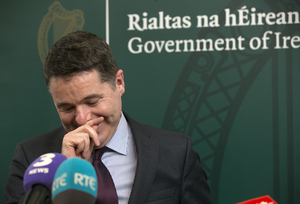

From top: Minister for Finance Paschal Donohoe; Michael Taft
Put the cat out, pop the popcorn and pull up a chair: the great pre-budget tax debate is commencing. For the past few years we have heard that our income taxes are high, very high, too high and this is creating all sorts of economic havoc. Enjoy the show.
One example of this is the claim that Irish taxpayers enter the top rate of tax earlier than any other EU country (bar Denmark). This is true – but the claim that this shows Ireland has high income taxes ignores two issues.
First, in many EU countries low-paid workers pay a much higher marginal tax rate (marginal tax rate is the tax you pay on the next Euro you earn; it is not the effective tax rate – that is, the tax paid as a percentage of income).
For example, at €30,000, Austrians pay 35 percent marginal income tax rate while Belgians pay 40 percent; and this doesn’t include much higher social insurance (PRSI) rates. In Ireland, taxpayers pay only 25.5 percent.
So, yes, Irish taxpayers enter the top rate of tax earlier than Austria and Belgium – but they pay much lower marginal tax rates on lower income.
A second issue is that most other EU countries have more than two tax rates; therefore, their taxpayers progess through a number of tax rates before reaching the top. Ireland has only two rates (discounting USC): 20 and 40 percent. For instance:
Austria has six tax rates – from 25 percent at entry level to 50 percent at the top
Belgium has five tax rates – again, from 25 to 50 percent
France has four tax rates – from 14 to 45 percent
Netherlands has four rates – from 8.9 to 52 percent
Luxembourg tops them all – with 18 tax rates from 8 to 38 percent. The point here is that the reason Irish taxpayers enter the top rate of tax early is that there are no intermediate rates between entry and top level.
But you won’t hear any of this in the debate. You’ll get sound-bites and ‘oh, isn’t this terrible’; but an analysis of comparative tax structures will be lacking.
Fortunately, we can make relatively robust comparisons between Irish personal tax levels and other EU countries courtesy of Eurostat’s informative Taxation Trends in the European Union.
The two ways of measuring this tell similar stories.
First, we look at employees’ personal tax (including social insurance and sur-taxes like the USC) as a percentage of gross, or aggregate, wages.

We find that personal taxation on Irish employees is slightly higher than our peer-group average. It ranks 4th and is ahead of ‘high-tax’ Sweden (which surprises many).
When we look at employees’ personal tax as a percentage of national income we see a similar story.

In this measurement we see Ireland (using the CSO’s special GNI*) falling below our peer-group average – but only marginally so.
These measurements do not speak to the progressivity of different tax systems – they just take the total amount of personal tax revenue as a proportion of wages and national income. In essence, both these measurements show that Irish employees’ personal taxation is approximately average.
We will still hear arguments – about how the Irish personal taxation system is a disincentive to employment creation.
The broad parameters of the tax system have not changed in the last four years, although there has been a slight reduction in marginal tax rates with the cuts to USC. And yet during that period employment has increased by 270,000, or 14 percent. That doesn’t look like much of a disincentive.
Or you will hear that our tax system is a disincentive to earning more. Yet, in the last four years we see the weekly income of managers and professionals – who are likely to be in the top tax rate – rise by 11 percent compared to an economy-wide average of five percent. Again, the tax system doesn’t seem to be a disincentive to top rate taxpayers.
Could we devise a more efficient taxation system? Yes, of course. Is personal taxation a priority in this budget? No.
We are an average personal–taxed economy, and clearly our structure is not a disincentive to employment creation and wage increases.
The priorities lie in housing, childcare and education; in infrastructural deficits; in the quality of our public services and in a social protection system that can provide security to everyone – including those in the workforce.
Next up: the ‘we-spend-too-much’ show. Let’s get some more popcorn.
Michael Taft is a researcher for SIPTU and author of the political economy blog, Notes on the Front.
Rollingnews

Following Boris Johnson’s resignation yesterday, Jeremy Hunt (above) has been appointed UK’s Foreign Secretary
A fellow called Jeremy Hunt
Has been given a shunt to the front
After making a mess
Of the poor NHS
He’s a fool, and yes I’m being blunt.
John Moynes
Pic: Getty


MORE to folly


From top: today’s GSOC report into complaint of the Garda initial investigation into the death of Fr Niall Molloy in Clara, County Offaly on July 8. 1985
Almost thirty three years to the day Fr Niall Molloy was killed following an attack at a society wedding party in County Offaly, the Garda Síochána Ombudsman Commission (GSOC) has published its report into a complaint of the initial Gardaí investigation.
Fr Niall’s relatives have considered the case a cover-up since he was pronounced dead on July 8, 1985 and renewed their campaign when medical evidence suggested the priest may have lived for up to six hours following his attack.
Documents on the case held by the DPP [Director of Public Prosecutions] were among a cache of files stolen by Martin Cahill. They revealed the presiding judge, who had dismissed all charges in the manslaughter trial, was a close friend of the defendant and many of the wedding guests, including Brian Lenihan Snr.
Via GSOC:
A significant amount of material from the original garda investigation from 1985 was provided to GSOC, along with the opportunity to inspect documents in the possession of the gardaí.
It was established that a Senior Investigating Officer was still assigned to the file and the case is classified as “open” in light of the fact that no one has been successfully prosecuted for the death of Fr. Molloy.
However it became apparent during the GSOC investigation that many original documents including exhibits are missing.
There appears to be no record of handling of exhibits, and as such the person responsible for their loss cannot be identified.
The Senior Investigating Office in the gardaí involved with the Molloy investigation endeavoured to find the missing exhibits including searching the Forensic Science Laboratory. By the end of the GSOC investigation the exhibits remained missing.
A review of the original investigation and discussions with gardaí currently tasked with the case confirmed that members of the original team were retired [GSOC Is permitted from interviewing retired Gardai]
The original State Pathologist, Dr John Harbison, is also deceased. This led to the conclusion that, having reached this stage, GSOC was precluded under the 2005 Act from proceeding further with the investigation of Mr. McCourt’s complaint.
There you go now.
Previously: Fr Niall Molloy on Broadsheet

High Time cookery show.
How to make crunchy, booze-laced jelly.
Matt (top) writes:
Something simple and sweet for the hot weather! We’re also looking for anyone with suggestions of dishes/recipes for us to try out, or if anyone is looking for tips on how to cook something they’re not sure of – we’d love to feature it. They can drop something in the comments, or go to our new and tumbleweed infested subreddit!
Previously: High Time on broadsheet

From top: Jack Lynch’s cabinet in 1969; Conor Lenihan
“I think for the first that time this was a legitimate covert operation of the state in an effort to raise, arm, supply both the IRA and ‘citizen’s defence committees’ as they were politely termed
…[it was ] an authorised political operation mounted by the then [Jack Lynch led] government, of which my father [Brian Lenihan Snr. – top pic third left standing) was a member and he never made any secret to us at home what that was about and everybody knew about it
Yet for 20, 30 years in Ireland it would almost put you off the country. We were in denial about this and a lot of people, because of the influence, I suspect, of Jack Lynch and those around him were able to suppress that and say ‘it was a rogue element within the government’ privately and off their own initiative arming the IRA or giving weapons to people north of the border’…”
Former Fianna Fail Minister Conor Lenihan discussing The Arms Trial during a talk on Charles Haughey at the Little Museum of Dublin. Mr Haughey was implicated in the scandal, sacked by Mr Lynch and, although acquitted in a subsequent trial, had his political career derailed for a decade. Mr Lenihan is the author of Charles Haughey; Prince Of Power.
Full speech here

This afternoon.
EPIC the Irish Emigrant Museum, Custom House Quay, Dublin 2.
Expecting someone special?
Oh.
Thanks Anon

Seatown Road, Swords, County Dublin
Mark writes:
Anyone know why these 10 gaffs around the corner from Fingal County Council have been vacant for the past 4 months given the housing crisis we are currently experiencing?
They nearly all have cars parked outside them to make them look inhabited too.
They were originally owned by the solicitor Mr Shannon before Nama took them over.
Fingal Lettings & Property is currently looking after them and there is talk that they may have passed hands many times over the past 8 years…
Anyone?
Empty gaffs to Broadsheet@broadsheet.ie marked ‘Empty Gaffs’
