Pope Francis

Kate O’Neill, in The Times Ireland edition, reports:

Thousands of tickets for the papal visit in August have been snapped up by protesters aiming to ensure low attendance by not showing up to the event.

The Say Nope to The Pope group is encouraging people who object to the Pope’s visit to Ireland in August to book tickets online, which are available free of charge.

One protester claimed to have booked 1,312 tickets to the events, which may now go unused.

“You can book as many times as you like on the same email address. I’ve booked 12 (9 times) so 108 tickets! They all have different booking references so they are definitely working,” the Facebook user wrote.

In a later update the same user said: “Even better!! I’m now booking in coaches (max is 8 coaches with 82 passengers on each total of 656 “pilgrims”) so I’ve googled a random name of a parish, a random name of a coach company, made up the drivers’ name and number, etc, and I’ve already booked two of these bookings, so a total of 1,312 people. Do this instead of the individual bookings!”

Protesters grab Pope tickets . . . to bin them (Kate O’Neill, The Times Ireland edition)

Say Nope To The Pope (Facebook)

Previously: ‘Expect Very Vocal Protests From Victims Who Won’t Be Silenced Any More’

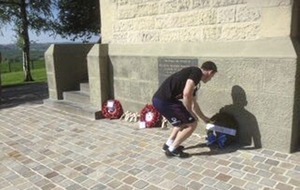
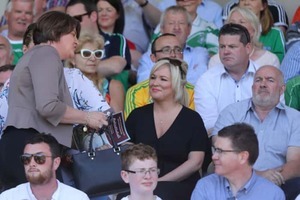
From top: A member of the Dublin Senior football team laying a wreath at the Ulster Tower at the Somme, France in May; DUP leader Arlene Foster (standing) and Sinn Féin’s Michelle O’Neill (in black) at the Ulster final between Fermanagh and Donegal in Clones, County Monaghan last Sunday; Derek Mooney

Post Hoc Ergo Propter Hoc. Though I am tempted to pretend that I recall this dusty old phrase from my days doing inter-cert Latin in Synge St., the truth is that I only know it from watching The West Wing.

It is the title of episode two of season one and its significance is explained by the President Bartlett character when it translates it to his staff saying:

“‘After it, therefore because of it.’ It means one thing follows the other, therefore it was caused by the other. But it’s not always true, in fact it’s hardly ever true.”

Yet another “The West Wing” truism. Nonetheless, the point is well made. It’s a common mistake in politics to so imagine that there is order and logic in events that we manage to project some form of order and sequencing on to them.

In politics, the cock-up theory more often applies than the conspiracy one.

But, just as we should not presume that Event A caused Event B to happen simply because one thing follows another, neither should we assume that there can be no other relationship between the two except causation.

The relationship between actions and events in politics can be far more complex than it may at first seem.

All of this is a somewhat convoluted way of explaining why I think the Dublin Senior Football team was one of the key architects of Arlene Foster’s visit to the Ulster Final in Clones last Sunday, even if is was a bit inadvertent.

Back in May last a group from Dublin GAA, including several players from the senior football team, visited the Ulster Memorial Tower as part of a tour of WWI sites around the Somme.

The Ulster Tower marks the spot near Thiepval in France from where the 36th Ulster Division attacked the German lines on the first day of the Battle of the Somme on July 1, 1916. Though they were one of the few divisions to make significant gains on the day, they came at a very heavy price. During the fifteen or so hours of battle that day the Ulster Division endured over 5,000 casualties and saw 2,069 of their comrades killed.

Though the Dublin GAA visit was low key and done with a minimum of fuss and publicity, news of it quickly spread courtesy of a generous online acknowledgement by the Somme Association of the respect paid by the team.

Am I saying that Arlene Foster’s trip to Clones to watch Fermanagh play in the Ulster Final was the direct and inevitable consequence of Dublin GAA’s Thiepval trip? No, I am not. But I am saying that simple, but sincere, actions, such as those of the Dublin GAA senior team did help set background for Arlene Foster’s visit to Clones.

This does not take anything away from the significance of her action – and action is the right word, because it was an action not merely a gesture.

Though she is not the first DUP leader to attend a GAA match, back in early 2012 then then leader and First Minister, Peter Robinson attended a McKenna cup final alongside the late Martin McGuinness, it was a welcome move in the context of the political entrenchment from both Sinn Féin and the DUP over the past year and a half.

While the rules of political dynamics may tempt some to start listing the gestures or actions that they now want to see Mary Lou McDonald or Michelle O’Neill perform as some form reciprocation, that would be a mistake. Though Sinn Féin are the masters of making demands of others, out-Sinn-Féin-ing the Shinners won’t move us forward.

The kudos in these situations comes not with doing something in response to demands, particularly demands from the other side, but in doing something almost spontaneous. I say “almost” as any such moves are calculated politically with an eye to the reaction, nonetheless the spontaneity comes from your assessment that this is the right time and this is the right move.

Hopefully, this is also what has motivated today’s outreach to the Orange Order by Mary Lou, which should also be welcomed, though it is still at the gesture stage and has not fully matured to an action.

Either way, while there is still a long way to go, seeing the political dynamic in the North change from negative to positive is still progress, by which I mean it is good to see the two main parties potentially begin to up the ante on how far they can reach across to the other, rather that how hard they can poke the other in the eye.

That said, while seeing Arlene and Michelle spend an hour or two attending a game together is positive, it is nowhere near as positive as seeing the two of them in a meeting room together hammering out an agreement that would allow both the Northern Ireland Executive and Assembly to get back to work.

Not that this will be an easy task just now. While July has never been an easy political month in the North, it is potentially about to become a little more tricky.

A BBC NI Spotlight investigation to be aired later tonight claims to have new information on how the DUP and the UK Vote Leave campaign worked together in the Brexit referendum, particularly in the area of spending.

The programme raises serious questions about the DUP’s Brexit campaign finances, including a massive £435,000 Brexit spending spree, exploring a money trail which BBC Spotlight says leads to Ukraine and beyond.

If its claims prove accurate – and that is a big “if” right now – it will take a lot more than a visit to a GAA game to restore the institutions.

If I were a DUP MP right now I’d start to go into training, as it may require a few of them joining the Riverdance touring company to get this show back on the road.

Derek Mooney is a communications and public affairs consultant. He previously served as a Ministerial Adviser to the Fianna Fáil-led government 2004 – 2010. His column appears here every Tuesday Follow Derek on Twitter: @dsmooney

Top pic: Belfast Newsletter

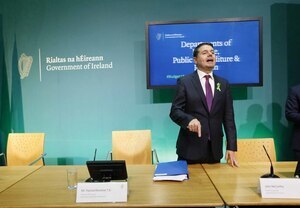
From top: Minister for Finance and Public Expenditure & Reform Paschal Donohoe TD at a Budget 2018 press briefing; Michael Taft

The Revenue Commissioners have produced some interesting data relating to incomes over the period of the recession and the beginning of the recovery. What’s noteworthy is the reversal of fortunes between low/average and top income earners in these two periods. There are some caveats in the data.

First, Revenue income data includes those with occupational incomes which are taxable. So the following data includes more than just those at work

Second, incomes do not include contributions to pension schemes; therefore, this is likely to understate incomes at the higher end.

Third, this counts cases, not individuals. This is important when it comes to ‘married’ cases where there are two earners but only counted as one tax case.

Keeping these caveats in mind let’s see what stories the data may be telling us.

Over the period of recession and stagnation, median incomes (the point at which 50 percent earn above and below) increased while the incomes at the top declined – for the top 0.1 percent, quite substantially.

We should note that the rise in median incomes doesn’t mean that all or most received income increases. This could include the compositional effect whereby people lost their jobs, changing the make-up of the group we are measuring.

For those at the higher incomes, the decline was due primarily to the self-employed (property-related?). The EU Survey of Income and Living Conditions shows that employee (PAYE) income rose between 2007 and 2012; however, self-employed income fell by nearly two-thirds.

The story changes, however, when the recovery set in. Between 2012 and 2015, median income fell marginally by 1 percent. However, the top 10 percent saw incomes rise by 2.1 percent while the top 1 percent and top 0.1 percent experienced income increases of 3.6 and 6.8 percent respectively.

Other Revenue data confirms this trend.

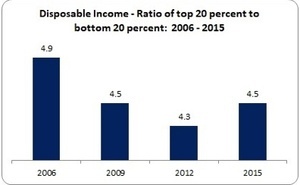
Prior to the crash, the top 20 percent earned 4.9 times that of the bottom 20 percent. This fell during the recession but started rising with the recovery. This is consistent with the data above.

While Revenue shows rising inequality among income tax payers, there is other data that shows inequality falling.

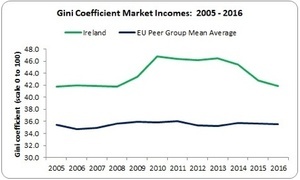
This Gini coefficient measurement refers to market incomes (before social transfers) and covers the entire population, not just those in work; the higher the number, the higher the inequality. We see Ireland returning to pre-crash levels; and in contrast to Revenue, inequality has fallen since 2013.

We should note, though, that Irish market inequality remains substantially higher than our peer group. Indeed, it is the highest in the entire EU, not just our peer group.

Returning to pre-crash levels is not enough from an equality perspective. And if the trends identified in the Revenue data persist, Ireland’s Gini coefficient could start to turn north.

Three policy responses (among many) are needed to address in-work in equality:

First, collective bargaining: there are indications that sectors with high levels of collective bargaining rise to the average of our peer group (along with those sectors where there is high labour demand such as the ICT sector). However, those sectors with low bargaining coverage and union density fall well behind. Collective bargaining – especially in the large domestic sectors such as retail and hospitality – would boost wages and working conditions and make a substantial contribution to closing the inequality gap.

Second, increase the social wage – that is, employers’ social insurance and introduce new in-work innovations such as pay-related sick pay and pay-related maternity benefit. We are an outlier by not linking social benefits with income. This, again, would boost low/average incomes especially as many high-income earners already benefit from workplace schemes designed to protect incomes.

Thirdly, limit precarious contracts by not only facilitating collective bargaining across sectors, but introducing minimum requirements regarding certainty of working hours, temporary contracts and, specifically, public sector and public agencies’ outsourcing.

We shouldn’t always think that inequality is about taxation and social transfers (though there is that). The inequality that flows from the workplace must be addressed in the workplace. And we can do this without resorting to fiscal space gymnastics.

But the benefits – in terms of increased tax revenue (though higher wages) and higher consumer demand (through social benefits and certain working hours) – shows that reducing inequality can be a win-win win situation; for the workers, the Exchequer and domestic businesses reliant on the spending power of workers.

Michael Taft is a researcher for SIPTU and author of the political economy blog, Notes on the Front. His column appears here every Tuesday

Lion’s Mane Jellyfish in Sandycove, County Dublin

There’s a creature that lives in the sea
Which is bigger than it used to be
So if you get a sting
Off this terrible thing
Just sprinkle the sore place with wee.

John Moynes

Rollingnews


Broadsheet.ie