Youssra Oukaf, otherwise known as Soultana

Marcelo Biglia in collaboration with Caoimhe Butterly – of The Border fame – recently travelled to Morocco to document the young feminist rapper Youssra Oukaf.

They report…

In a regional context, in which inter-generational struggles for gender equality continue, Moroccan rapper Youssra Oukaf – popularly known by her stage-name Soultana – is an uncompromising voice of dissent.

Using her lyrics as platform, she spotlights movements for gender and social justice in Morocco and grassroots feminist organising for change.

Through work and art that causes creative challenge to conservative religious and political currents, Soultana defines rap as a means through which to “talk about issues: poverty, violence, abuse, societal contradictions”.

Through holding the tension between challenging gender-based discrimination while maintaining vocal pride in her identity and roots, she has gained the respect and support of a loyal following in Morocco and beyond.

In response to a media environment in which much coverage of the Middle East and North Africa perpetuates reductionist gender stereotypes, Soultana narrates the struggles of women who are active in movements for equality, emancipation and political change.

Resolutely non-commercial, her consistency in speaking out sees her experiencing times of precariousness, as do other emerging artists who receive little support or funding.

“To be an Arab woman artist is to be consistently strong- to live with pride. To work with limited resources and sometimes limited rights but to continue to love, to struggle, to create,” she reflects.

Though facing sporadic societal and political censure in Morocco, Soultana’s vocalisation of her identity as a nuanced, self-empowered Moroccan woman and lyricist is a source of inspiration to many and her work has served as mentor to younger emerging MCs.

Reflecting on her work and sources of emotional strength, she explains: “I’ve faced through some difficult times, personally and professionally, but like they say, ‘what doesn’t kill you makes you stronger’. Everything still gives me hope, though I try to keep my hope in a different world alive. I want to see change in this world – to turn on the television and not watch more wars, bombs, guns.

“Of course I want to see democracy, freedom of speech, access to healthcare, happiness, love, friendship, but all of this can be summarised by saying that I just want to see people to be able to live with dignity.”

The following pictures have been taken by Marcelo Biglia

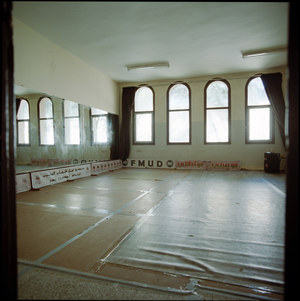
Training rooms at the youth centre in Meknes in which FMUD (Freestyle Maroc Urban Dance) has a base and which also acts as a gathering point for hip-hop, graffiti and dance artists, some of whom Soultana helps to mentor

Graffiti artists and break-dancers are amongst the young artists who use the centre

Sports facilities at the youth centre in Meknes, in which FMUD train and organise some of their annual events. Its grounds serve as the only local facility in the area for young performers to practice and interact

Soultana, lacking ongoing funding or support, stays in the apartment of friends on the outskirts of Meknes and writes daily as she prepares to record her next album

Meknes outskirts, Morocco

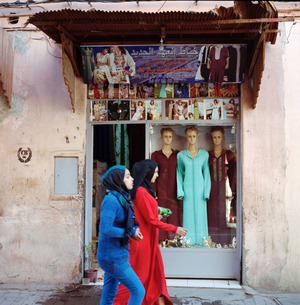
At the medina in Marrakesh

Portrait of King Mohammed VI of Morocco at a framing shop, Marrakesh

Tearoom reflection at Djemaa El Fna Square in Marrakech

As Morocco’s urban youth navigate high levels of unemployment, increased migration to Europe and nascent social movements for socio-economic parity, gender equality and political plurality, Soultana’s lyrics speak to the contradictions and beauty of a collective home-land. At the medina, Marrakesh

At the medina, Marrakesh

Supported by the Simon Cumbers Media Fund

From top: Independent TD Paul Murphy and Taoiseach Leo Varadkar

Earlier today.

During Leaders’ Questions in the Dail.

Solidarity–People Before Profit TD Paul Murphy recalled the “Welfare Cheats Cheat Us All” campaign previously launched by Taoiseach Leo Varadkar.

Readers will recall how at the launch of the campaign, Mr Varadkar – then Minister for Social Protection and not leader of Fine Gael – stated a range of anti-fraud and control measures in the Department of Social Protection saved taxpayers more than €500million in 2016.

The campaign was later referred to as a ‘mistake’ by the Secretary General of the Department of Employment Affairs and Social Protection John McKeon.

Mr Murphy also spoke about JobPath.

He said since the ’employment activation programme’ was introduced in July 2015, €84million has been paid to two companies Seetec and Turas Nua.

Following on from this, Mr Varadkar spoke about welfare fraud and criticised the “hard left”, again.

Paul Murphy: “‘Welfare Cheats Cheat Us All’ you said, Taoiseach, in a campaign now universally recognised as being based on false figures which your own department questioned. You cynically used public money to enhance your appeal to Fine Gael members.

That campaign may now be largely forgotten but the agenda behind it remains. It was more than just a dog whistle campaign for votes. It was part of an ideological assault on social welfare…”

“140,000 unemployed people have been turned into opportunities for profit for private companies. In the process without significant debate the provision of social welfare has been partially privatised. I’ve spoken to a number of people who’ve been through JobPath, they say they’re not given any real training, they’re just supervised while looking for jobs on a computer meaning that it’s pointless travel for many, they describe it as demeaning, as patronising, as infantalising.

“And what hangs over all of their interactions with private companies is the threat of having their social welfare cut by more than €40, leaving people to try to survive on €150, or less, a week.

Since JobPath has been introduced, the number of people who have had these so-called penalty rates applied has increased from 5,000 in 2015 to 16,000 last year. That is in one year alone. Some 6,500 JobPath participants have had their dole cut.

“On the other hand, €84 million of public money has been paid to just two companies, SeeTec and Turas Nua. They get money each time someone signs a personal progression plan and they get paid job sustainment fees.

Both SeeTec and Working Links, which is one of two companies behind Turas Nua, have been accused of fraud in the operation of similar schemes in Britain. Last October in the Dáil, Deputy Catherine Murphy raised a very serious case of fraud by SeeTec in Ireland.

All of that has been justified up until now on the false basis that the system works and gets people into employment. That has now been completely exposed by the Government’s own figures which came out three weeks ago. Only 18% of those who engage in JobPath end up in full-time employment.

“Some €84 million has been given to these private companies to get people jobs which they would have got themselves. Will the Taoiseach now read the writing on the wall for JobPath? Will he agree that the scheme needs to be scrapped and that instead of handing money over to private companies, he should invest in proper education and training and in real jobs for unemployed people?”

Leo Varadkar: “Welfare fraud is very real. And it is a real problem in this country and in every western society. Even if we take the lowest estimate of the scale of welfare fraud in this country, it is about €40 million a year. That is a lot of money in my view. Let us not forget that people who engage in welfare fraud are not the poor and vulnerable. They are people who are pretending to be poor and vulnerable. They are people who are working and claiming.

“They are people who are working, not paying their taxes on that work, and also claiming welfare at the same time. I do not believe that is defensible or acceptable. There are people who are pretending to have a disability they do not have or pretending to care for someone for whom they are not caring.

People are claiming to be somebody they are not to claim pensions for people who are long dead. It really disappoints me to hear left-wing politicians in this country constantly defending fraudsters as though they are entitled to the benefits that they are stealing. They are not — to prevent and crack down on welfare fraud in any way we can.

One only needs to look at the court reports every other day to see the detail of some of those cases and what people have been doing to defraud our system. The reason we cracked down on welfare fraud is not ideological. The reason is that fraud is wrong, whether it is tax fraud or welfare fraud, and we act against it.

“In doing so, we ensure that the welfare budget is protected for those who are entitled to it, including our pensioners, people with disabilities, carers, the unemployed, lone parents, blind people, widows and others. As a result we have been able to increase in two budgets in a row the State pension, payments to carers, payments to people with disabilities and payments to people who are unemployed. It is Government policy to crack down on welfare fraud in order to protect the welfare budget for those who need and deserve it, particularly pensioners, the disabled, carers and people who are unemployed.

I am very disappointed to hear politicians on the left continuously equivocating on this issue and not condemning welfare fraud. I note that the Deputy did not do so on this occasion. Tackling unemployment is one of the areas in which everyone acknowledges we have seen a real turnaround in recent years.

“Unemployment peaked at 15% and is now down at approximately 6%. Long-term unemployment is down to 3%. That is not just because of a recovering economy. Unlike many recoveries, we saw unemployment fall rapidly once our recovery started. That is not the norm in recoveries. There is usually a lag. The reason unemployment fell very rapidly in Ireland once the recovery started is the kind of active policies in which the Government engaged both on the enterprise and welfare sides.

Had we listened to the Deputy and had we pursued the policies which he advocated, which have been attempted in Greece, Zimbabwe, Venezuela and other countries, not only would we have mass unemployment, but we would have a mass refugee exodus from this country similar to the current exodus from Venezuela to Colombia.”

Murphy: “It is like Deputy Enda Kenny is back. The Taoiseach managed not to answer the question at all. Instead he attacked something which I did not say and then went on an ideological attack about Venezuela. I think he might have even referenced Colombia and Greece.

Varadkar: “Colombia is where the refugees are.”

Murphy:Let us go back to the question. The question is on the Government’s JobPath scheme, which has failed in its stated aim of getting jobs for people. That is what the facts now demonstrate. Only 18% of participants get jobs, which is no higher than the rate for people who do not have access to JobPath. These companies have been accused of fraud in Britain. What is the Taoiseach doing to make sure that they are not engaged in fraud here? To deal with the curveball which the Taoiseach has thrown, which is that he will stand over and double down on his rhetoric about welfare fraud, the Taoiseach gave the figure of €40 million two minutes ago, but his advertising campaign said €500 million. Which is it? Who is engaged in fraud here?

Mattie McGrath: “It is the spin machine.”

Murphy: “The Taoiseach is engaged in fraud against unemployed people and is using public money to demonise them in order to drive precarious employment. He is continuing in that same Thatcherite vein here. Will he please answer the question asked in respect of JobPath?”

Varadkar: “I said that even the lowest estimate is €40 million. I note the Deputy has not refuted that.”

Eoin Ó Broin: “What is the actual figure?”

Varadkar:The figure of €500 million was what it said on the tin, that is fraud and control. Fraud and control. They are two different things.”

Pearse Doherty:It was the Department’s Brexit bus.”

(Interruptions)

Varadkar: “On the whole issue of JobPath, we must look at the counterfactual analysis. People who are long-term unemployed can be referred down a number of different routes. They can have assistance through the Intreo service provided by the Department of Employment Affairs and Social Protection; they can be assisted through JobPath, which is outsourced to two companies; or they can be referred to bodies such as local employment schemes, for example. It is interesting to compare counterfactually how people perform under those different headings. There is a complaints procedure in place. If participants feel that they are not getting a proper service from JobPath, they can make a complaint directly to the company. If they are not satisfied with the response, they can go to the Department and make a complaint through its procedures.”

McGrath: “They would be wasting their time.”

Varadkar: “It is important to note how the companies are paid. They get a registration fee per client referred to them but after that they only get paid if the person gets a full-time job and sustains it. The incentive is there for the companies not just to get people into any old job, but to get them into full-time jobs which they can sustain for more than 13 weeks. The longer the person keeps that job, the more the company gets paid. Its strength is in its results. Unemployment is now falling below 6% and long-term unemployment is now below 3%.

Murphy: “The Government’s own figures dispute that.”

Varadkar:Where would we be today if the policies of the hard left had been followed in this country?”

Murphy: “We would not have vulture funds dealing with public banks.”

Varadkar:There would be mass unemployment and mass emigration.”

Previously: Populist Chancer Cheats Us All

This afternoon.

Leinster House, Dublin 2

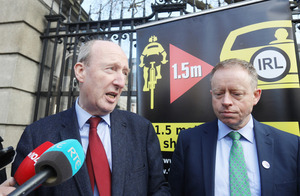
Minister for Transport Shane Ross with junior minister Ciaran Cannon at the formal handing over of a submission about Minimum Passing Distance Law (MPDL) to the Oireachtas Joint Committee on Transport (JCT).from cycling bodies in Ireland, including (pic 2) Ernestine Woelger from Skerries Cycling Club with Vice-President of European Cyclist Federation Dr. Damien O Tuama

The number of cyclist fatalities (15 dead) increased by 50% in 2017.

The proposed distance is 1.5 metres.

FIGHT!

Leah Farrell/RollingNews

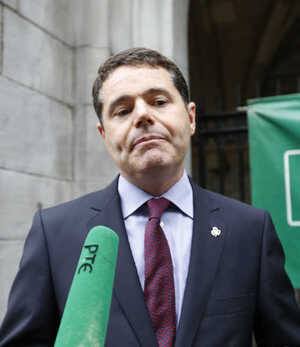
Minister for Finance Paschal Donohoe

This afternoon.

RTE’s News At One broadcast an interview Christopher McKevitt had recorded earlier with the Minister for Finance Paschal Donohoe.

They discussed Permanent TSB’s  plans to sell loans connected to 14,000 private homes in Ireland.

From the interview…

Paschal Donohoe: “The board of Permanent TSB can and have moved ahead with this process and do not require my consent to do so.”

Christopher McKevitt: “And yet many people will say that, as the Minister for Finance, you wield extraordinary power and you wield immense power over Permanent TSB in particular amongst banks because you own 75% of the lender on behalf of the Irish people. So, setting aside the many pressures that you’re under, in order to restore a healthy banking system and protect people in vulnerable situations in mortgage difficulties, what do you intend to do or what can you do?”

Donohoe: “And I’m privileged to be in this office and I’m deeply aware of the concern and vulnerability that many people feel as a result of the announcement by Permanent TSB but I also have to be conscious is we have a Central Bank regulator that is saying to Permanent TSB that it needs to reduce its non-performing loans and the bank that we are talking about in Permanent TSB has a million customers and it has deposits of €17billion and it’s essential for the long-term health of Irish banking that we have a third bank that is sustainable and is secure. As against that, of course I appreciate the concern that people feel about this announcement and that loan owners in particular feel and I’m really, acutely aware of that.”

McKevitt: “Because many would feel that this is perhaps a soulless, cost accounting exercise lacking completely in compassion and that’s where you step in, that’s your role.”

Donohoe: “And I would relate that back to all of the experiences that we have had over the last number of years in relation to Irish banking. We have a legal and regulatory framework in place that has been allowed and seen the amount of mortgage arrears in our country decrease very, very significantly so, for example, Permanent TSB has halved the mortgage arrears they have from around 33,000 cases to 16,000 cases.

“We’ve managed to see this kind of change happen with a low level of home repossessions to date. And the reason why those things have happened is, as against the figures, which I’m deeply aware of, I’m also aware of the social cost and difficulties involved in this kind of change happening.

“And that is why, as I look to deal with this matter, across the coming months, yes it is vital that we have a Permanent TSB that it’s in a long-term, stable and sustainable [inaudible] I want that to happen. We all need to see it happen. I also cannot be in a position that I’m interfering with how a Central Bank works. We put that behind us.

“And I want to create and build on having an environment in which people are treated fairly and effectively as this moves forward.”

McKevitt: “But yet you say Permanent TSB has done good work in reducing the number of loans in mortgage arrears. What’s the problem with continuing that work in much the same vein as they’re going? They’re talking about a sum of €3.7bn attached to 18,000 properties – 14,000 of those are private, principled dwelling homes for people who have families presumably, people who are embedded in their community, requiring schools and services.

Donohoe: “With respect, I didn’t say that good work had happened here, because I’m conscious that as that work happened that it was also very difficult, it involved lots of difficult conversations with citizens. To answer your question directly about why they are required to do more, they’re required to do more because they’re non-performing loans, as a percentage of their balance sheet are at 28% which is five times the average across the Eurozone.

“And I’m conscious as I say that to you Christopher and your listeners that they are figures against the worry that people feel today. But reducing those figures today is vital to ensuring that we have a stable and competitive banking system in the future, able to deal with the next difficulty that we might encounter. And what I will do in order to deal with the concerns that I know have been ignited by this announcement is I will look at the legal and regulatory framework that we have in place afresh. It will be an opportunity to do so as a minister for finance dealing with this matter. And I will be asking and consulting with the Central Bank for their further views on where they stand today.

“And I will be meeting deputy Michael McGrath this afternoon to look at how I can engage constructively in his bill and I’m going to do all of that because as we make the journey to having a stable and secure banking system and further work needs to happen there, I do so conscious of the worry that people feel now and the misery that we’ve already gone through. And I want to ensure we have the fairest legal system in place to balance all of that together.”

Later

McKevitt: “It sounds like there’s quite a job of work for Fine Gael and Fianna Fail and I’m thinking confidence and supply here to do, in order to have a meeting of minds.”

Donohoe: “And. Permanent TSB have reduced their mortgage arrears by 43% versus the peak difficulties we were all in. So one of the points, they had 33,000 families that were affected by this, it’s now nearer 16,000. If you look at where we are, as an entire country, a few years ago, we had €54bn worth of loans that were classed as being non-performing loans – that figure is now €22bn so a journey has been made but for a bank in particular they still have a level of non-performance that is exceptionally high by either regulatory or European average.

“And what I will be doing is I will be meeting deputy McGrath this afternoon. I understand the concerns that he is raising and I will be working constructively on that bill to see how it can be adopted, how we can build on it and then, in parallel to that, I will be consulting with the Central Bank to take account of where we are now and where we might go to the future.”

McKevitt: “Are you happy that of the order of 18,000 property loans will shift potentially, and many say very likely, to an investment fund outside the gaze and outside the control, the regulatory control of the Central Bank of Ireland?”

Donohoe: “Well, if I could break that into two different questions. Firstly, in terms of who will buy and what will be bought, I genuinely can’t answer that question today Christopher and the reason why is this process has not yet even begun to get into that area.

“So later on in the year, Permanent TSB and then I will be able to answer that question but I can’t do so today.”

“In relation to the second part of your question. Any organisation who is managing the loans on behalf of a private fund who might not be located in our jurisdiction is already regulated. So that regulation is in place and the rights that anybody will have and does have will not be changed by the change in ownership of the loan.”

McKevitt:“And you’re referencing the Credit Servicing Firms Act of 2015 but that act does not include determining the overall strategy for the management and administration for those portfolios of loans – the making of portfolio decisions or enforcing indeed loans. So, in a sense, there is still many would argue, far too much free rein for what people call vulture funds to do as they please with the lives of fellow citizens.”

Donohoe: “And as against that, before I answer you question and tell you what I’m going to do about it. Against that, let’s just be cognisant of the journey that has occurred in relation to non-performing loans and banks within our country where we have a legal framework currently in place that has seen many of these difficulties evolve and be resolved without the mass home repossessions that did appear a prospect in our very very recent past.

“But then to answer your question regarding where we are now – that’s why I want to be very clear with your listeners on this matter. The legislation that was in place happened in 2015 and I will look at this issue afresh both by asking the Central Bank for their views and where we stand now and then by engaging with Deputy McGrath and his party on this point across the coming weeks and months.

McKevitt: “Briefly, can we look at what Permanent TSB has told us about the portfolio, the Project Glas portfolio it’s selling. It’s loan values of around €3.7billion, 14,000 of them principled dwelling homes, they’re saying €1bn of the €3.7bn is investment properties and the remainder then is principled private homes. Of that, they’re saying close on €2bn worth of those loans with principled private properties are people who haven’t engaged with the banks for a number of years. Do you feel that the time has come for those people to leave those properties if they haven’t engaged, if they’ve no entitled to maintain the property that they’re in.

Donohoe: “The recent trend and what we have managed to deliver in our country of people staying within their homes while difficulties being resolved as fairly as possible I want to maintain. I am so conscious of, particularly with the housing difficulties that we have of the value and necessity of having a stable home, a roof over your head – these things are a vital part of what it is to be a citizen. And a member of our state at the moment.

“In relation to the question that you have asked me about all of those loans, I want to maintain that approach but the answer is going to vary loan by loan and that is why I’m saying to you today that the legal framework that we have had replaced has been successful in staving off the kind of repossessions that many feared would happen and conscious of the concerns that have been ignited by this, I will look at that legal framework again.

“But the balancing act I have to manage Christopher, that’s why I wanted to talk to you about this issue today, is I have to work with everybody to weave a way through, having a stable banking system for our country in the years to come, able to lend to people, able to offer good rates of interest and deposit, able to offer security to people, while at the same time, deal with difficulties that are there and I am committed to try and find an build on a framework to do that.”

McKevitt: “Just north of €700m of those loans are people who have engaged with Permanent TSB, who have sought resolution and to discuss their mortgage arrears difficulties, should they be surprised that they’re going to be included in this tranche for sale?

Donohoe: “Well, in, where that matter will move to is the legal rights that those loan owners have will not be changed. So they will have the same protection and obligations now legally – they will have the same level of protection in the future as they have now. So that is where they will stand in the future and it’s just an example of the kind of understandable sensitivity that people have here in relation to this transaction and that is why I”m being very clear Christopher, that the legislation that we have in place, I believe has served our country in dealing with difficulties that we had in the past and I will look at that afresh now to see how we can be best placed to manage the challenge that is approaching us now.”

Listen back here in full

Earlier: ‘A Sick Joke’

Tuesday: Michael Taft: Not Too Late To Save Public Banking

11 April, 2000.

The last day of the trial of Catherine Nevin for the murder Tom Nevin at their pub, Jack White’s Inn, near Brittas Bay in County Wicklow in the early hours of 19 March 1996.

Paddy McEntee (left) senior counsel for Catherine Nevin and Peter Charleton (right) senior counsel for the prosecution – currently chairman the Disclosures Tribunal – outside the Four Courts await the verdict, as the jury neared the end of its fifth day of deliberation.

Ms Nevin, who died on Monday night at a care facility in Dublin after being diagnosed with a brain tumour, was given a life sentence.

Yesterday: Gone

Rollingnews

Broadsheet.ie