https://www.youtube.com/watch?v=IPy2DyRV3Mo
Fail Army’s monthly roundup. You know the drill.
Previously: Frail Army



https://www.youtube.com/watch?v=IPy2DyRV3Mo
Fail Army’s monthly roundup. You know the drill.
Previously: Frail Army

https://www.youtube.com/watch?v=y4HJ1Y3sWPs
He’s back!
Are Ya Having That write:
‘LeatherJacketGuy’ reacts to ‘Life’


From top: Aston Martin in South William Street, Dublin 2 last month; Michael Taft
Inequality is growing again and the income of the Irish 1 percent is growing faster than anywhere else in the EU-15.
Michael Taft writes:
The 1 percent serves as an excellent symbol of actually existing capitalism. Examining the inequalities between households gives an insight into the level of solidarity within a country.
Wealth and power is manifested in other systemic ways – namely, the level of financialisation and bargaining power between capital and labour.
Still, a system that produces a 1 percent will be reinforced by that same 1 percent. So let’s take a look at how the 1 percent is doing these days.
A standard measurement is by ratio.
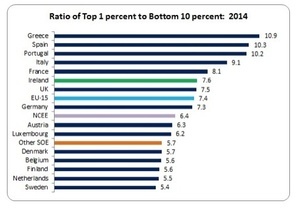
Here we see the ratio of the income of the top 1 percent (see below for a statistical description) to the to the top cut-off point of the first decile.
Though Ireland is not the worst – that is reserved for the poorer Mediterranean countries and France (this might help explain the rise of the National Front) – we’re still in the top half of the table.
We’re slightly ahead of the mean-average of the EU-15, but much higher than our peer groups: Northern and Central European economies (NCEE excluding the Mediterranean countries) and other small open economies (Other SOE).
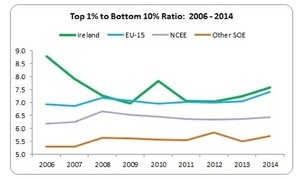
Ireland had very high levels of inequality towards the end of the boom period. The 1 percent took a hit with the crash given their greater reliance on property and speculative activity and this resulted in falling inequality: not because low income groups saw their income rise. It was just that their income fell slower than the 1 percent.
However, we will see below that not all higher income groups suffered.
But let’s first look at another measurement, the ratio between the 1 percent and the 5th decile – or that proverbial squeezed middle:
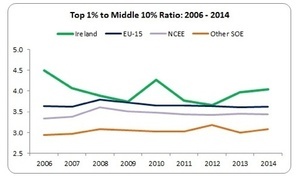
We see a similar pattern as with the ratio to the bottom 10 percent – except that since 2012, the gap with the top 1 percent has widened faster. And we see that in this measurement, Ireland has a high level of inequality. In fact, the gap between the top 1 percent and the middle 5th decile in Ireland is higher than any EU-15 country bar France.
It’s been quite a roller-coaster for the ol’ 1 percent in Ireland. In 2006, they had the highest level of income in the EU-15 bar Luxembourg. But by 2012, they had experienced a fall of 22 percent.
However, though they haven’t climbed back to their dizzying pre-crash levels, in the last two years their income has grown faster than any other EU-15 country with a growth rate of 13 percent compared to an EU-15 average of 3 percent.
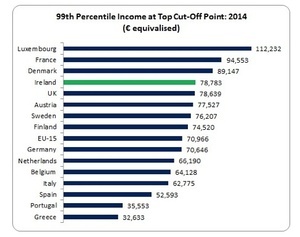
Even after the big recession hit, the Irish 1 percent still rank high in the EU-15 tables.
But not everyone in the high-income category are the same.
Unfortunately, we don’t have a compositional breakdown of the top 1 percent so we will have to make do with the CSO’s data which provides the top 10 percent.
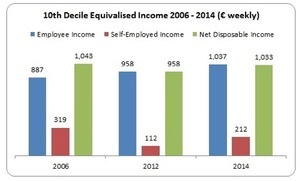
Let’s walk through this table. Between 2006 and 2012 we see that the weekly net income of the top 10 percent fell from €1,043 to €958.
However, employee income continued to increase (and remember, employees in this top 10 percent would include CEOs, senior executives and managers, higher professionals, etc.)
The hit was to those relying on self-employed income which fell by 65 percent. We can assume that a large proportion of this was property-related income. Reduced social transfers and higher tax would have also reduced overall net income.
However, since 2012 net income is rising. Employee income continues to rise and the fall in self-employed income has been reversed; indeed, it doubled in the two years up to 2014. Net income for the top income earners rose by 7.9 percent; for everyone else it rose by less than 4 percent. The gap is widening.
Of course, we can’t automatically assume that the 1 percent had the same rise in income as the overall top 10 percent. It might be higher, lower or the same. But I’m pretty confident – and I’ll give good odds.
Prior to the crash Ireland was highly unequal with the top 1 percent doing better than almost any other 1 percent in Europe. In the recession they took a hit but if the CSO data can be used as a proxy, then this was due mostly to the loss in self-employed income.
This decline has been reversed, inequality is growing again and the income of the Irish 1 percent is growing faster than anywhere else in the EU-15.
Yes, the 1 percent are doing alright.
Michael Taft is Research Officer with Unite the Union. His column appears here every Tuesday. He is author of the political economy blog, Unite’s Notes on the Front. Follow Michael on Twitter: @notesonthefront
NOTE: the tables present household income in ‘equivalised’ terms. This accounts for the size of the household (adults, children). In the Eurostat tables, the income level is based on the top cut-off point. For instance, for the bottom 10 percent, the top cut-off point is that income point in which people rise to the next decile. For the top 1 percent, this is the income at which they enter that top decile.

ATMs may be hit by a cash shortage this weekend if the Garda strike goes ahead
This weekend some will wonder why
The drink links are all running dry
So build up a stash
Of your hard earned cash
Or your barman will soon see you cry.
John Moynes
Pics: Rollingnews.

Ah here.
This morning.
Ranelagh, Dublin 6.
Thanks Dermie









MORE to folly
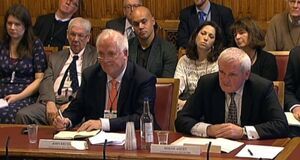
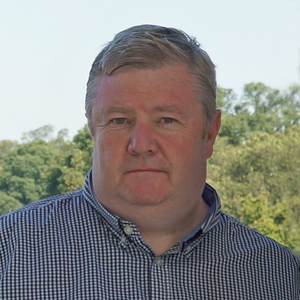
From top: Former taoisgh Bertie Ahern and John Bruton at the House of Lords; Derek Mooney
The provisions of the British Irish Agreement are not something that the pro-Brexit DUP or anyone else can wish away.
Derek Mooney writes:
Like about 98% of the adult population I rarely, if ever, watch RTÉ’s European Parliament Report. While this has more to do with the ungodly hour at which it is scheduled, rather than any lack of interest in what our MEPs might be up to, last night was an exception.
By chance, I happened to catch the first half of last night… actually it was this morning’s programme… which included a short discussion on the impact of Brexit on Ireland.
On the panel were three Irish MEPs. Two from this side of the border: Sinn Féin’s Liadh Ní Riada and Fine Gael’s Mairead McGuinness and one from the other side of it, the DUP’s Dianne Dodds.
Though the discussion was interesting enough in itself, with both Ní Riada and McGuinness arguing their case well, its real value was the insight that Mrs Dodds feisty contributions gave us into the DUP’s Brexit mindset.
Her comments and the thinking underpinning them allow us to see where the Northern Ireland First Minister is coming from and may even assist in interpreting [First Minister] Arlene Foster’s recent DUP conference address.
When the two MEPS from this side of the border reminded Mrs Dodds that over 56% of voters in the North had chosen to remain in the EU she countered, as many DUP and pro Brexit unionists do, that the North is part of the UK and must be bound by a UK wide vote.
The presenter Tony Connolly followed up on this point, referring to the majority consent provisions of the Good Friday Agreement.
He slightly tripped himself up however, incorrectly suggesting that the DUP had signed up to the Agreement. Mrs Dodds was quick to correct him saying that the DUP “did not sign up to the Belfast Agreement” adding that “our party vociferously opposed the Belfast Agreement”.
She is correct on her party’s historic opposition, however her belief – and doubtless the belief of many of her DUP colleagues – that they somehow are not committed and bound by the Good Friday/Belfast Agreement is based on a false premise of their own construction.
They ignore the deeply inconvenient fact that the Agreement was passed by 71:29 by Northern Ireland voters on a massive 81% turnout and that other agreements, which Mrs Dodds cited, that the DUP have since signed up to since are predicated on that Agreement.
They also omit a very significant aspect of the Agreement, one which many of us down here also forget, namely that the document we refer to as the Good Friday/Belfast Agreement is not just the deal reached among the parties in Northern Ireland, it is an internationally recognised agreement between the two Governments.
This point was made forcefully at the UK House of Lord’s EU committee last Tuesday by former Taoiseach, Bertie Ahern, when he gave evidence alongside former Taoiseach John Bruton on the impact Brexit will have on UK./Irish relations, both political and economic.
As Mr Ahern reminded them, the British Irish Agreement (BIA) is the bedrock of that settlement.
Even though it appears at the start of the document; the portion we think of as the Good Friday Agreement (it is referred to as the multi-party agreement in the document) is actually the annex to the British Irish Agreement. Not that its position matters greatly, as the BIA commits the two Governments – as a matter of international law – to its implementation.
The provisions of the British Irish Agreement are not something that Mrs Dodds, First Minister Foster or anyone else can wish away. Indeed, the BIA will have to be a part of the post Brexit treaty between the UK and the EU.
The reason for stressing the significance of the BIA is evident from the first line of Article 1.
It says that both sovereign governments
“recognise the legitimacy of whatever choice is freely exercised by a majority of the people of Northern Ireland with regard to its status…”.
Later in the same Article, it says:
“…it would be wrong to make any change in the status of Northern Ireland save with the consent of a majority of its people;”
These lines are crucial. Though they appear in the BIA in the context of a move to a United Ireland, those core principles apply equally to any change in Northern Ireland’s constitutional status: majority consent within Northern Ireland is required.
The DUP cannot have it both ways on this. It affirms its allegiance to the sovereign government which contracted the agreement and is thus bound by it. It put its case against the deal to the people on the Good Friday Agreement in 1998, and it lost. Just as it put its pro-leave case to the people of Northern Ireland last June and lost again.
Yes, it is in a bind, which may explain some of the hyperbole from its recent conference, but welcome to politics.
The DUP may not like the fact that the people of Northern Ireland voted against Brexit and would prefer to remain within the EU, but that is the situation and accusing Dublin of talking down the North will not distract from that reality.
The DUP put a pro Brexit position to the voters, though it did so unconvincingly with some senior DUP-ers privately indicating their preference for Remain, and the voters rejected it.
Now it has an obligation to reflect that majority view as well as its own defeated minority view. The “D” in DUP does supposedly stand for democratic, afterall.
Despite Mrs Foster’s playing to the gallery last Saturday with some southern bashing, the DUP cannot construct majorities to suit its political needs, no more than it can construct its own facts.
Derek Mooney is a communications and public affairs consultant. He previously served as a Ministerial Adviser to the Fianna Fáil-led government 2004 – 2010. His column appears here every Monday mid-afternoon. Follow Derek on Twitter: @dsmooney
Pics: RTÉ

He’s back.
Are Ya Having That writes:
‘LeatherJacketGuy’ visited a couple of the best ‘Halloween Themed Pubs’ in Dublin…including The Adelphi [Middle Abbey Street, Dublin 1] and….

….samples the Zombie Apocalypse at The Exchequer [Exchequer Street, Dublin 2]…