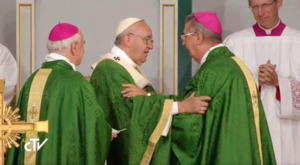
Pope Francis (second left) and Archbishop of Dublin Diarmuid Martin
This morning.
On Today with Sean O’Rourke, hosted by Keelin Shanley, Archbishop of Dublin Diarmuid Martin talked about how the World Meeting of Families will take place in Dublin in 2018.
It’s described as the “world’s largest Catholic gathering of families” and happens every three years. Pope Francis hopes to attend.
From this morning’s interview.
Keelin Shanley: “Archbishop, the World Meeting of Families [Congress]. First off, why was Dublin chosen or how did you manage to bring it to Dublin, I suppose is the real question?”
Diarmuid Martin: “I didn’t ask for it. The pope decided that he… I was told the pope was thinking, you know, Dublin and if that was the case, would I, would I accept. And that’s the way it went. The pope himself told me that there were two other…generally speaking, it’s once in Europe and then once somewhere else… that two other European cities had made the request, that he felt that Dublin would be an interesting place for him to come to and to reflect on, on family, family in the church, family in society. That that would be not just a reflection for Ireland but a reflection coming from Ireland for major parts of Europe.”
Shanley: “That’s interesting so two other European cities, they’d asked for it?”
Martin: “Yes.”
Shanley: “Ireland hadn’t asked for it?”
Martin: “No.”
Shanley: “And yet he came to you and asked…”
Martin: “It was…in a sense…it was embarrassing because I was asked and told under no circumstances to say this, and at the same time, there’s a parallel process going on among Irish bishops wanting to invite the pope and I couldn’t say ‘well, you know, the pope is looking at this’.”
Shanley: “And do you think the pope will come in 2018, at the same time?”
Martin: “He has, he said to me that he hoped he would come or, if not him, his successor, that’s the first thing you have to say, the pope will be 80 next month or in December. So he’ll be 81 and a half by the time this event would take place and, obviously, you know, that poses questions as to what he would be able to undertake at that particular time. One thing is certain that, you know, if he does decide to come, he will come to something, to a different Ireland but also with a very different understanding of what the pope coming to Ireland is about. I hear people saying ‘the World Meeting of Families and the papal visit’ as if these were two separate things. The pope would come to Ireland for the Meeting of the Families – and that would be the primary purpose of him coming and most of his time would be dedicated to that. And when he goes to a country…when he goes to an event, for example, and…in Krakow, he went to Auschwitz and he went the marian shrine in Czestochowa, but if he went there and back in both cases in the morning, there weren’t those huge events that we are associated with the papal visit in 1979 and I think if he were in Ireland going outside the actual meeting, he would go in a framework which would stress that he’s here in Ireland for the Meeting of the Families.”
Shanley: “Right, so it would be a much lower key event than we would have seen before?”
Martin: “A different kind of event. But it’s primary purpose in coming was to the World Meeting of the Families. As I say, to bring a message for Ireland, to bring a message from Ireland for families, particularly in Europe.”
Shanley: “It’s interesting, I mean since he became pope, this pope has been very interested in the family, it’s very much put at centre stage. And yet, when the church begins to talk about families, there is always the ‘well, why are these usually older men, unmarried, with no children themselves, why are they talking about family?’ How difficult is that? That bridge?”
Martin: “I think, you know, we can have lots of discussions around the family and the difficulties of the family as an institution but I think all of us realise that when family, when families work, they bring stability to society, in a way that no other institution does. If you look at the trans-generational dimension of families, the idea of the nuclear family that we had – mother, father, two children, a boy and a girl – that really is a distortion of the real notion of family. Family is the place where values are passed on from one generation to the next, where families bring – through the love and the support they give – within their own homes and in society and, if that breaks down, then everybody should be concerned about it.”
Shanley: “And would that be part of this next World Meeting of Families? The embracing of new types of families, including same-sex couples, divorced couples, separated couples?”
Martin: “If you start going around, looking at a whole series of categories, you miss the important, most of us know, we’re able to identify what is family – whether that’s in Africa, whether it’s in South America or in Ireland. And there’s a huge variety in families. The same thing is, we often say the church is opposed to the idea of family. I’ve gone to meetings recently and one of the questions they ask is: hands up anybody who says their family here is the ideal family? And, of course, we all know that isn’t the case. We all know that there’s imperfection in us, in all our institutions. But does that mean that we have to renounce the idea of having an ideal to which people can aspire? Of having with young people, saying to them, look, this is a vital part of your search for happiness in your life. Get ready for it…”
Shanley: “And what is that ideal? As you would see it, that the church would aspire to in terms of family?”
Later
Shanley: “When you talk about permanence, fidelity, love, you could find permanence, fidelity, love in any type of relationship and I suppose that is around the key issues of family and the Catholic Church. It’s had so many families around Ireland feel that they are not respected equally by the Catholic Church, if they are a same-sex couple or if they are, you know, a non couple or whatever the individual kind of family is made up as. Do you think you will extend out to these families and bring them in?”
Martin: “I think there’ll be ways in which you can do that, but not sort of generalised decrees saying there’s an amnesty for this group or an amnesty for that group..many of these things can be looked at on an individual basis.”
Shanley: “What does that mean?”
Martin: “Well, you’ll have to find the particular circumstances in which people find themselves in and begin to reflect on that and see are there elements which really belong to the church’s understanding of marriage present in people who don’t fully realise those..”
Shanley: “I, I don’t… sorry, not to be..but I don’t fully understand there. Are you saying, for example, two women living together with two children which, if they’re permanent, faithful…”
Martin: “In that particular case, my first concern would be about the two children. And to see that they receive from the church and from society all the support that is there, despite, and, you know, without going, despite the fact that it’s, it’s a different type of relationship to the church’s teaching on marriage. One of the big challenges, if you take, for example, what is it in today’s world, why is it that so many people are not getting married? Why are people afraid of a commitment for life and what is that saying? These are big societal questions that we have to look at..”
Listen back in full here