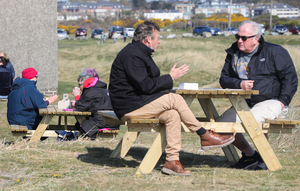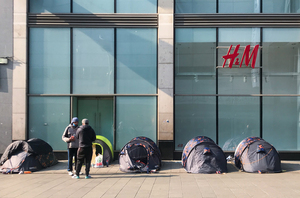

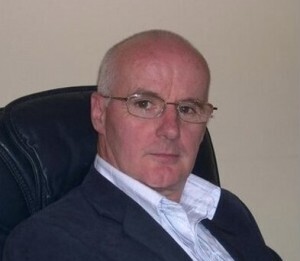
From top: Minister for Health Stephen Donnelly’s home in Greystones, County Wicklow; Anthony Sheridan

In 2018 Stephen Donnelly Fianna Fáil TD was refused permission to erect a fence around his home. In 2021 a fence was erected around his home at taxpayer’s expense.

Just two things changed between 2018 and 2021- Donnelly became the Minister for Health and sometime between the end of January and early February this year, a number of incidents were alleged to have occurred at the Minister’s home.

The story broke on February 20 when Irish Examiner journalists Paul Hosford and Aoife Moore reported they had received an anonymous tip-off that a security fence had been erected outside the Minister’s home as a result of the incidents.

An unidentified source said the fence was erected after items were thrown at windows and left on the minister’s doorstep.

An unidentified spokesperson for the Minister declined to comment except to say the fence was for security reasons.

The story was accompanied by an outraged editorial condemning the alleged attack on the minister’s home.

So, what have we so far?

An anonymous tipoff followed by an unidentified source, followed by an unidentified spokesperson alleging, without providing any evidence, that at some point in the recent past, persons unknown threw items at the windows of the Minister’s home and left items on his doorstep.

In other words, what we have so far is – hearsay

Later that day Ms Moore was interviewed by Damien O’Reilly on RTÉ Radio One’s Brendan O’Connor Show where RTÉ had upped the language surrounding the story from ‘incidents’ to ‘an attack’ on the minister’s home.

Unfortunately, Ms Moore did not provide any additional information but did expand on what she did not know – some examples.

“Is there any evidence that this is related to his work?”

“It appears it is but we can’t go into detail.”

“Do we know what was thrown at the house?”

“We don’t know.”

“Did it involve an individual, a group, was it over a prolonged period?”

“We don’t know. The advisor didn’t really want to go into it in any more detail. I think they would rather if the story was a private family matter.”

So here we have a journalist reporting an [alleged] attack on a government minister and happily accepting that such a serious event can be treated as a private family matter.

Ms. Moore was however very supportive and even emotional on behalf of the minister, saying:

“He has three young children…and obviously he’s up in Dublin for a lot of the time…and of course he’d be really concerned about his children and his wife. It’s just really rotten to be honest. I think everyone is really disgusted that politicians can’t go to work without having to worry about the safety of their families.”

Staying with the emotional angle O’Reilly/RTÉ linked this alleged attack with the perfectly legitimate, peaceful protest held outside the then Minister for Health Simon Harris’ home in 2019.

Ms. Moore was also happy to go along with this linking of two completely different stories:

“He [Harris] had a very young baby at the time, his wife and daughter were at home, it was very scary.”

O’Reilly concluded the interview with a strong note of outrage:

“Who would want to go into politics when you hear stories like that?”

That appeared to be the end of the story but then, curiously, a full seven weeks later, on April 9, the story was resurrected when Newstalk journalist Ciara Kelly interviewed Minister Donnelly in his constituency in Greystones Co Wicklow.

Listening to the interview it was clear Ms. Kelly is a great admirer of the minister, excitedly telling listeners that both of them were locals and even attended the same school.

The form of the interview was very similar to that on RTÉ between journalist Aoife Moore and journalist Damien O’Reilly. Very friendly, no challenging questions and buckets of sympathy for the minister for the alleged attack on his home.

“Does it frighten you that your family is being swept up into all of this?”

Donnelly: “Obviously, but I don’t want to get into it too much details for reasons you’ll understand.”

If Ms. Kelly did understand why a government minister would want to keep the details of an alleged attack on his home secret, she wasn’t telling her listeners. Just as journalist Aoife Moore was happy to accept that such an attack could be treated as a private family matter.

Ms. Kelly’s co-presenter Shane Coleman concluded the piece in a similar manner as Damien O’Reilly did on RTÉ by angrily asking:

“Why would anyone go into politics and subject themselves to such abuse?”

So here we have five journalists reporting a story as fact without any real evidence. Apparently cooperating with anonymous sources and the minister to keep details of the story secret and expressing strong support and sympathy for the minister’s unsubstantiated claims.

Journalists cannot retain credibility when they publish stories without corroborating evidence. Respect for their profession is also seriously damaged when they take sides, particularly when they take the side of a government minister who stands to gain from such media support.

Anthony Sheridan is a freelance journalist and blogs at  Public Enquiry.

RollingNews

A mapping expert with Ordnance Survey Ireland (OSi) says he believes a children’s burial ground associated with a mother and baby home in Cork is located on land now earmarked for apartments.

John Clarkin, who has worked with OSi for more than 46 years, and who has been an expert witness on boundary matters for over 30 years, made his comment during a detailed assessment of historic maps which were at the centre of the second day of An Bórd Pleanála’s oral hearing into plans for 179 apartments on a privately-owned site on the former Bessborough estate in Cork.

Part of the development site overlaps an area marked on historic maps as ‘children’s burial ground’.

Bessborough children’s burial ground on land earmarked for apartments, says expert (Irish Examiner)

Earlier…

From top: the former Mother and Baby Home at Bessborough, Cork; Professor Phil Scraton, whose report on the Irish coroner system was published yesterday by the Irish Council for Civil Liberties

“It is a remarkable coincidence that the submission that we made on the Mother and Baby Homes, the Magdalenes, two weeks ago coincides with the launch of this report [see below]. It’s quite difficult for me some days to disentangle the work I’m doing on both.

“But I do believe, very, very strongly that we have to listen to families in terms of the issue of dis-internment and re-internment. If this is a matter of simply dis-interning to re-intern then we are missing the most significant issue.

“The most significant issue for many families, certainly that I’ve spoken with, is that they want to actually have their story told. They want, if possible, through DNA, to be able to identify their loved one and they want an appropriate inquest in which at that inquest they can give evidence around the circumstances of death.

“When we think about what inquests are, they are there to establish how a person died. That means the circumstances of their death. This means that evidence, where it is at all possible, should be brought forward into an inquest of anyone who died in the Mother and Baby homes or as a consequence, they should be brought forward to an inquest into that death. And as far as is possible: the story told.

“Now not all families will want that and some will just simply want re-internment in appropriate burials sites. That is their choice. But I think that as a matter of real concern, this has to be done, for those cases where families wish that to happen.

“Now immediately the response is the coronial process in Ireland just couldn’t cope. Nor could it cope in the North either. I understand that. So that’s why one of the reasons we’re arguing for, in this particular case, specific coronial appointments to deal precisely with this issue.”

Phil Scraton, professor emeritus in the School of Law, Queen’s University.

Professor Scraton was speaking during a webinar yesterday on Death Investigation, Coroners’ Inquests and the Rights of the Bereaved, a report published by the Irish Council for Civil Liberties and compiled by Professor Scraton – a key figure in the Hillsborough investigation, and Gillian McNaul, also of Queen’s University. The report looks at the Coroner system currently in place in Ireland.

Yesterday: Inquestigation

Meanwhile..

A forensic archaeologist who has helped to recover the remains of ‘the Disappeared’ in the North has recommended a new search for human remains on the grounds of a former mother and baby home in Cork.

Aidan Harte, a senior team member with the Independent Commission for the Location of Victims Remains, was senior archaeologist for site investigations at Tuam and at Sean Ross Abbey on behalf of the Mother and Baby Home Commission of Investigation.

He set out the approach for a new search of a 3.7-acre site on the former Bessborough estate during a Bord Pleanála online oral hearing yesterday into plans for 179 apartments on the sit

He suggested the deployment of ground-penetrating radar at specific locations on the site

If human remains are found, the excavation work should cease, the coroner and gardaí notified, and the site secured, he said.

Expert outlines new search for human remains at Bessborough (irish Examiner)

Getty

The sculptures of New Zealand artist Ben Young – hand-cut glass and jagged concrete marine-scapes precision-cut like the facets of gemstones, revealing their topographies.

Also, weeny little human figures dwarfed by the majesty of the oceans.

That’s you and all your mates, that is.

colossal

Emergency regulations introduced by Minister for Health Stephen Donnely on April 13

Anyone?

S.I. No. 168/2021 – Health Act 1947 (Section 31A – Temporary Restrictions) (Covid-19) Regulations 2021

This morning.

The Health Information and Quality Authority (HIQA) has found the use of a closed-circuit television camera in a resident’s bedroom at a designated centre for people with disabilities run by the Daughters of Charity Disability Support Services.

Via RTÉ News:

…the inspection identified a number of concerns [-at the north Dublin-based facility’ including the use of restrictive practices, the management of behaviours of concern, the manner in which residents were supported to exercise their personal rights and the management of risk.

The report notes the use of closed-circuit television cameras in resident apartments and in a resident’s bedroom.

…There was significant use of restrictive practices in the centre which primarily included “environmental restraints”.

HIQA finds use of CCTV in resident’s bedroom at centre (RTÉ)

RollingNews

This morning.

Via Irish Times Letters:

Just a few weeks ago, the Court of Session in Scotland ruled that government closure of houses of worship was unconstitutional and a breach of the European Convention on Human Rights.

In essence, the court held that, while coronavirus restrictions are necessary, they must be proportionate.

This may not be the product of a court gone rogue.

Indeed, courts around the globe have reached similar conclusions. In the US, the Supreme Court has tossed out restrictions on religious worship in several recent cases (see, for example, Roman Catholic Diocese of Brooklyn v Cuomo).

Closer to home, last November the French Conseil d’État overturned limits on religious worship, calling them disproportionate and a “manifestly illegal attack” on freedom of religion.

It is important to add that judicial scrutiny of Covid-related laws has been more frequent internationally and not simply limited to religious rights.

Indeed, the Conseil d’État in France has been particularly hawk-eyed when it comes to restrictions. For instance, it ruled just over a month ago that a total ban on senior citizens leaving their nursing homes was “disproportionate” because it would, among other reasons, “alter their physical and psychological state”.

The global cases cited above should be food for thought for courts here, and especially for Irish citizens, whose physical and psychological states may be similarly “altered”.

If we are to live under changeable restrictions for the foreseeable future, more exacting scrutiny by the judicial branch could be brought to them, ensuring they are above all proportionate.

Irish Times Letters

Yesterday: Get Off Your Knees

RollingNews

Broadsheet.ie