From top: Alec Guinness; David Langwallner
“The circus world no longer exists. The real clowns have all disappeared. The circus no longer has any meaning in today’s society.”
Federico Fellini’s I clowns (1970)
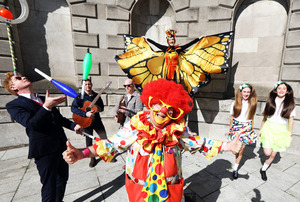
I have taken my daughter Lara to the circus several times. Not the circus of the Four Courts, but the visiting itinerant players in Clontarf. A nether land. Located between the interstices of Clontarf and Fairview. She was frightened by the Clowns though. No one should be. Clowns are good people largely. And her daddy likes them.
I have written for Broadsheet on how advocacy is a part of the dark arts of irrational persuasion not unlike magic or sorcery and have written for Cassandra Voices, Village and The English Speaking Union contributions on the essential aspects and skills required of an advocate and also how it behoves advocates both as a profession and in an extracurricular sense to contribute to the importance of speech and public debate. For free. Itinerant players and clowns. Mugs in professional contribution.
Advocacy trains an individual in seeing the wood from the trees and focusing on fact and conversely fiction in our post-truth universe and an advocate should be a public advocate and understand vocational responsibility. That is vital. Few do.
But there is one salient theme I have left unaddressed and I do so finally in a no-stone-left-unturned kind of way and, in a way, which troubles me at one level and invigorates me at another as well as something that is crucial to realise. The role of clowns, actors and players.
Advocacy is at one level acting and performance. The muck and greasepaint. Advocates have an element of the clown about them. Why do it otherwise? The rewards are less than you might think.
Though not if you are a tax lawyer. Its sure beats working, to transpose a quote from another actor Robert Mitchum. And the best at it do not work much. Or rather work with more speed and less haste. Only fools and horses work. Less is often more.
This final comment is also prompted by three no less of the Broadsheet ultra-critics; one who pointed out how the skill set can be used, in a strictly non-Kantian ethical sense, to represent anyone. For good and for bad.
And one who pointedly reprimanded me for representing Mr. John Gilligan, forgetting that no brief fee was accepted and constitutional rights were at stake. But how would the layman know? One also suggested the days of the debate chamber are over. Thus, the days of clowns are over and why nefarious lobby groups are thriving. Scene shifters and shapers to stop the clowns performing. Or to stop the truth getting out. Or to bankrupt the clowns and the circus. A salient theme of Bergman’s early masterpiece Sawdust and Tinsel (1953)
Of course, there is a strict code of ethics imposed upon barristers, but it is legal ethics, as one of the commentators is correct about. And to deal with that old chestnut – what do you do if a client tells you he is guilty? – well then you cannot raise the affirmative evidence, merely challenge the prosecution evidence.
So, it is a different brand of ethics or not true ethics to accept the veracity of the commentator’s remarks. But part of the pursuit of results and the dark arts are theatrics, which are also part of the advocate’s job. They are acting and performance and being a clown. And they can accomplish a lot. Before a jury or for that matter a tribunal.
Advocacy thus is a performance and great advocates are born not made. And that is a truism. Although you can teach advocates to be very good and in the traditional vernacular, competent, highly competent et al, you cannot teach great advocacy that is innate and it is a performance art. It might be nature/nurture but it a skill set that is unquantifiable and intersects with performance.
The late great Alec Guinness, the most diverse and eclectic of the great English acting lords, straddling equally and with equal acumen the cinema when he accepted the life-time Oscar, thus made one of the most complete statements about acting which applies equally to advocacy.
“You know, when I was a drama student forty-seven years ago, I think, there used to be a formidable lady who came to take classes of what she called “film technique.” And she arrived with a large wooden frame about four-foot square which she placed in front of our faces saying it was a close-up. And then she barked at us: Show fear, anger, joy, despair. And I quickly learned how to get maybe a laugh or two out of my fellow students. And then it dawned on me that, if I was seriously going to have a career in movies, the wisest thing was to do absolutely nothing at all. And that is more or less what I’ve done since then. I feel very fraudulent taking this, but not letting any expression pass over my face.”
The best performer is the neutral performance. Rhetoric – yes, but with carefully-marshalled stony-faced facts. You may be trembling inside but you must show the same emotion. Not a poker face as such but an agreeable expression of equanimity.
Zen. Or silence. stillness. Lessness. Service with a smile. A cheeky assassin grins. Or a clown’s expression? Humour and insouciance.
Now Guinness was not trained as a lawyer, but surprisingly many great performers were and many great actors could and perhaps should have been lawyers or, in fact, seem to be lawyers in the popular consciousness.I
My personal favourite and he really should have been a lawyer is Spencer Tracey as the legendary trial lawyer Clarence Darrow in Inherit the Wind (1960). You could transplant him from that film and put him in any courtroom. Anywhere. And he was president of the debate union at college. So, a budding prospective lawyer.
But acting or clownishness is only one form of performance for advocates many singers and noticeably opera singers were trained as lawyers. Andre Bocelli for one.
Stillness and quietude as performance. For advocacy is not just about talking it is about listening. And watching. The watching briefs. The unsaid and that is also acting. Non communication. lll seen. Ill Heard. Ill said. To misquote the master of lessness.
The troubling question for advocacy and the art of communication is what is real and what is acting. It is a crucial question as many actors are politicians and corporate leaders and sell soap as do the media
And the circus moves on as in life.
But the clowns are good, Lara. As long as they know when they are being manipulated, exploited or discarded.
Thus, send them in.
David Langwallner is a barrister, specialising in public law, immigration, housing and criminal defence including miscarriages of justice. He is emeritus director of the Irish Innocence project and was Irish lawyer of the year at the 2015 Irish law awards. Follow David on Twitter @DLangwallner
Getty