

This morning.
The River Lee, Cork.
Via Eoin Kennedy



This morning.
Assistant Professor at University College Dublin Stefan Müller tweetz:
“New working paper with Aidan Regan: “The Compass of Irish Politics is Moving to the Left” Based on @csestweets data and the 2020 @ucdpolitics election poll, we show that the average Irish voter now identifies on the centre-left.
“Comments welcome!”
From the paper:
“…we find that respondents with lower incomes and higher education are most likely to self-identify on the left. In terms of voting behaviour, lower income voters and those who self-identify on the left have a higher probability to vote for Sinn Féin.
“Conversely, lower educated voters on higher incomes are most likely to self-identify on the right. In terms of voting behaviour, higher income voters and those who self-identify on the right are most likely to vote Fine Gael.
“The deeper theoretical question is what explains this variation, and why certain voters (lower income, women, urban, higher educated) are more likely to self-identify on the left than others? This requires much more longitudinal research, and more fine-grained data. But we suggest it is related to a growth in higher educated voters that do not earn high incomes, and the explicit left populist strategies of Sinn Féin.
“Sinn Fein’s left populism has enabled them to build a broad left coalition that cuts across gender, and one that integrates the preferences of low income households with low to middle income higher-educated voters, whilst also adopting a cultural nationalist narrative that appeals to many voters.”
Read the paper in full here

This morning.
Cork County Fire Service tweetz:
“This was sent in to us this morning by one of our followers who was woken by this little fella testing their smoke alarm. Time to test yours today.”
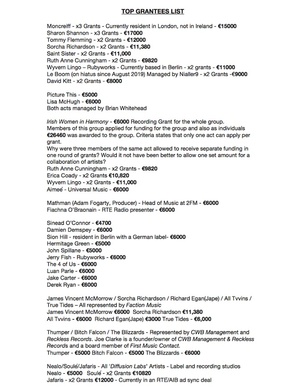
Covid-related Music Industry Stimulus Package grantees
Under the Music Industry Stimulus Package, €1.7 million was given in grants to artists whose livelihoods were ravaged by the rona.
MISP Transparency Group (MISP) writes:
We are not sure if you are aware of this story yet but we wanted to forward this information on to you. While we, and many others have created some much needed public awareness of the issues below we feel that there are still answers needed, and valid concerns that have been neglected…
‘We are speaking as and on behalf of very concerned music industry professionals. These concerns have been heightened by the results of the recent Music Industry Stimulus Package (MISP) announcements and the processes and allocation system that were set up to award these grants by: First Music Contact (FMC) , The Department of Arts & Culture and The Arts Council of Ireland.
In a follow up to the posts and threads from established and unestablished acts about the grantees this week, as well as readily available information on official websites, we have gathered together a range of points and questions about the processes involved in the allocation of public funding intended to support the development and future of the Irish music industry.
These concerns and questions must be addressed and answered by First Music Contact (FMC) The Department of Arts & Culture, The Arts Council of Ireland and Yangaroo.
With the new announcement by FMC on November 23 that ‘Picture This’ did not in fact apply for any grants, but were still announced as having received €5000, it is even more vital that these questions are answered by those who are overseeing this process.
There has been a huge breach of trust and confidence in a body that advocates for the industry both at home and abroad. Concerns around the process of choosing who gets a launch pad or push, have existed for some time but it has taken these grant funds to bring them to the forefront.
We need to have confidence that the best people are providing public services and adjudicating things independently and fairly. It is less reassuring that this is the case based on the grantees in these lists. That is a great shame at this time.
There was a large amount of public funding allocated for these particular grants, €1.7 million in total, up from the original €1million.
For us, this is about the long of it, not just the short. There must be greater transparency/accountability/inclusion and focus on grassroots levels, where the needs are greatest.
Many of us did not apply for any of these grants but we have been in discourse with both successful and unsuccessful recipients; observing from a distance as individuals with well over 20 years of experience in many different areas of the industry.
We have let similar things slide over the years, and in some cases have been belittled and made to feel that careers will be at stake should we speak up. Enough.
To be clear, the issues here are not with these artists at any level who received grants, it is with a tired system that has a huge amount of control on what music, artists and related businesses actually get heard and seen here; that has now allowed several major label and established acts to receive in an around €20,000 from three grants combined, while other less established acts did not even get one grant.
We are surprised that some of these grantees actually applied considering their success both here and internationally but this is not on them. It is on a process that created the grounds for this scenario to exist in the first place.
Allowing these bigger profile and major acts to even apply for grants of this size is stifling the industry and it’s future right now by giving boosts to those who are already household names and can sell out venues and merchandise as soon as they can play live again, and who also earn more royalties across the board than most.
We respect the work all acts have put in to get where they are and the successes they have achieved, but generally these acts are doing very well – long may they continue to do so, but not to the detriment of the rest of our industry and a majority of artists trying to breathe some much-needed fresh life into the Irish Industry. We have already seen many acts on the Irish scene calling it a day during the lockdowns, why create the grounds for more of this?
All of these points raise fundamental questions about the way our industry works here and the control that is held by particular bodies.
The main questions for First Music Contact, The Department of Arts & Culture and The Arts Council of Ireland at present are:
– What was the process of deciding who was successful and who was deemed unsuccessful – what were the criteria for these choices and how were they marked?
– 56/189 have been approved for the Album Stimulus. How were the 56 selected ahead of others?
– How was the expert panel selected?
– Were the expert panel aware of who the major label acts and employees of RTÉ are?
-Some artists awarded grants are not currently residents in Ireland. Why were they given grants when this clearly goes against the stated criteria?
– How and when was it decided that music distribution company ‘Yangaroo’ would receive €500 for each successful recipient of the Recording Stimulus? (Totaling €28,000)
– Isn’t one of the board members of First Music Contact also a manager and label owner of three of the acts that have received funding?
– Was it always intended that artists could receive funding in all of the categories, in some cases totaling over €20,000?
– Why wasn’t this cross-referenced across the three grants before announcing publicly?
– How was the band ‘Picture This’ publicly announced as receiving a €5000 Songwriting Camp grant in error? Was this a phantom application?
– Is it realistic that both the Songwriting Camp and Recording grants have to be completed and undertaken by December 23rd 2020?
– What happens if the camps are not undertaken by this date? Will the artists return the money or do they keep 50% of the fund even if they do not fulfill the criteria?
– How are the successful songwriting camps being overseen after the funding has been paid?
– Why have several of the artists from ‘Women in Harmony’ been given more than one grant in the same category? The criteria states that one artist only from each act can apply for funding. Is this not the same as each member of a band applying as individuals also?
– Why weren’t there different grants for different levels of the industry?
– Why has there been no feedback given to many unsuccessful applications?
– What has the remaining €79,774.62 from the total fund gone towards?
– Why has there been no feedback given to unsuccessful applications?
We can only assume that these acts and their teams did not realise that their names would be published – as one band also recently posted a photo of “how it started vs. how it’s going” with a photo of one of their 3Arena crowds from their 5 shows there in 2019.
This band has also recently announced new shows for summer 2021 in: Irish Independent Park in Cork, Malahide Castle and Ormeau Park in Belfast. An amazing achievement by them and their management team, but does that not feel a bit off that they can not only submit for a grant like this, but will get approved? Are they in that bad of a deal that they need €5,000 to write new songs?
This was claimed to be an admin mistake by FMC and that this act never even applied. How was this error made? How could this happen for any act, especially such a major act in the Irish Industry?
The RTÉ connections here are another red flag and need to be queried. Isn’t the role of RTÉ, and furthermore the role of 2FM to support and cultivate the next “big things” in the Irish music scene?
We wouldn’t be surprised now if we see a Late Late special with the major acts being brought in to praise the Government / Dept & FMC. It is as if the whole thing was set up for this sole political purpose as two of the expert panel are also Radio presenters at RTÉ.
The final point and issue for us to bring up is about how each act is given a €500 voucher for Irish media company Yangaroo, who also own PlayIrish Radio and are partnered with First Music Contact. This is something that hasn’t sat well with many from the start due to the close connections between First Music Contact and Yangaroo.
Yangaroo will receive €28,000 with no competition and profit directly from the awarded grants, for a job that any good PR company should be doing anyway for €2500.
As with many artists, we would much rather have the option to put as much of the €5,000 from the grant to the recording process rather than have no say at all in where €3,000 of our funding goes, especially if it is once again going to close connections.
There are always going to be overlaps in a small country and industry such as ours in Ireland, however the overlaps here and connections are too interconnected and coincidental not to raise serious questions, especially when it is down to one body in charge of managing it all.
We are calling for all grants to be reviewed on the basis of the above points and for answers to be given to all questions.
We hope that this will improve and help our industry grow and develop and get back to the standards it has been known for.’

Back before you know it.

This Christmas.
Give the gift of wearable bone, copper or even vinyl!
Amy Houlihan writes:
Galway-based brand Iasc Designs uses traditional techniques to make modern mixed-media jewellery from a variety of materials including copper, bone, recycled vinyl records and computer parts. Each piece is individually handcrafted to produce high quality, one of a kind, eye-catching accessories.
Irish-made stocking fillers to broadsheet@broadsheet.ie with bio and pics marked ‘Irish-Made Stocking Fillers’.

Kevin Higgins
Kevin writes:
A new poem inspired by people who claim to be all for equality but, if they live in the US, wouldn’t support [Bernie] Sanders; if they live in the UK wouldn’t support [Jeremy] Corbyn; and if they live in Ireland would never vote Sinn Féin.
Our Posh Liberal Friends
(for Susan)
Whenever I show them the Future,
they refuse it;
say: this future has bad hair,
waves its arms around too much,
is too Jewish,
or not Jewish enough,
too not-a-woman,
or the wrong sort of woman.
This Future has a face that one day
might raise the corporate tax rate
by zero point five percent,
and is a little too insistent
that poor people be allowed live,
give or take, as long as the rest of us.
That sort of thing scares the people we dine with
nights we’re not dining with you.
I ask the barman for more finger food,
picture the ocean raging into the restaurant,
and them still sat there muttering at the chicken goujons:
the people we talk to won’t vote for
such extreme solutions. No one wants to live in Cuba,
one of them says, as she’s washed out the door.
I pray, when all the futures
they’ve turned their noses up at
are safely in the mud
and the men in boots and leather come
to escort us all to the Processing Centre
in the back of a truck
that I be shot, cleanly through the skull, at the front gate,
so I don’t suffer their groans
about the quality of the gruel,
and how that last beating one of them got
was clearly in breach of the Human Rights Act
and worthy of a curtly worded,
but still civil, letter to The Observer.

There’ve been a few (but none quite like the outgoing one).
Behold: a spectacular display of mammatus (breast-like) clouds over Mount Rushmore last September. To wit:
Unlike normal flat-bottomed clouds which form when moist and calm air plateaus rise and cool, bumpy mammatus clouds form as icy and turbulent air pockets sink and heat up. Such turbulent air is frequently accompanied by a thunderstorm. Each mammatus lobe spans about one kilometre. The greater mountain is known to native Lakota Sioux as Six Grandfathers, deities responsible for the directions north, south, east, west, up, and down.
(Image: Laure Mattuzzi)
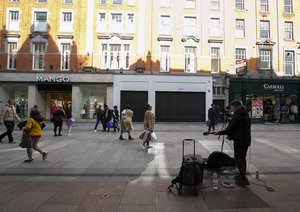
Dublin City Council has banned buskers from performing on the streets this December
As the council erects Christmas lights
The buskers are read their last rites
Covid’s still raging and
This means singing is banned
So we’re all in for long silent nights.
Meanwhile…
The Corpo have banned busking in Dublin city centre so the big all-star annual fundraiser for @Dublin_Simon on Grafton St is looking very unlikely this year – fortunately #YHRF are having an online hootenanny! €10 tix to help the homeless this Saturday💚 #Dublin pic.twitter.com/UmHv4OsefH
— Cáit O'Riordan (@rockyoriordan) December 8, 2020
