Tag Archives: coronavirus

This morning.

Ireland is among the most obedient countries in the world when it comes to muzzling up, according to research by financial comparison website Finder.com.

Singapore (76%), New Zealand (71%) and Australia (58%), had the lowest face mask ownership rates while the United Kingdom ranked number one (97%), followed by South Africa (90%), the Philippines (87%) and Mexico (85%).

Ireland ranked 5th for face mask adoption.

…Susannah Binsted writes:

The global study included a poll of 1,211 Irish adults, revealing 84% – the equivalent of 3,078,085 adults – own a specified face mask.

Cloth face masks are the most popular mask type in Ireland, with 42% of the adult population possessing one, followed by blue surgical masks (32%), homemade masks (11%) and medical grade masks (11%)….

Well done, everyone.

FIGHT!

Face masks and coronavirus in Ireland (Finder)

Rollingnews

Meanwhile…

Hmm.

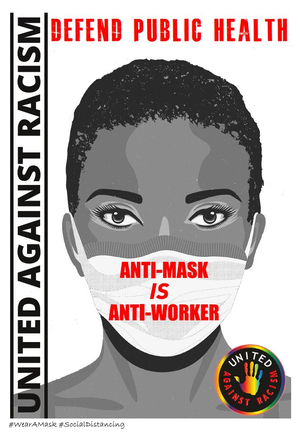
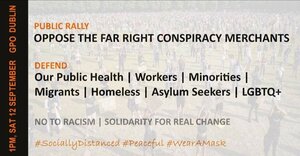
Via United Against Racism

Dublin Airport last month

Yesterday.

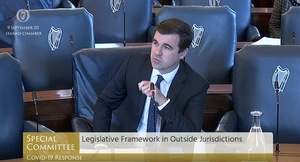
At the Special Committee on Covid-19 Response, Rise TD Paul Murphy was asking questions about the issue that beset the Government  prior to the summer recess about social welfare officers and gardai holding checkpoints at airports.

It’s since emerged that, between April 1 and June 13, the Department of Employment and Social Protection held checkpoints concerning 30 flights at Dublin Airport and that 70% of these were flights to either Romania or Moldova.

This information was obtained under FOI legislation by legal executive Roman Shortall whose children’s Child Benefit was cut after he was approached by officers at Dublin Airport while he, his wife and children were preparing to board a plane to Romania on June 13.

Yesterday, Mr Murphy told the committee that he wanted to focus on the data protection aspect of the checkpoints and the cutting of people’s State benefits, Covid-19 PUP payment or otherwise.

He then had this exchange with Free Legal Advice Centre (FLAC) legal officer Christopher Bowes:

Paul Murphy: “There’s at least anecdotal evidence to suggest that the department had access to the registers of the ferry companies and airlines companies which would prima facie, anyway, would be a breach of the Data Protection.

“And in kind of investigating this, I’ve been informed of previous cases where people have had Child Benefit cut from them for being out of the state and it seems there is no basis in which the department could have known, no inspections, etc, except from having information either from airline companies, ferry companies or from immigration at Dublin Airport.

“So my question is, is this an issue that you’ve come across before in relation to other payments, where the department has access to information that certainly seemed it shouldn’t have?”

Christopher Bowes: “Yeah. I mean we haven’t actually had, prior to the issues around the Covid PUP. We haven’t, FLAC hasn’t come across any cases in terms of, which have raised concerns about what information the department has access to. But we certainly, going back as far as 2016, have had cases where we’ve raised concerns in relation to the actions of the Department at airports and ports in terms of those actions potentially exceeding the legal limits created by the 2005 Act.

“And in terms of the kind of the data protection concerns you’re talking about. I mean FLAC welcomes the fact that the office of the Data Protection Commissioner has launched an investigation into those actions and I think only through engagement with the department on that issue, engagement between the department and the DPC I think, is the only way to get clarity on the issue and to get some finality in terms of what has been going on in terms of these airport checks.”

Murphy: “And when you’re talking about previous instances where the inspectors were potentially operating outside the law, i.e. without a reasonable cause. Are you aware of the kind of profiling of particular flights to particular destinations in those previous cases?”

Bowes: “In each of those previous cases, they would have been flights to Romania and FLAC runs a Roma legal clinic and so we provide legal representation services to members of the Roma community and we would come across those issues. So in each case, it certainly would have been flights to Romania.”

Murphy: “Thanks a lot.”

Meanwhile, last night, Mr Shortall published on Twitter responses that Social Democrat TD Catherine Murphy received from the Minister for Employment and Social Protection Heather Humphreys about these checkpoints.

In her reply, Ms Humhreys confirmed that the last DEASP checkpoint held at Dublin Airport was on July 16, while the last inspection at ports was on July 28. She also stated that no criminal prosecutions have been initiated by the DEASP directly arising from the checks at the airport.

Ms Humphreys did not respond to Ms Murphy’s question concerning the authorisation of these checkpoints. Specifically, Ms Murphy asked if Ms Humphreys or her predecessor Regina Doherty had a role in authorising the checkpoints.

Previously: Reasonable Question

Rollingnews

Dr Mike Ryan, Executive Director of the World Health Organization’s Emergencies Programme

Speaking on RTÉ’s Today with Claire Byrne, Dr Ryan said that although younger people may suffer a less severe version of the disease, it is not guaranteed that this will be the case and that there is always the risk of passing it to older populations.

If the disease is passed onto older generations again, he said, the hospitals will refill and “this is not something we want to see”.

Dr Ryan said it is not known yet about what kind of protection people will have if they contract the disease.

Anyone?

Ongoing shift of virus to younger adults – WHO expert Ryan (RTÉ)

Meanwhile…

Back in April.

Dr Ryan (@1.15) suggests entering homes and removing suspected Covid-19 patients.

Good times.

Meanwhile…

Oh.

Dr David Kenny (above) assistant professor at the Covid-19 law and human rights observatory of Trinity College Dublin

Yesterday.

At the Special Covid-19 committee, a number of legal experts went before the committee to answer questions about the rule of law during Ireland’s response to Covid-19.

The experts included Maura McNally SC, chair of the Bar Council of Ireland; Ken Murphy, director general of the Law Society; and Dr David Kenny assistant professor at the Covid-19 law and human rights observatory of Trinity College Dublin.

Dr David Kenny: said

“…there are several core rule of law concerns in respect of the pandemic regulations… One significant problem is the failure to promulgate or publish regulations in a timely manner. Ideally, this should be done before they come into effect, to allow scrutiny, comment and explanation.

We would recommend a statutory requirement, similar to the one found in New Zealand, that regulations be published 48 hours in advance of their coming into effect unless there are public health reasons that make this requirement unworkable.

Another major issue is the failure to properly communicate the content of regulations. This is most problematic in the repeated elision, in State communications, of legal requirements and public health advice.

For example, it was unclear to those “cocooning” in the most severe period of movement restrictions if they were legally required to remain in their homes; they were not.

It has been heavily implied in several instances and fora that the requirement to isolate for 14 days after travel is a legal obligation. It is not and never has been.

It might be thought in some quarters that this is a useful strategy for ensuring compliance with public health advice because people will be more likely to comply if they think they are legally obliged to do so.

“Such a strategy raises serious rule-of-law concerns and has real costs. It confuses members of the public, erodes public trust in communication about the law and is an abuse of State power, implying a legal threat that simply does not exist.

We believe this could have long term consequences in terms of public confidence in, and compliance with, legal obligations and public health advice in respect of the pandemic.”

The Law Society’s Ken Murphy said:

“It is thematic in the Law Society’s submission that the issue of being able to identify what is law and what is guidance and the difference between the two and the potential for sanctions for breach of the law is essential.

“There is confusion in this regard. I wish to clear up some confusion, if there is any, regarding a headline in The Irish Times this morning which seemed to suggest that it was a Law Society suggestion that the confusion between the two had been deliberate by the State. The Law Society is not suggesting that; it is not part of our submission.

“However, we think that just as the law always strives for certainty, inevitably in circumstances where there was an enormous need for speed of response, which the State rose to admirably during those crisis weeks and months, there was some absence of certainty in the capacity of the public to be able to distinguish what was law and what was guidance.

We are not suggesting there was a deliberate confusion of the two by the State or any organ of the State, but we believe, and this is thematic of the society’s submission, that for the future there should be greater clarity.

“We say in the submission there is a need for clearer communication as to what restrictions are being imposed, the reasons for them, whether they are intended to have legal effect and the sanctions for breaching them if they are legally binding. A consequence of an absence of that is confusion and, potentially, resentment due to that lack of clarity.“

Mr Murphy added:

“Part of the Law Society of Ireland’s submission has under a heading a discussion on house parties, which is something else the Deputy referred to. The proposal to empower gardaí to enter private dwellings with a view to enforcement of Covid-19 regulations is of some concern to the society, as we have said in our submission.

“Criminal statutes that provide for powers of entry by gardaí into private dwellings generally have safeguards that require certain preconditions to be met.

The Oireachtas has generally provided that powers of entry into private dwellings are reserved for the investigation of serious offences, for example, an arrestable offence, whereby the penalty for such an offence is a penalty of five years imprisonment or more.

Again, without expressing any definitive view on it I conclude with a sentence from our submission which states that the society cautions against introducing powers which are normally reserved for the investigation of serious criminal offences for the purpose of enforcing what are, in effect, health regulations.”

Mr Murphy added:

“Clearly, the Constitution provides protection for the dwelling houses or homes of citizens.

“The circumstances in which that can be violated are highly restricted. Again, it becomes a question for argument as to whether the power being introduced and the circumstances for which it is being introduced amount to a necessary and proportionate response.

I simply pointed to something that was in the submission of the Law Society of Ireland, which all Deputies received. It was no more than an expression of concern, not a definitive expression one way or another that we are for or against it. We are simply saying there are legal concerns about this.”

David Kenny added:

“The key thing about proportionality is that context is key. If a severe public health need could be shown, something might be proportionate while it might not be if that evidence cannot be presented. That is why it is difficult to speak in general terms about this. It really depends on the evidence that can be presented for such an extraordinary power to be necessary.

“What we can say is that there is certainly a credible constitutional objection to such a power of entry, not that it is certainly or definitely unconstitutional. It is for these Houses in debate to work out whether they believe that the evidence and threat is sufficient if that comes forward as a proposal.

“We have been saying repeatedly that there is a need for oversight of regulations. Perhaps it is essential that the primary legislation allows for some broad regulations which may even include making a civil offence relating to the establishment of dwellings.

However, we would need primary legislation to create a search power and then there would be Oireachtas oversight. We need Oireachtas oversight of these regulations as well because they are significant. Some of the most significant rule-making in this pandemic has been done by regulation. It is important that this oversight is in place.”

Yesterday: Sumption Happening Here

This morning.

The Seanad.

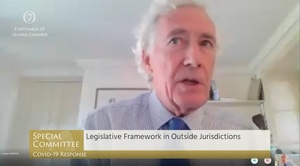
At the Special Committee Covid-19 Response, Labour TD Duncan Smith (top) had the following exchange with lockdown critic and retired UK Supreme Court judge Lord Jonathon Sumption (above).

Duncan Smith: “Lord Sumption, you’re on record as having admitted to not obeying Covid regulations when they began to reach a “level of absurdity” in your words. So, what was your threshold for what became an absurd regulation to which that you would no longer comply?”

Lord Sumption: “What I was referring to was the fact that the lockdown, the lockdown had originally been justified on the grounds that it was necessary in order to enable the intensive care capacity of the National Health Service (NHS) to catch up. And, although I disagreed with that, I thought that at least that was a serious justification which was a perfectly defensible position.

“The position was reached by the end of April, early May, when the NHS confirmed the intensive care capacity had caught up. And nonetheless, the Government, at a very critical moment decided that it would continue with the regulations. Although, on the Government’s own epidemiological, it seems very difficult to identify any legitimate purpose to it.

“It seems to me that there comes a point when the moral force of the law disappears and at that point had been reached by then. Of course, anybody who decides not to comply with the law has got to be prepared to take the consequences. But you cannot have… the reality is that coercion only works if a sufficient number of people accept the moral force of what the (UK) government is doing. And we have reached the stage in the United Kingdom where the level of acceptance, what the government is doing, is at a fairly low level.”

Smith: “Do you have a concern…but do you have a concern that when people of power or influence or privilege, of however you want to put it, decide at a certain point in their own heads that they’re not going to obey lockdown laws or regulations, that the impact that that’s going to have? And, in particular, are you concerned that whatever valid questions there are, and there are a lot in relation to the legislative framework on which the response to Covid-19 is based, that they can be subverted by elements in society that are not, have no interest in democracy, the far-right elements, conspiratorial elements, anti-health elements?

“Do you have any concern that actions such as yours and actions of others are lost and are then corrupted by those forces?”

Sumption: “Of course I do. However, I think that one has to remember that sometimes you make a decision for perfectly responsible and morally defensible grounds which other people, who are a lot less careful about [inaudible], will take advantage of. I don’t think that it is a sufficient reason for keeping silent about what I personally and what other people regard as a moral constitutional outrage.

“Sometimes you have to put up with the fact that a lot of unpleasant people might agree with you in the interests of truth and [inaudible].”

Smith: “You know, that’s your opinion in terms of being a holder of the truth there. I would disagree because we’re talking about a lockdown as something that is to be feared. And no one wants to go into lockdown. But I remember lockdown, a lot of people remember lockdown here. And it was a perfectly understandable response to a crisis that was scaring the life out of people all over the world. And a lot of people felt safe during that lockdown and it did serve to reduce the numbers.

“Now, we can’t live in lockdown forever and the challenge now for Ireland and the UK and everywhere else is to get back to some form of normality across all levels whilst living with this virus. So do you think that discussing lockdown in those fearful terms and talking about, you know, democracy being threatened and the rise of despots, do you think that’s a proportional narrative to the reality of what’s going on politically in our region or throughout the world?”

Sumption: “Yes I do. I think that the way in which we govern ourselves is a great deal more important than the way in which we react to any particular crisis because that will live with us forever whereas the way in which we respond to particular crises may be mistaken, may be misguided and the consequences will not live with us forever.

“I don’t accept your starting premise that the lockdown saves significant numbers of lives. I think that, in the long term, it will be found to have saved very few lives because [inaudible] infection rates simply rebounced afterwards. I also think that in areas like dementia, mental health and delayed diagnosis of treatments of cancer, that deaths occasioned by the lockdown may, in the end, not fall far short of the deaths occasioned by the disease.

“So my answer to your question is, in part, that I think that history will look back on this as a monument of collective hysteria and governmental folly.

“Now that’s a view that many people would reject. I take it that you would reject it. But it is a view that others hold and that I hold.”

Smith: “It is a view that I would reject. But thank you for your contribution this morning.”

Previously: Lord of Misrule

Paul Murphy TD


Hardcore.

Last night: For The Many

Taoiseach Micheál Martin (second left), Tánaiste and Minister for Enterprise, Trade and Employment Leo Varadkar (second left),Minister for Health Stephen Donnelly (left) and Acting Chief Medical Officer Dr.Ronan Glynn at a Post Cabinet Press Briefing in Dublin Castle, Dublin 2. last month

This morning.

The Government “deliberately obfuscated the line” between Covid-19 guidelines and legal requirements to maximise compliance, an Oireachtas committee will be told today.

Via The Irish Times:

The Law Society, the representative association for solicitors, will say there is a need for clearer communications on restrictions.

It will say “confusion and resentment arose due to the lack of clarity as to what the rules were, whether they were legally binding or merely guidance, how they applied in different situations, and whether they were consistently enforced”.

…The Irish Council for Civil Liberties will say many regulations were not published in advance of coming into force, and were difficult to find even after being signed by a Minister.

“We consider that at times the Government deliberately obfuscated the line between what was a legal requirement and what was a guideline in order to ensure the widest compliance with the guidelines. [We consider] this approach to be unacceptable.”

Covid-19: Government ‘deliberately blurred’ line between coronavirus law and advice (Jack Horgan Jones, Irish Times)

Rollingnews


This afternoon.

Dáil, Leinster House, Dublin 2.

Sinn Féin TD Matt Carthy (top) criticises seating arrangements in the Dáil chamber as a return to the Convention Centre is rumoured.

Meanwhile, People Before Profit TD Richard Boyd Barrett  (above) called out the €25,000-a-day Convention Centre cost, saying:

“We are spending about 50 times more on insuring adherence to public health guidelines per TD than we are spending per pupil in school.”

Earlier: Underlying


Simon Harris, Minister for Further and Higher Education, Research, Innovation and Science, at government buildings this afternoon.

This afternoon.

Earlier…

Pre-rona boozing in Dublin city

Via RTÉ:

It is understood that the Cabinet has agreed that pubs that do not serve food will be able to reopen from 21 September.

This will be subject to local restrictions that may arise from time to time.

Draft Government guidelines, which were drawn up in conjunction with Fáilte Ireland, were circulated to vintners’ groups last weekend.

They are broadly the same as those that have been brought in for pubs where food is being served.

Hic.

Reopening of all pubs set for 21 September (RTÉ)

Earlier: A Limerick A Day

Rollingnews

Meanwhile…


This afternoon.

Outside Leinster House, Dublin 2.

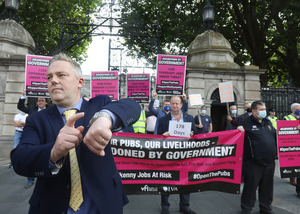
TJ McInerney, of T.J Mac’s pub in Mullinahone, County Tipperary breaks down as he joins other publicans in calling for the re-opening of so-called ‘wet pubs’.

Rollingnews

Report from the The Health Protection Surveillance Centre to NPHET on COVID-19 cases and deaths in Ireland

Gavin T writes:

The most recent HSE Covid-19 report might put things into perspective.

It reveals the median age of all deaths was 84 and of the 1,777  deaths, 1,677 had underlying conditions…

So, the number of deaths with no underlying conditions in Ireland was…100 people…

Um.

Epidemology of COVID-19 Cases in ireland (HPSC)