
This morning.
In the Dáil.
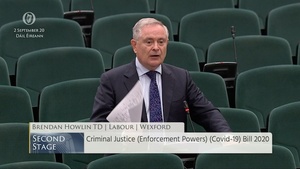
Labour TD and the party’s spokesman on justice Brendan Howlin (top) put forward several amendments to the Criminal Justice (Enforcement Powers) (Covid-19) Bill 2020.
The first amendment called for the deletion of the words underlined in red (above).
He explained:
My amendment seeks to delete that final half-sentence which is line 14, namely, “whether in relation to a relevant provision or otherwise”. The interpretation section, under section 1 of the Bill, defines a “direction” given by a member of An Garda Síochána as “a direction given under section 31A(7) of the Act of 1947 in relation to a relevant provision”.
Therefore, under the direction section of this Bill, a member of An Garda Síochána can legitimately enter a premises for the purposes of giving direction in regard to a relevant provision of this Bill. Section 3(1)(a) expands that so they can enter the premises for the purposes of giving a direction not only under the provisions of this legislation, but also “or otherwise”, whatever “or otherwise” might mean.
…. We need to clarify that what we are giving here is the power for members of An Garda Síochána, without warrant, to enter premises to do inspections.
…We need to ensure that the provisions we are providing for in this legislation are met, and where they are not met, there is the capacity to give a direction to the proprietor of such a premises to comply with the legislation.
It is often the case the drafters slot in words like “or otherwise”, giving a much broader scope than this House would intend to legislation.’
A Dail vote on implementing the amendment subsequently failed.
Meanwhile,

Minister for Justice Helen McEntee
During a debate on the bill last night, Mr Howlin said:
“I listened carefully to the Minister, Deputy [Helen] McEntee, at the beginning of this debate but we do not actually know what specifically is to be criminalised either now or into the future.
…At the briefing on Friday, I asked the Minister for Justice and Equality’s officials what specifically the offences are and where are the regulations are. These crafters of the legislation before us told me they did not know.
“I have never dealt with a situation where the crafters of the legislation did not know what the crimes being specifically legislated against were.
They said that it was a matter for the Minister for Health and that it would be published on Monday. In fact, the Minister for Health signed 14 pages of regulations yesterday. The difficulty with the regulations is that some of them are what are known as “penal” and some are not penal. What is the difference?
“In essence, non-penal regulations are entirely advisory and nobody can enforce them. The penal regulations are enforceable. There is a strong view in jurisprudence that a law that is not enforceable is not a law at all. Regulations that do not carry a penal sanction are not regulations.”
Meanwhile…Continue reading →














 </a
</a