Tag Archives: coronavirus

From left: Dr Colm Henry, Chief Clinical Officer, HSE; Dr Tony Holohan, Chief Medical Officer, Department of Health; and Dr Ronan Glynn, Deputy Chief Medical Officer, Department of Health at a Covid press briefing last night

This morning.

Via RTÉ

All indications point to the Cabinet giving the green light to begin the reopening of around 1,500 businesses on Monday.

These include homeware stores, garden centres, farmers’ markets, bicycle shops and motor garages, electrical and IT stores, as well as opticians.

Construction workers and gardeners are also set to be able to return to work on Monday.

As part of Phase One, people are advised to continue to stay at home as much as possible but can travel up to 5km from their home to exercise.

Outdoor spaces and tourism sites, along with golf clubs and tennis courts, can re-open as long as social distancing is in place.

Up to four people who do not live in the same household will be allowed to meet up outdoors, as long as they maintain a two-metre distance.

Cabinet set to approve easing of restrictions (RTÉ)

Rollingnews

This morning/afternoon.

Dail, Leinster House.

Taoiseach Leo Varadkar said

“As an Oireachtas and as a nation our thoughts are with the families and loved ones of those who have lost their lives to COVID-19.

As of last night, 1,497 people have died in our State and 449 more in Northern Ireland. Our thoughts are also with all those who are working to fight the virus every day, as well as all those fighting with the virus.

In total 23,400 people in the Republic of Ireland have been diagnosed with Covid-19. 17% or 19,470 have made a full recovery.

Thanks to the majority of people across our country following the guidelines we have slowed the spread of the virus. It has not been easy and it has had an impact on all of us in many different ways.

Some have lost loved ones, others have missed out on the events which strengthen the ties of family and friendship, such as weddings, birthdays, or the birth of a new arrival.

Many have lost their jobs or fear losing them. Others wonder if their businesses will ever re-open.

This has been a test of our solidarity and resilience, and it is one we are passing as a nation every day. We are seeing what we can achieve when we put the needs of the many above the needs of the few.

COVID has had a devastating economic impact. Our mission is to get people back to work, get businesses open again, and get the economy humming so that we have the resources we need to build a better society. A great society worthy of the great people we have proven ourselves to be.

The first steps to reawaken our economy will be done in a slow and gradual way. At all times we will maintain an intense focus on the virus and follow four guiding principles – isolate; test; trace and treat – so that we can quickly react if things go wrong and there is an increase in cases.

As we are seeing around the world this is not a straight path. Sometimes progress is halted and there are set backs and we have seen examples of this in Germany, South Korea and most recently again in Wuhan. The crucial thing is to keep doing the right things, to stick to the strategy, and to maintain our focus.

To expect and look for new clusters and flare ups.

This virus is a ‘fire in retreat’.

We must quench its every spark.

And stamp out every ember.

Whilst every new case and death is a cause for serious concern, over the last 7 days we have seen the lowest daily number of cases and deaths since March.

As a result, we are increasingly confident that we will be able to move to phase one on Monday. NPHET is meeting today to conduct its assessment and Cabinet will make its decision tomorrow after we receive its advice.

It is worth remembering that we are still in Phase Zero. All things going to plan, Phase One will begin on Monday, if and only if it is safe to do so. The moment we assume that our progress through the phases is inevitable we will risk regressing.

I acknowledge that as we open more workplaces, we will see more workplace clusters and we need to be vigilant about that. The ‘Return to Work Safety Protocol’ has put measures in place that will prevent the spread of COVID-19 in the workplace. It is a living and evolving document that ensures we protect those at work as well as customers and clients.

The Health and Safety Authority will help business to achieve compliance in a co-operative manner, but will close workplaces if necessary. I want to extend my thanks to the unions and the employers bodies for working with us to develop the protocol and for playing their part in this time of national crisis.

We may in the coming weeks, as Germany has, see an increase in the R number as we ease the restrictions.

So, after May 18th, we need to be more disciplined and act more responsibly than ever before when it comes to vital public health actions – no handshakes, keeping a physical distance of 2m where possible, washing our hands regularly, sneezing or coughing into a tissue or our elbow, staying at home and self-isolating if we become sick.

Face coverings, visors, sneeze guards, while they have a role, are no substitute for any of this. I have every confidence in the Irish people to embrace this new normal.

As we know, extensive travel restrictions are in place. We are requiring that all people arriving in our ports and airports must complete a Public Health Passenger Locator Form and self-isolate for 14 days.

There are exceptions like supply chain workers or those people stopping over in one of our airports before travelling onwards. Or, of course, people on their way to and from Northern Ireland. We’re examining ways of strengthening these actions in the next few days.

However we must also remember that we have a land border with Northern Ireland that we want to stay open, a Common Travel Area with the UK which we want to preserve, and our right as European citizens to travel, study and work anywhere in the European Union which we want to uphold.

While these rights may be restricted for a time due to the pandemic and public health emergency, it is our policy to resume normal travel for business, leisure, study and visits to friends and relatives as soon as it is safe to do so, but not before. This is something the European Commission is currently working on.

However, it’s going to be months not weeks before this is possible.

Testing is ramping up and over a quarter of a million tests have now been carried out. 44,000 tests have been carried out since we last met in this format. We understand that we are the first country, after than San Marino, to test all nursing home staff and residents. This is now being recognised as best practice and other countries are following suit.

Testing is now underway in care homes for people with disabilities and also mental health facilities.

It is now an emerging fact, sadly, that across the developed world, a very high percentage of deaths with COVID have involved residents of care homes, with a very high percentage also in countries where total numbers are low like Norway, Canada and New Zealand.

As the numbers come in, those percentages continue to rise, including in Ireland. While it is an easy analysis to blame nursing homes affected or the HSE, or HIQA or the Department of Health, it might yet prove not to be fair or factual to do so. It doesn’t seem that any country has been wholly successful in keeping COVID out of its care homes.

We are not alone in experiencing this tragedy. That however is no comfort. No matter what their age, every life shortened is a life lost. Families grieve and many have been unable to say goodbye in person or have a proper funeral.

While measles and meningitis targets the young, coronavirus targets older people, the frail and those with pre-existing conditions.

It has been suggested by some that the best way to protect our care homes is to lock them down, residents and staff for months on end and ensure they have no contact with the outside world. I am not sure this is the model of care we want for our seniors in the long-run.

We need to consider alternatives. For example, more and better homecare. This Government was able to afford to increase the homecare budget by 40%. It’s unlikely the next Government will have such resources. So we’ll need a new funding model and place it on a statutory footing.

The outgoing Government did some excellent work developing alternatives like supported housing and housing with care, and the new Government can and should build on and operationalise this work.

We need to consider a move away from large modern newly built 150-200 single room nursing homes towards smaller units like we have done in the disability sector. And also re-examine clinical governance.

We must integrate nursing homes better with the health service, enable therapists and geriatricians and infection control nurses to reach in, avoid hospital as much as possible, and ensure there is a medical director as well as a ‘person in charge’.

I don’t have all the answers. But I am thinking about them every day and I know other deputies are as well.

There are lots of examples of good practice already. We need to identify them and mainstream them. This will be a major challenge for the next Government. It should be approached in an open-minded, non-judgemental, evidence-based way that respects the dignity and agency of older people.

This emergency has hit our country very hard. As we reopen our country and rebuild our economy we have the opportunity to reshape our society in ways that will benefit our citizens for generations to come.

We should seize those opportunities. Greater homeworking; online education; e-health and telehealth; reduced unnecessary domestic and air travel; lower greenhouse emissions and cleaner air.”

FIGHT!

Meanwhile….

Paul Reid, HSE CEO this morning

This morning.

O’Brien Centre for Science, UCD, Dublin 4.

Via Irish Times:

“We need to improve where we’ve been at,” he {Paul Reid, CEO HSE][ said, while defending progress made to date. “We have faced very significant backlogs which resulted in a very poor experience for many people,” he said, adding the HSE had been “rightly judged and held to account”.

…His comments come amid scrutiny of the State’s contact tracing and testing process, seen as a key element of relaxing restrictions on movement and other measures over the summer.

Experts have said current timelines are too slow relative to where they should be to help ensure the disease is kept under control as lockdown measures are relaxed.,,,

Coronavirus: HSE says new three-day target for testing and tracing to be introduced (Irish Times)

Meanwhile…

That’ll learn him.

Rollingnews

EURO MOMO detects and measure ‘excess deaths related to seasonal influenza, pandemics and other public health threats’

Anon writes:

Could you ask one of your mathematics competent regulars to look at this?

I was looking at the EURO MOMO site this morning and checked the Irish situation.

EURO MOMO uses the Z-scale to monitor excess mortality throughout Europe. Z numbers are a statistical method based on the expected mortality rate for each week of the year.

A Z score of 2 for the country ( which equals 2 x the Standard Deviation of the base line ) is considered to start moving above the expected.

I was shocked to see that Ireland has not had, and has never has had, a problem with covid-19. In fact the Z score for week 19 in Ireland is negative, which means Ireland had less deaths than expected for that week.

Ireland’s peak weekly total at 492 in week 17 has a Z-score of -1.76. Definitely not a problem.

Look at “Map of z-scores by country” and use the timeline slider to look at week 15 onwards and then at “Z-scores by country” to see the Z numbers graph.

Compare with England, Belgium, Italy, France and Spain….

Anyone?

EURO MOMO

Z scores?

From top: Phoenix Park, Dublin last Saturday; Neil Curran

A month ago, a post went up on Broadsheet headlined ‘Dash It’, which highlighted a sign erected in Irishtown, Dublin 4, presumably by locals, requesting no joggers on a street due to the narrow pathway.

Some commenters threw ire at joggers, while others scratched their heads at the anger and some just got a chuckle from it.

Regardless of whether the sign did anything to deter joggers from doing their thing, the post does mark a moment in our Covid-19 journey where society risks turning on itself.

It’s now May and with the Government’s roadmap to lifting restrictions published, the reality of another three months of restrictions is sinking in and there are elements of society looking to vent frustration and anger somewhere.

Certain work groups, such as the publicans, are making noise about the desire to open earlier in line with restaurants and cafes. Until now, public talk of ridiculing the lockdown restrictions was taboo, something quickly shut down and certainly not entertained by the mainstream media.

We were all in this together by staying apart, as the campaign goes. However, as plans to lift restrictions, it is apparent that we may not be in this as together as we think, as we all have different paths out depending on our profession, employer, family status or age.

More and more, people are expressing frustration, pushing the limits of restrictions as the Government notes an increase in motor traffic and anecdotal evidence of more people outdoors going about their walks and exercise without giving much consideration to social distancing.

And to be fair, society’s frustration is understandable. We are social creatures, most of us haven’t seen friends and family in too long and online interactions will never make up for it. Many people are concerned about their livelihoods and are eager to get back to work.

Some are facing the prospect of having to rethink their careers as certain industries have a high degree of uncertainty as to how they can operate profitably in the new social distanced world.

As society’s frustration grows, that frustration will be directed somewhere and the risk of a potential segregation of society is growing.

From the Government’s perspective, the Department of Health’s Chief Medical Officer Dr Tony Holohan recently singled out “younger people in the community” when speaking out about the community infection numbers not falling at the desired rate.

Perhaps the evidence does highlight that “younger people” are part of the community infection chain, but what does that mean when generalised statements are used. What age brackets are “younger people” in? Is it nationwide?

From other parts of society, as more and more people speak out about restrictions, there are  suggestions that we should look at continuing to cocoon the elderly and the most vulnerable in society while everyone else gets back to work and gets on with it.

The mention of this one month ago would have evoked the wrath of the heavens, but now it’s becoming more and more acceptable to air these views. While there is no issue in that, the greater concern is the potential slur on society as a result.

Parents with young families, single working parents and families with special needs children are also facing a dilemma. We know that creches and schools are closed over the summer and as businesses return to work, the honeymoon period of working from home will end and parents will have to juggle their job and home-schooling/childcare at the same time, while those with no children or older children have less of a burden.

The option of Granny and Grandad isn’t there due to cocooning, leaving parents in a difficult position. I know of two working parents who encountered issues recently due to this challenge. One lost a client contract with comments made about children in the background during an online meeting and another faced a frosty reception during an online interview. Has being childless suddenly become a huge plus on your CV?

Love it or loathe it, the path to a lifting of restrictions has been mapped out and the next few months are going to bring new challenges for our society as we rebuild our routines and livelihood. There will be anger, frustration and sadness along the way.

We are looking to the Government’s plan as a route out of this but must remember it’s a two-way street; if the virus takes hold again, we take a step back. No one wants that. We may see further anger and frustration directed at parts of our society, including the vulnerable as a result.

The mental health of the nation is strained way beyond anything we have seen in a very long time. More than ever, we need to practice empathy at a time like this.

So, if you are the neighbour, the manager, the co-worker or just stuck in line outside the supermarket in the rain, remember we still need to be kind to one another and recognise that we are all struggling in different ways.

Neil Curran is part of the Broadsheet on the Telly team, an Improviser and in his own words, an unqualified commentator. You can follow him on Twitter here or on Instagram here.

This afternoon.

D’olier Street, Dublin 2.

Taoiseach Leo Varadkar visits the ‘Contact Tracing Centre’ where he received a briefing on the redeployment of welfare staff and the ‘importance of the work being done in the area of contact tracing’.

Hmm.

Meanwhile…

This afternoon.

Taoseach leo Varadkar with Minister for Health Simon Harris following his contact tracing HQ visit.

Leon Farrell/Photocall Ireland

Garda Commissioner Drew Harris inspecting new’ Gardaí at the Garda Training College, Templemore, County Tipperary last month

The changes mean recruits will undertake most of their education from their homes on an e-learning platform before gaining practical experience in frontline policing.

It will also mean students will deploy to stations with little or no practical training. However, these students will not typically deploy on the streets and will not be able to perform arrests…

Coronavirus: Garda recruits to be deployed after just one week in Templemore (Irish Times)

Rollingnews

When

And when this ends we will emerge, shyly
and then all at once, dazed, longhaired as we embrace
loved ones the shadow spared, and weep for those
it gathered in its shroud. A kind of rapture, this longed-for
laying on of hands, high cries as we nuzzle, leaning in
to kiss, and whisper that now things will be different,
although a time will come when we’ll forget
the curve’s approaching wave, the hiss and sigh
of ventilators, the crowded, makeshift morgues;
a time when we may even miss the old-world
arm’s-length courtesy, small kindnesses left on doorsteps,
the drifting, idle days, and nights when we flung open
all the windows to arias in the darkness, our voices
reaching out, holding each other till this passes.

John O’Donnell

Videographer Colm McElwee writes:

This poem by barrister, poet and author John O’Donnell featured in The Irish Times on April. I think it captures a lot of the contradictory, painful and hopeful feelings people are having through the lock down.

I thought the poem might go well with some music so I put something together (above) for it. John has kindly given me permission to share….

Carlow Digital

Last night/this morning

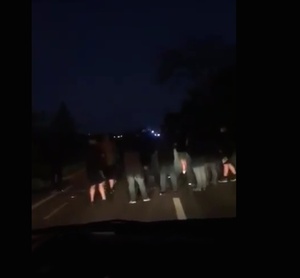
A blockade of Headford Road, County Galway in protest over Garda checkpoints (top).

Anon writes:

Just after 9am this morning Keith Finnegan spoke to local councillor James Charity (above) who was sent a video (top) after 10pm last night. The busy Galway route network N84 to Mayo approximately three miles from the city is home to a number of members of travellers living in camps on the site. Due to covid 19 restrictions Gardaí have been manning checkpoints from Friday on a 24 hour basis.

Last evening some members of the community – 30 males staged a protest. Am Ambulance was one of the first vehicles to be stopped at 10.15 pm and the confrontation lasted for 45 minutes . Councillor James Charity placed footage on his FB page and attended the incident. He spoke frankly to Keith Finnegan this morning. A statement from chief super of division was read also.

Concern over blockade at Carrowbrowne in protest over COVID 19 checkpoints (Galway Bay FM)

Councillor James Charity (Facebook)