Tag Archives: coronavirus

</a

From top: Taoiseach Leo Varadkar (right) and Health Minister Simon Harris; Naima

This morning.

As groups working with asylum seekers and refugees continue their appeal for the Government to move people most at risk from Covid-19 out of crowded direct provision centres…

Naima, who lives in a centre which has more than 200 residents, has written an open letter:

Dear Sir/Madam,

“The routine is the same every morning. I wake up, grab my phone and text the lady a few rooms up the corridor to check that she’s okay. On Tuesday, last week, she started to display flu-like symptoms. Her GP referred her for a Covid-19 test, which she still hasn’t had, and she was told to self-isolate.

There are 234 people living in our Direct Provision centre, there is no space for more self-isolation rooms. We are scared, we are anxious – what happens when more start to get sick? Where are we supposed to go?

My main concern is for the older and more vulnerable people. There are five individuals aged 60, or over, in our centre but many more with underlying health issues. One woman in her sixties had cancer treatment recently. Another has a rare genetic condition which means her immunity is compromised. Another younger woman had a stroke not so long ago.

These people need to be moved out of Direct Provision and Emergency Accommodation centres now before it’s too late. What exactly are we waiting for?

We don’t understand how people at risk on the outside are being asked to cocoon and keep social distance but we’re being kept together – and many are still going out to work every day in vital front line services. They, and we, need to be protected.

The woman who is in self-isolation shared her room with two other women. They haven’t been tested but their GP does not think they have the virus. In other centres we know there are many more people to one room.

The HSE posters about the importance of hand washing are up in the centre and there is an attempt to promote social distancing but it’s just impossible – there are 81 children in our centre.

Over the last two weeks we’ve been asking what the plan is for when people start falling ill in greater numbers – no one can tell us.

Please start moving people now. There is no time to wait. We cannot look back in a few months and say ‘if only’. We need action today. Taoiseach, Minister Flanagan, anybody – help us.”

Letter from Direct Provision Resident – MOVE THE VULNERABLE OUT (The Sanctuary Runners)

Yesterday: No Room To Isolate

Rollingnews

Tonight.

Earlier…

This evening.

Via RTÉ:

RTÉ broadcaster Claire Byrne has told colleagues that she tested positive for Covid-19.

In an email to staff, she wrote: “As some of you may know, I tested positive for Covid-19.

“I made the decision that I wanted you all to know this at the earliest opportunity. The HSE contact tracing system worked with me over the weekend.”

Ms Byrne said that she was now well, and through the peak of the condition, and wanted to thank everyone who had expressed support, in particular those in RTÉ who spent the weekend dealing with issues that arose as a result of her diagnosis.

She said she was getting better and was working with Medmark and her own GP who will assess when it is safe to return to work.

RTÉ broadcaster Claire Byrne confirms she tested positive for Covid-19 (RTÉ)

Medmark?

Earlier: What Do You Mean You ‘Weren’t Infected’?

Last week: Shedding The Virus

Fergal Bowers

Meanwhile…

Via RTÉ:

Tonight’s programme will be co-presented by Sarah McInerney in studio, and Claire Byrne via live video link

Singer and mental health champion Bressie will speak about the pressure the crisis is putting on our mental health and suggest ways we can be kind to ourselves and compassionate to each other.

Fair City actor Jim Bartley, best known for his role as Bella Doyle, will discuss how he is adjusting to life in isolation.

Dr Maitiu O’Tuathail (GP) and Professor Sam McConkey will guide viewers through the testing process for Covid-19.

Presenter and entrepreneur Kathryn Thomas will talk about the pressure of Covid-10 on business and the heartache of having to lay off staff from her business, Pure Results Bootcamp.

And as Dancing with the Stars finalist Grainne Gallanagh puts back on her nurses uniform to join the front-line in the fight against the Coronavirus, she will speak about about returning to the health service.

Claire Byrne Live tonight at 10.35pm on RTÉ One.


This morning/afternoon.

Sir John Rogerson Quay, Dublin 2

Members of the Defence Forces, the HSE and the Irish Naval Service at the Covid-19 testing  centre at the LÉ Samuel Beckett, as it becomes operational.

It’ll be grand.

RollingNews

https://www.youtube.com/watch?v=RENJR8tM9VM

Of course you are.

Tonight at 8pm.

Sinn Féin will hold an online public meeting with the party’s president Mary Lou McDonald, Michelle O’Neill, Matt Carthy and Pearse Doherty, during which they will discuss “tackling the covid-19 crisis”.

The meeting will be broadcast live on Twitter, Facebook and YouTube.

Previously: The Revoloution Will Be Televised

From top: Fianna Fáil leader Micheál Martin  and Sinn Féin President Mary Lou McDonald  on the plinth at Leinster House this afternoon; Heber Rowan

The quote familiar to us all right now is the classic “Events, dear boy, events!”. The concern over, and response to, the Covid19 pandemic has become a proverbial cat among the pigeons of Irish political discourse.

Here’s why it may shift the balance of power.

Before the response to the virus became unavoidable by Leo Varadkar’s caretaker government, it was largely expected that government formation talks between the dead heat of Sinn Féin, Fianna Fáil and Fine Gael would continue for months.

Yet the recent passing of emergency legislation to bolster quarantine powers and approve a financial aid package in response to the Covid19 crisis was an indication of the need to have a working government in place as soon as possible.

There are bound to be more challenges faced by the Irish government over the coming months that will determine the efficacy of the mitigation efforts in place.

Though the Seanad clock is ticking.

The Irish constitution sets out a time limit for the Seanad elections to take place within 90 days after the dissolution of the Dáil. While the election of the senators continues at present, the Taoiseach’s 11 nominated senators are a big question mark hanging over the 33rd Dáil.

Constitutionally, the current Taoiseach and his cabinet remain in office with full powers until the election of a new Taoiseach who would then go on to select his or her ministers and thus appoint the 11 new senators to the Seanad. New laws and a new government simply can’t happen without a Taoiseach.

This could be a problem.

Despite the calls for the creation of a ‘national government’, or more technically a consensus government with a rotating Taoiseach, it is not a workable solution.

Particularly given the prerogative of the Taoiseach to request the dissolution of the Dáil at any time provided he/she gets the consent of the President. The Taoiseach holds considerable sway on national discourse and authority of government. If that authority isn’t there, the Taoiseach isn’t a Taoiseach.

Moreover, if there is fear about using cash at present from the risk of spreading the Coronavirus, there certainly will be fear about handling paper ballot papers if a new election is called. So it just won’t happen.

What may happen is that the Supreme Court might issue a writ to force the appointment of the Taoiseach’s nominees after the conclusion of the Seanad elections. In the same way that the six-month time limit was imposed on bye-elections after the high court case by Pearse Doherty a number of years ago.

New senators could be appointed in a D’hondt method allocating seats to different parties based on their share of the national first preference vote.

However, given the collapse of the ‘Independent Alliance’ there would be many non-party politicians up in arms and threatening to stymy or block such a proposal. Wearing the ‘Green jersey’ may only go so far.

What could happen is the continuation of Leo Vardakar’s caretaker minority government for the next two months until there appears to be a perceivable drop in new Covid19 cases. On the back of widespread political praise of his address to the nation, it is still a possibility that he is not yet politically finished.

Realistically though, Sinn Féin is on 35% in the opinion polls and have a lot to gain by entering government with Fianna Fáil.

Micheál Martin, the stubborn leader, won’t and claims he can’t break his promise to the electorate that he would never enter government with Sinn Féin. Extraordinary times may make for extraordinary politics.

The political wind is out of the sails of Sinn Féin, who have little to add to the national conversation at present. Health is the bigger priority now and housing appears to be improving as thousands of empty Airbnbs enter the now affordable rental market as the prices for rents plummet with thousands becoming unemployed at the same time and the collapse of the tourist industry.

How this crisis gets used to tackle the persistent problems of housing, social welfare and an under-resourced health service, are the main things people will be wondering about beyond the short term. Not who is the Taoiseach, just what gets action done.

The proposals for a rotating Taoiseach, in my opinion, are moot. To reiterate, once appointed by the President, there is no one but the President, who has the power to stop a Taoiseach from calling a new election.

The idea of three-month shifts shared between Sinn Féin, Fianna Fáil and Fine Gael is laughable against the political opportunity that taking off the ‘green jersey’ presents and claiming a ‘need’ to call an immediate election once the worst of the Covid19 crisis is over.

Recent proposals by Leo Vardakar to limit a ‘unity government’ to not include Sinn Féin are indicative of how unworkable a rotating Taoiseach would be and the limited extent that the Covid19 crisis has actually shifted power. As for instance at the time of writing, there are three deaths in Ireland compared to over 4,000 in Italy.

The Supreme Court could hold out the creation of a new working Dáil on the basis of a lack of a Taoiseach (thus risking public ire) or they could expedite a quick interpretation on the nature of the Taoiseach’s nominees and have the 11 appointed proportionally.

While the Irish constitution has many provisions for the continuation of government during a national emergency, it doesn’t provide many options for persistent political deadlock like the one we face now.

A national government could be appointed temporarily but the junior partners of any government would bear the risk with little potential political gain.

It is arguable that if the crisis gets severe enough, that the hand off all political leaders may be forced for the short term, but they all know that eventually, this crisis will be over and that there will be a political and economic cost to account for at the end.

Brexit is still happening and funds, which were set aside to deal with it, are being used for the Covid19 response. Though that is a problem to face in nine months time.

Tragically the refrain of economist JM Keynes comes to mind that “in the long run we are dead”. Unfortunately for many in the short term that is not an abstract concept of economic management anymore.

As a positive note, unlike the ‘Great Recession’ of 2010, there is not an underlying problem of excess credit within the Irish economy like then and the economy has diversified significantly from an over reliance on construction.

This means that while the costs of Covid19 will be colossal, they could be short-lived. Ireland as a globalised economy traditionally recovers faster on the basis of the diversity of its industries that rely on global trade.

The swift market interventions by governments internationally may result in (merely) a short and sharp recession. There is much hope to have.

For Leo and indeed Micheál, they’re perhaps hoping that the response will be good enough to earn the trust of the electorate again. Meaning that when the cards are up, people will trust those who they know already.

Extraordinary times do call for extraordinary politics indeed.

An Extraordinary Virus For Extraordinary Times In Irish Politics (Heber Rowan, Medium)

Heber Rowan is a Sligo native with a passion for politics. He works in public affairs and enjoys listening to and narrating audiobooks. He can be found on Twitter and occasionally blogs on Medium.com.

Rollingnews

This morning.

At Kerry General Hospital.

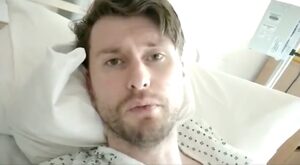
Micheal Prendergast, aged 28, who is recovering from the coronavirus, recorded a message of himself in which he appealed for people to practice social distancing.

He also appealed for the Government to take a “proactive” step and to implement “tighter controls” on people’s public movements.

Sky News journalist Stephen Murphy subsequently put Mr Prendergast’s appeal to Taoiseach Leo Varadkar at a press conference this morning.

Mr Varadkar replied:

“I think we are being proactive and, you know, I think I’ve answered that question…any decisions that we make on further restrictions around social distancing and what happens in public places should be rooted in the advice of the Chief Medical Officer [Tony Holohan] and those public health doctors, not what’s trending on Twitter, not what maybe politicians are calling for.”

Earlier: Separate And Conquer

Yesterday: Pier Review

Yesterday.

In Ballycotton, east Cork, no nonsense ‘Garda Mick’ directs traffic away from the carpark for the popular cliff walk.

Hard but fair or frankly ridiculous?

YOU decide.

Meanwhile…

Criminal Courts of Justice, Parkgate Street, Dublin 8

This morning and this afternoon.

Some legal proceedings are continuing at the Criminal Courts of Justice on Parkgate Street, Dublin 8.

How’s that going?

Oh.

Anyone?

UPDATE:

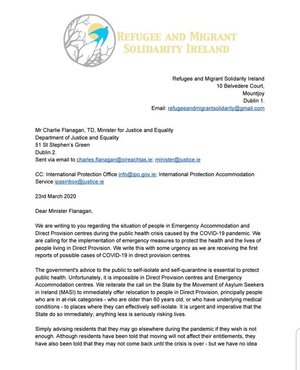
From top: Bedroom at a direct provision centre; letter from Refugee and Migrant Solidarity Ireland to the Minister for Justice Charlie Flanagan

Today.

The group Refugee and Migrant Solidarity Ireland has written to the Minister for Justice Charlie Flanagan, calling for “at risk” people who are living in direct provision centres to be relocated from the centres where they say social distancing is “impossible”.

The group also states that they are making the appeal with “some urgency” as it has received reports of possible cases of coronavirus in the centres.

It has also called on centre managers to allow residents to bring food to their rooms because, in some centres, groups of more than 100 people are congregating in dining halls for meals, a situation that is “against Government recommendations”.

Finally, the letter states:

“The State must provide compensation to those with the right to work who have lost their jobs because of this crisis. The DEASP has confirmed that international protection applicants are not eligible for the COVID-19 Pandemic Unemployment Payment.

“This is unacceptable, especially in the light of reports of some direct provision centres that are forbidding residents to return to the centre if they go to work.”

Meanwhile…

Quarantine Video Number 1.

From Moojoo.

Odhrán Beechinor writes:

A video about quarantine that my pal Danny [Danny Dempsey McMaho] made – this Moojoo is a local hero. Will bring some positive/happy vibes to your readers…

Earlier: No Walk In The Park

Meanwhile…

Meanwhile…