

Tag Archives: Direct Provision

rodley

Sir Nigel Rodley

Over the last two days the UN Human Rights Committee in open hearings in Geneva, Switzerland has been examining Ireland’s human rights record.

The committee’s chairman Sir Nigel Rodley closed proceedings today with an address that included the following..

Ireland’s treatment of women:

“the Magdalene Laundries, the Mother and Baby Homes, the child abuse, the symphysiotomy – it’s quite a collection and it’s a collection that has carried on [for a] period that it’s hard to imagine any state party tolerating. And I guess I can’t prevent myself from observing that [they] are not disconnected from the institutional belief system that has predominated in the state party.”

On Ireland’s laws on women’s reproductive rights:

“the recognition of the primary right to life of the woman who is an existent human being has to prevail over that of the unborn child and I can’t begin to understand by what belief system the priority would be given to the latter rather than the former. It is good to see that in 2013 at last that is clearly being clarified. I’m sorry that the clarification does not extend to the health of the woman.”

On the Protection of Life During Pregnancy Act:

“Life without quality of life is not something many of us have to choose between, and to suggest that regardless of the health consequences of a pregnancy a person may be doomed to continue it at the risk of criminal penalties is difficult to understand, even more so arguably for rape where the person doesn’t even bear any responsibility and is by the law clearly treated as a vessel and nothing more.”

ICCL [Irish Council For Civil Liberties] Wholeheartedly Endorses Coruscating UN Comments on Ireland (ICCL)

(Getty)

asylum

You may recall a post from yesterday which included excerpts from a blog by Joan O’Connell in relation to local election candidates being prohibited from canvassing at Ireland’s direct provisions centres, which are home to approximately 4,360 asylum seekers. This is despite adult asylum seekers being allowed to vote in the local elections.

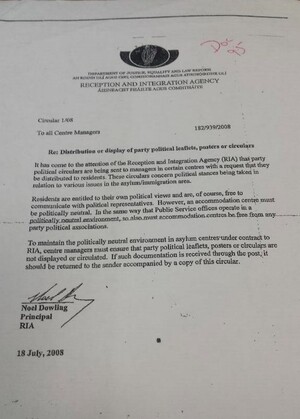
The post included a picture of a July 2008 letter from Noel Dowling, of the Reception and Integration Agency, which is responsible for the care of asylum seekers. It claimed the RIA had been made aware that certain party literature was being sent to managers of certain direct provision centres with requests that the material be given to residents. Mr Dowling’s circular basically stated that political party leaflets and posters were prohibited from being on display or being circulated in direct provision centres.

Well.

UCD law lecturer Dr Liam Thornton has written an update on the matter this morning on the Human Rights In Ireland blog.

He writes:

On April 23, Noel Dowling of the Reception and Integration Agency issued Circular 1/14 to all direct provision centre managers [see here: RIA Circular 1-14 of 23 April 2014] noting that there can be no display or distribution of party political leaflets, posters or circulars to residents. This did not prevent addressed literature from being delivered to residents.

On May 14 2014, Noel Dowling of the Reception and Integration Agency issued Circular 2/14 to all direct provision centre managers. This circular varies Circular 1/14 of April 2014 in one important respect:

Candidates who call into centres may be allowed to drop off election leaflets to be picked up and read by residents if they wish. This material may be left in a suitable designated area of the centre such as the reception desk. Candidates may, if they wish, place on their leaflets their contact details or details of political meetings outside the centre to which residents can be invited.

That’s good of them.

Direct Provision, Local Elections and Political Campaigning (Dr Liam Thornton, Human Rights In Ireland)

Previously: Alternatively

DP

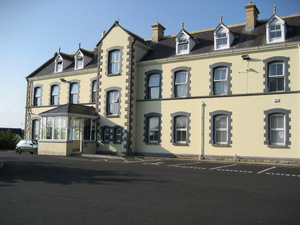
[Direct provision accommodation centre for asylum seekers in Lissywoolen, Athlone, Co. Westmeath]

There are approximately 4,360 asylum seekers living in direct provisions centres across Ireland. The adults among them are allowed to vote in the local elections.

However, election candidates are not allowed to canvass at the centres.

On this matter, Joan O’Connell writes on her blog:

“If politics is conceived as a zero-sum competition for power, then this step by a state agency can be regarded as the yet another exercise of power over an already almost totally disempowered group in Irish society. The near-total exclusion of asylum seekers from participating in the society where they live is highly questionable.
“By denying election candidates the opportunity to canvass the views of certain constituents, this “policy” impedes the opportunity for candidates to hear the views of asylum seekers and others – to hear their minds and voices. In turn, the “policy” hampers the ability of voters in direct provision centres to be fully informed about their rights and obligations, and to contribute to and influence the local politics – which by law they are entitled to do. If voices are silenced and bodies remain invisible, what does this mean for the ideas and leadership which shape Irish society?”

Joan O’Connell’s blog post, An interference with democratic process: The right to vote in Ireland, in full here

Update:

letter

UCD law lecturer Dr Liam Thornton writes:

“Asylum seekers not even entitled to receive leaflets from political parties…”


1027016 7102734 7672468

Above: examples of unused spaces within direct provision accommodation for asylum seekers in Ireland.

Eamon Sheehy of Migrate To The Fringe writes:

The asylum system functions as a closed and confined space far from the rest of society. It is the other, the outside, and a ghetto. The direct provision hostels and their residents don’t seem to have physicality. The rest of society is not to be concerned about their existence. Asylum Archive is taking visual samples of this reality…

UPDATE:

Over on the Human Rights In Ireland blog, Dr Liam Thornton writes:

“Direct provision is 14 years old today. Today, from 7am to 9pm, there will be 14 hours of blog posts on the issue of direct provision. The voices of asylum seekers themselves are central to this blog carnival, and we will hear their voices throughout the day. The Department of Justice and Department of Social Protection were invited to contribute to this carnival, however they have not replied to my email. Therefore, posts from several organisations working with and on behalf of asylum seekers, social workers, others challenging this system and artists, are all present.”

Human Rights In Ireland (#directprovision14)

MosbigMOsneyy

(From top, accommodation at Mosney in Co. Meath and asylum seekers at the centre)

Carl O’Brien, of The Irish Times, reports this morning that the State has paid a total of €800million to private firms to provide accommodation to asylum seekers since the system was rolled out in 2000.

Mr O’Brien writes:

“Today, many of the companies providing shelter are large firms involved in the property, hospitality or catering business. Some have moved to re-register themselves as private unlimited companies in recent years, which means they have no obligation to file accounts. This shields their financial affairs from public scrutiny.”
“In addition, in some cases the beneficial owners or part-owners include companies in offshore jurisdictions such as the Isle of Man and the British Virgin Islands.”

He adds that the five top recipients of funding for direct provision are:

Mosney Accommodation Centre, Co. Meath: €101million.
Directors: Phelim McCloskey, Drogheda, Co Louth; Sarah Gates, Drogheda, Co Louth; Ruth Kierans, Drogheda, Co Louth.

East Coast Catering: €91.5million.
ECC provides accommodation at Baleskin Reception Centre, Co. Dublin; Hatch Hall, Dublin 2; Carroll Village, Dundalk, Co. Louth.
Directors: Dundalk businessmen Denis Williams and Brian Byrne; Canada-based businessmen Patrick O’Callaghan and Richard Sheppard.

Bridgestock: €66.7million.
Bridgestock provides accommodation at Globe House, Sligo, Lisbrook House, Galway, The Old Convent in Ballyhaunis, Co. Mayo and Athlone Accommodation Centre, Co. Westmeath.
Directors: Séamus Gillen, Tullamore, Co Offaly; Eoghan McGinty, Galway; Michael Gillen, Sligo.

Millstreet Equestrian Services Ltd: €52.6million.
MES provides accommodation at Viking House, Waterford; Bridgewater House in Carrick-on-Suir, Co Tipperary and Drishane Castle, Millstreet, Co. Cork.
Directors: Noel C Duggan, Cork, and Thomas A Duggan.

Shaun Hennelly, Galway: €24.3million.
Mr Hennelly provides accommodation at Great Western House, Galway
Owners: Shaun and Kathleen Hennelly, Galway.

Meanwhile, way back at the beginning:

Book1 Book2

Excerpts from New Guests Of The Nation, by University College Dublin Professor Bryan Fanning. The pages are from chapter five, entitled The Politics of Racism.

Top five recipients of State funding (Carl O’Brien, Irish Times)

Asylum industry has become a cash cow for big business (Carl O’Brien, Irish Times)

New Guests Of The Irish Nation

Previously: “Issues Too Extensive To Catalogue Individually”

Related: One man’s death a sad indictment of ‘limbo’ life in direct provision (Catherine Reilly, October 2012)

Pics: Catherine ReillyIrish America


Conventlogo_bridgestock(The Old Convent in Ballyhaunis, Co. Mayo, top, which provides accommodation for 293 asylum seekers and is owned and run by Bridgestock Ltd)

Carl O’Brien, of the Irish Times, reports this morning that unpublished inspection reports of State-funded asylum seeker accommodation centres show evidence of overcrowding, poor fire safety practices and poor hygiene levels.

In the last year alone, Mr O’Brien reports, of the 34 direct provision centres across Ireland, at least three were warned they would be shut down within 30 days, unless they addressed their shortcomings or failings.

The inspectors’ concerns, amongst others, included that a family of six had to live in a single bedroom; there were serious breaches of fire safety; and breaches of child protection.

Specifically, he writes about one centre: The Old Convent in Ballyhaunis, Co. Mayo which provides accommodation for 293 residents, and is owned by Bridgestock Ltd.

It was inspected in March of this year – just a month before Bridgestock Ltd was awarded its highest score in the annual Q-Mark Awards [a quality management award].

From the report:

“The number of general maintenance issues identified was too extensive to catalogue individually . . . It needs to be restated that the prevalence and frequency of the items requiring maintenance was extremely disappointing and is not acceptable to RIA [Reception and Integration Agency] . . . (March 2013)”

“Response: The management said it had responded to issues highlighted, including tackling fire safety risks, deep cleaning and maintenance.”


Meanwhile, back in 2010:

A recent “value for money” review found the Government pays too much to house and feed asylum seekers because it does not run fully open tender competitions to secure contracts with private operators of asylum centres. The review also found the agency maintains too much “excess” bed capacity at accommodation centres nationwide.

One of the findings of the “Value for Money” review is that private hostel owners rather than asylum seekers or taxpayers have been the real beneficiaries of the direct provision system since it was set up in 2001.

It found “restricted competition” among commercial operators meant rates are not “robustly tested and the seven State-owned accommodation centres were €6 a person a day cheaper than those owned by private operators. The review expressed concern about contract renewals agreed by the Government, with 16 private operators in 2008 and 2009 that led to price increases of more than 5 per cent at a time of deflation.”

NGOs complain a culture of secrecy surrounds the award of these multimillion euro contracts because the Department of Justice refuses to disclose the details due to “commercial sensitivities”. This makes it virtually impossible to properly scrutinise payments worth almost €750 million since 2002.

“However, the financial accounts of the four biggest accommodation providers – Mosney, East Coast Catering Ireland Limited, Millstreet Equestrian Services and Bridgestock – demonstrate that housing some of the poorest people in society has proved a very lucrative business for some entrepreneurs.”

“The top four money makers: Bridgestock Limited is owned by Séamus and Kathleen Gillen from Tullamore, Co Offaly. It runs four centres in Athlone, Ballyhaunis, Sligo and Galway with contracts to house 1,249. The firm had net cash flow of €6.29 million in the year to the end of June 30th, 2008, generating operating profit worth €1.57 million. The company paid €1.12 million in rent to properties owned by the Gillens in 2008.”


Value For Money and Policy Review (Reception Integration Agency, May 2010)

Inspections reveal poor standards in centres which house thousands of asylum-seekers (Carl O’Brien, Irish Times)

Previously: Asylum seekers on Broadsheet

Pic: Picasaweb

DorasYesterday, the Northern Ireland High Court in Belfast ruled that a Sudanese political journalist, aged 37, and her three children, aged 18, 16, and 12, should not be sent back to Ireland because Ireland’s Direct Provision system would not be in the best interests of the family.

The woman, known only as ALJ, and her children made their way to Dublin from Sudan in April 2010, via a three-week boat journey operated by traffickers.

Their application for protection was rejected in Ireland and in July of 2011, they travelled to the North and applied for asylum there.

However, the UK Border Agency requested Ireland to take them back, which the Irish government accepted.

Yesterday’s ruling was a result of the family challenging this decision.

While delivering his decision to quash the removal order, Mr Justice Stephens took issue with the UK Border Agency’s assertion that the family would be afforded the same opportunities for development, and the same level of support, in the Republic as in the North.

On the contrary, he said:

“(This assertion) either fails to address the first question namely what is in the best interest of the children or it is an assertion that the best interests of the children are equally met in Ireland and in Northern Ireland.  If it is the former then the decision maker has failed to address an essential question.  If it is the latter then it cannot stand up to any analysis.  No specific plan individual to this family has been formulated in Ireland for their reception on removal.  ALJ, the children’s primary carer, has no prospect of working in Ireland but has the prospect of working in Northern Ireland.  The well-being both emotionally and financially of the primary carer and the importance of that to the well-being of the children in her care would point significantly to the best interests of the children being to remain in Northern Ireland.  The children, most significantly A, has no prospect of working in Ireland but he has that prospect in Northern Ireland.  In Northern Ireland the family is in a separate house of their own which they can call their home.  In Ireland they are required to live in hostel accommodation and prevented from living in their own accommodation.  In Northern Ireland the family are not bound to remain in close proximity to a hostel in order to eat regular meals.  In Northern Ireland being in their own home they can interact with each other as a normal family without interference by other asylum seekers or by hostel staff.  The children by virtue of being brought up in their own home can develop a sense of belonging and separate identity.  In Ireland there are problems with enforced isolation and poverty.  In Northern Ireland between the ages of 16 and 18 the children are entitled to receive a State education.  That is not so in Ireland.  A comparison of the description of the accommodation that is provided in Ireland and the accommodation that is provided in Northern Ireland shows a marked difference in quality and therefore in the quality of life of those who live in such accommodation.  There is ample evidence of physical and mental health issues developing in Ireland amongst those asylum seekers who are in Direct Provision accommodation.  Ireland has opted out of the minimum standards directive and there is considerable evidence that the provisions in Ireland do not meet the minimum standards in that directive.  Any analysis of the best interests of the children would have led to the inevitable conclusion that the best interests of the children favoured remaining in Northern Ireland.”

“For those reasons alone the best interests of the children are that they should remain in Northern Ireland.”

Read full judgement here

Sudanese family win right to stay in NI (UTV)

Related: Ireland’s Asylum & Direct Provision System under the Spotlight in Northern Ireland High Court (Dr Liam Thornton, Human Rights In Ireland)

Previously: Today In The High Court

How The Common European Asylum System Will Work

Shutting Out The Asylum Seekers

An Asylum Seeker Writes

The Institutionalisation of 1,818 Children In Ireland

Pic: Human Rights In Ireland

Thanks Sido

Not BadThe Human Rights of Ireland website is reporting that a family of six will take a legal challenge against the system of direct provision in a case (N.M. and others V Minister for Justice and Equality, Minister for Social Protection, the Attorney General and Ireland).

The family, originally from Africa, includes a mother, father and their four children, who range in age from 20 to a few weeks. They have been living in direct provision for four and a half years.

Their challenge against the system of direct provision is three-fold:

1) The system of direct provision – which was set up 14 years ago, in 1999, and was supposed to see families or individuals live in it for six months – has never been given a statutory basis. As a consequence of that, the family are arguing that the direct provision allowance of €19.10 per week per adult and €9.60 per week per child is beyond the powers of the Social Welfare Consolidation Act 2005.

2) The family are also arguing that the exclusion of asylees from any social welfare payments through the Habitual Residence Condition is unconstitutional.

3) The family are also challenging the ban on a right to work and seek work. They claim this ban is unconstitutional as the State is obliged to defend and vindicate the rights of individuals and the right to family and private life.

Dr Liam Thornton, of Human Rights Ireland and who is a lecturer in law and director of clinical legal education in University College Dublin, writes:

“It remains to be seen whether the applicants will be granted leave to challenge the system of direct provision.  Legal arguments aside, life in direct provision is dehumanising. There is a total lack of respect for dignity of individuals, a highly controlled environment, struggling to survive on a meagre financial allowance, an inability to feel included within the community, the inability of children to grow up in a normal family centred household, the stress, boredom and anxiety for the adults of having nothing to do all day. This is a day in the life of a direct provision resident. At a time when Ireland is rightly correcting historical wrongs of our past institutionalisation of women, the on-going scandal that is the system of direct provision, may finally be put under the spotlight.  The current government (including some Ministers who vocally opposed direct provision in opposition) need to reflect on the untold damage that direct provision is having on its residents.”

Legal challenge to Direct Provision in the High Court (Dr Liam Thornton, Human Rights In Ireland) 

Meanwhile…

“Our failures are essentially human rights failures and we should be particularly alive to the fact that, never more so than at a time of recession and austerity, are bodies such as a Human Rights Commission and an Equality Authority needed to make sure that in a decade’s time we won’t be weeping our way through another pitiful cataloguing of State-inflicted abuse, albeit with a modern twist.”

Ombudsman Emily O’Reilly speaking at the MacGill Summer School in Glenties, Co. Donegal last night.

Previously: Enemy Of The State 

‘Improperly Discriminatory’

Shutting Out The Asylum Seekers

On Our Doorstep

It Goes Way Back

Let’s Give Them Home

An Asylum Seeker Writes

Pic: Screengrab from Discouragement