

There’s hope yet.
A MAT checkpoint leads to recovery of stolen items in Dublin (An Garda Síochána/Facebook)
(H/T: Spaghetti Hoop)



There’s hope yet.
A MAT checkpoint leads to recovery of stolen items in Dublin (An Garda Síochána/Facebook)
(H/T: Spaghetti Hoop)

Glug.
Thanks MK

Ah now.
Kat Furey writes:
Parked in a disabled spot in Tallaght! [Yesterday]! Sound!!

https://www.youtube.com/watch?v=iXOyuYLFaBU
Yesterday, during Leaders’ Questions, Independent TD Mick Wallace asked Taoiseach Enda Kenny about certain matters relating to the gardaí.
On two occasions, Mr Wallace asked Mr Kenny when he was made aware of Garda malpractice in Athlone and what he did about it when he became aware of it.
Mr Kenny said he wasn’t sure what Mr Wallace was talking about.
Mick Wallace: “Much talk of police reform has not materialised. The Guerin report was published in May 2014, nine months ago, but only now is a commission of investigation being established. Its terms are too narrow and it will go through the Houses without debate. Will it even be completed before the next election? Will the Fennelly commission be completed before the next election or will it be kicked down the road? When will the report on the independent review mechanism be published? In July, the Minister stated the majority of cases would be reviewed within 12 weeks. That was a long time ago. The independent Garda authority was supposed to be up and running by the end of 2014. We have not even seen the first draft of legislation. The Garda Inspectorate’s report into serious crime, published on 11 November, has not even been discussed here yet. Debate has been stifled on policing issues. Since 11 November we have tabled 16 Topical Issue matters on policing matters but none of them has been taken.”
“The latest penalty points fiasco has reinforced the fact that indiscipline is rampant in the senior ranks of the Garda. As Maurice McCabe stated at the weekend, the penalty points system is broken and the Government is putting sticking plasters on it. There is no law and order with regard to senior management. There are no sanctions when they break the rules. This is not just about penalty points. If this is how the law is applied to the penalty points system, how is it applied when it comes to charging someone, arresting someone, and taking someone’s complaint seriously? The Garda Inspectorate’s report went to great lengths to point out the Garda widely ignores its own policy. Indiscipline is rampant. What is the Government doing about it?”
“In light of all this indiscipline and given that investigations into allegations of very serious wrongdoing, including Garda involvement in the drug trade, are ongoing in a number of Garda divisions, will the Taoiseach give us an assurance that the promotions and movement of senior gardaí will not include gardaí from these districts before investigations are complete? Will the Taoiseach confirm or deny whether Inspector John McDonald, who is in charge of the fixed charge processing unit in Thurles and who has been responsible for multiple terminations at a huge cost to the State, has been placed on a promotions list?”
Deputies: Out of order.
An Leas-Cheann Comhairle Michael Kitt: “Please, Deputy, do not name these people.”
Wallace: “I would like the Taoiseach to listen carefully to my next question. Will he tell the House when he personally was first made aware of very serious Garda malpractice in the Athlone area, and what action did he take?”
Durkan: “Out of order.”
Kenny: “I cannot answer all of the questions Deputy Wallace has raised. Am I to understand he is naming people who have been recommended for promotion, whom he alleges have been involved in criminal activities?”
Frances Fitzgerald: “Is that what he is saying?”
Kenny: “That is the import of what he is saying.”
Wallace: “I am asking—–”
Kitt: “The Taoiseach has the floor.”
Kenny: “If I understand what Deputy Wallace is saying, people involved in criminal activity are being nominated for promotion. Am I to understand that is what he is saying?”
Wallace: “If the Taoiseach checks the record that is not what I said.”
Kenny: “What did you say?”
Wallace: “I asked whether the person responsible for the fixed charge notice system in Thurles, who has been responsible for multiple terminations, is on a promotions list.”
Durkan: “You named the person.”
Kenny: “I do not have any information about who is or is not on a promotion list. I am glad the Deputy clarified the comment that he made.”
Wallace: “The Taoiseach can check the record later.”
Kenny: “The Deputy raised a number of issues. The Guerin report will follow the inquiry that the Government has agreed to set up. That will be set in place after today. The Fennelly inquiry is under way. The sole member wrote to me looking for an extension of time until the end of this year, and I have granted that. I support, if possible, the production by the inquiry of earlier reports in respect of a number of specific matters.”
“The review commission received 307 cases, some of which go back 30 years, and the vast majority of those have been examined by the panel of senior counsel and junior counsel appointed to review those cases. I assume that when they have completed their work they will bring that to the attention of the Minister for Justice and Equality very quickly.”
“I understand that the changes that have been made in respect of fixed penalty notice are significant and that there are now three senior personnel who are entitled and authorised to relieve penalty charges where they might be applied for whatever particular reasons. Yesterday the Government appointed a judge to oversee that practice, to give it further transparency and accountability.”
“Regarding the issues that I have missed in the Deputy’s long list…”
Fitzgerald: “The Garda authority legislation.”
Kenny: “When is that due to be ready?
Fitzgerald: “It is due shortly.”
Micheál Martin: “The Garda authority is due in here very shortly.”
Wallace: “The abuse of the penalty points system was so endemic that independent bodies have had to be created to keep an eye on things. The Taoiseach is not accepting the fact that there is massive indiscipline in the senior ranks of the force. Can he explain why there has been so little opportunity to debate policing matters since last summer? Can he also explain why the Government has no appetite for depoliticising policing in Ireland, despite the recommendations of the likes of Professor Dermot Walsh? Anyone who read Conor Brady’s book over Christmas would have noted that the politicisation of policing in Ireland has gone on since the 1950s at a really bad level, and that is part of the huge problem we are facing. Until the Government decides to depoliticise it and we have an independent police authority that acts as a buffer between the Government of the day and the police force, we will continue to have these problems. The former Minister, Deputy Shatter, would still be in power and would still have his job if there had not been such a flawed system, and the Government is not correcting it.”
“I remind the Taoiseach of my last question to him, which he did not answer. I asked if he could tell the House when he was first made personally aware of very serious Garda malpractice in the Athlone area and what action he took.”
Kenny: “I am not clear on what the Deputy is talking about in respect of the Athlone area. He will have to give me further detail on that, and if he wishes to do so, he can give me it me after the completion of the Order of Business.”
Mattie McGrath: “Somebody might have picked it up.”
A Deputy: “What about you, Mattie?”
Kenny: “In respect of the independent policing authority, this is the most radical shake-up in the justice system since the foundation of the State. The appointment of the Garda Commissioner was subject to open competition and was a completely independent system for making that recommendation for appointment by Government. All promotions of senior personnel are done by a panel for which completely independent people apply. It is not a politicised system any more because the situation is completely independent, and there has been the most radical shake-up since the foundation of the State.”
“Out of 400,000 penalty points issued every year, about 2.9% are quashed, in accordance with the system that applies, where that is valid. There are only three people who can now quash penalty points. Since the new system was introduced, only seven cases have been referred for further analysis under this new system. In anybody’s language there has been a serious shake-up, and it has been for the better in terms of accountancy, accountability and transparency in a system that is very important for people.”
Previously: The Wrong Side Of The Thin Blue Line
Related: Claims Shatter ‘muzzled’ Garda inquiry debate (Juno McEnroe, Irish Examiner)
Garda over penalty point office in line for promotion (Philip Ryan, Irish Independent)
Transcript via Oireachtas.ie

This morning.
They’re playing good cup bad cup.
Sue McK writes:
How many Garda does it take to buy the tea?
Anyone?
Lines MUST close at 1.15pm

This afternoon.
The cycle lane, Newtown avenue Blackrock, Co Dublin.
Clamp it. Clamp it.
Clamp it. Clamp it.
Etc.
Thanks Paul
Gardaí looking for a ‘Human Rights Assistant’ to work for nine months below the minimum wage. pic.twitter.com/4aP9Tms4jN
— Donie O’Sullivan (@DonieSullivan) December 8, 2014
Jaysus.
Thanks Donie
Driver parking in disabled spot without permit. On inspection tax disc for another car. Car seized Sc 41. summonses pic.twitter.com/KwbFeguQqD
— An Garda Síochána (@GardaTraffic) November 27, 2014
Shiela Larkin tweetz:
This tweet made for satisfying reading.
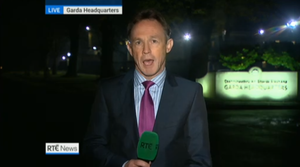
RTÉ crime correspondent Paul Reynolds on RTÉ’s Nine News last night
In light of Noirín O’Sullivan appointment as the new Garda Commissioner, last night Mr Reynolds reported the following:
“[Her appointment] has been broadly welcomed, there has been some criticism but Noirín O’Sullivan is the first Garda Commissioner in the history of the State to be appointed to the position, following and open, public competition and she got the position through, against national and international competition and that does give her some credibility as she takes up, begins the job first thing tomorrow morning.
She’s also dealing with the criticism, as you say, by distinctly saying that it’s an advantage, that she was an insider and that she was part of senior management in the force for so long because it does mean that she knows the members. She says she knows the organisation, she knows the problems, she can implement change and she also knows the community and what they expect from a policing service. And she was also appointed to the position, in spite of reports that the abuses are continuing in the penalty point system, in spite of the new system that she introduced last June.
And she said something very interesting in relation to that point, here at the press conference tonight. She said that she’s confident that when the audits are published very soon that they will show that the system she introduced is, in fact, working. And that’s at variance with many of the reports we’ve heard over the past few weeks.“
Meanwhile, John Mooney reported in last weekend’s Sunday Times:
“An internal investigation by gardai into fresh allegations that senior officers continued to terminate penalty points in questionable circumstances is to be referred to the Garda Siochana Ombudsman Commission (GSOC). The investigation identified a few cases of gardai deleting penalty points in contravention of new regulations introduced last June to prevent abuses of the system. It also found evidence to suggest officers continued to terminate penalty points even after two garda whistleblowers revealed there had been widespread abuse of the system.
“Nóirín O’Sullivan, the interim garda commissioner, ordered an investigation last September after The Sunday Times reported an allegation by Maurice McCabe, one of the two whistleblowers, that some officers caught speeding were continuing to claim wrongly they had been using private cars on official garda business.”
“These cases are among those being referred to the GSOC, which is already running a separate investigation into the termination of penalty points. The cases could result in disciplinary hearings, demotions or the imposition of fines.”
“The delay in finalising the GSOC investigation has been attributed to labour shortages, after the agency lost a number of staff. Frances Fitzgerald, the justice minister, and O’Sullivan have promised to restore public confidence in the penalty points system. Fitzgerald has promised to publish the findings of the internal investigation once it has concluded.”
“Security sources believe the report’s publication is unlikely, given that it contains evidence that could lead to GSOC taking disciplinary or criminal proceedings against officers. “The promise to publish the full report was politically motivated,” said one security source. “The Department ofJustice will probably publish a redacted version.”
Good times.
Watch back here
Galway Gardaí remind drivers that safe driving speed affected if towing load.car lost contol overtaking,shed turf! pic.twitter.com/HH25O3CiWz
— An Garda Síochána (@GardaTraffic) July 29, 2014