Tag Archives: INM

screen-shot-2016-12-06-at-14-58-24 screen-shot-2016-12-06-at-15-04-34

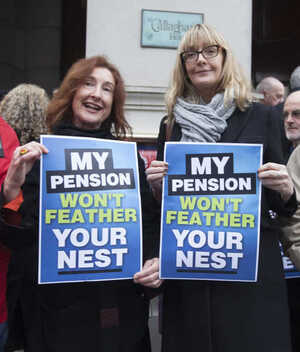
Further to yesterday’s vote by the board of Independent News and Media to give shareholders a dividend while closing off the company’s pension scheme – and the protest by former and current employers over the same…

This afternoon.

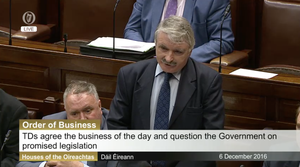
During Order of Business in the Dáil.

Fianna Fáil TD Willie O’Dea asked Taoiseach Enda Kenny if he found it acceptable that “a solvent, profitable company in this country, can change and close down a defined benefit pension scheme, on a whim – to the detriment of their pensioners and deferred pensioners”?

Readers will note that Mr O’Dea didn’t specifically name Independent News and Media (INM) and neither did Mr Kenny in his reply to Mr O’Dea….

Willie O’Dea: “There’s an implied recognition in the Programme for Government that the pension problem in this country needs to be dealt with. Now, can I ask you: do you find it acceptable that a solvent, profitable company in this country, can change and close down a defined benefit pension scheme, on a whim – to the detriment of their pensioners and deferred pensioners and there is no provision in Irish law to deal with it. Can you tell me when such a provision will be put in place?”

Enda Kenny: “There is no law, no legislation governing this, in respect of Ireland. As you know, there are two defined benefit pensions in respect of the case that you’re probably referring to. In Britain, they have a defined benefit which is based upon levies and only becomes of, only becomes, is only used when the company involved becomes insolvent. The measure, company, we refer to now, is not insolvent. This is a matter in respect of defined benefit contributions that has caused quite a difficultly, a number of difficulties, over the period. Obviously, the last actual certificates filled by defined benefit schemes with the Pensions Authority show that over 60 per cent meet the standard and the remaining schemes had recovery plans. And there is concern that the certificates due in the coming months will, however, show significant deterioration.”

“The operation of a pension scheme is, in the first instance, a matter for the trustees of the particular scheme. The minister met recently with the chairperson of the Pensions Authority. He’s asked the authority to report back to him with an assessment of the current overall position in relation to defined benefit schemes. So he will report to the House when that comes back.”

Meanwhile…

screen-shot-2016-12-06-at-15-07-47

Later.

Social Democrats TD Catherine Murphy also raised the matter but did specifically mention INM.

Catherine Murphy: “…Taoiseach, do you now accept that there is a gap in the law that is leaving a group of people, we’re seeing with one company, INM, the Independent newspapers, we’re seeing them – whom have the benefit, mind you, of €130m-plus being written off by AIB and the Bank of Ireland – leaving people who’ve worked in that industry, they’ve deferred their pensions in a lot of cases, leaving them very exposed because of this  gap in the law.”

“There’s an urgency about this and other companies doing exactly the same thing. Taoiseach, do you not see that there is a need for urgent legislation in respect of this gap in the law?”

Kenny: “Well, the point is that, in the UK, there is a pension protection fund which is paid for by levies, but it only comes into use when the company is insolvent and the company you mentioned is not insolvent. Clearly, the…

Murphy: [Inaudible]

Ceann Comhairle: “The Taoiseach, without interruption.”

Kenny: “The minister has met with the chairman of the Pensions Authority. He’s asked him to report back on the issue of defined benefit pensions. The situation that will arise over the coming months and coming years, obviously, we’ll deliberate on that when he, when he has that report back…”

Earlier: ‘You Can’t Take It With You’

cy6mpzbxgaadgxr

Right now.

Outside the Alexander Hotel on Fenian Street in Dublin 2.

Current and former employees of Independent News and Media (INM) and their supporters demonstrate against significant pension cuts at INM. The protest is being organised by Siptu and the National Union of Journalists (NUJ).

The protest is taking place as, inside the Alexander Hotel, INM shareholders hold an extraordinary general meeting (EGM).

Pic via Irish Congress of Trade Unions

Earlier: Free At 1.30pm?

UPDATE:

cy6pbcjwqaats9a

Ken Powell tweetz:

Suitably frosty reception for #Redacted at Alexander Hotel…

Update:

90435722 90435723 90435725

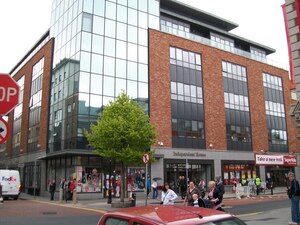
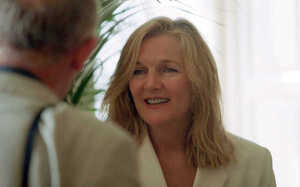
From top: Former Irish Independent journalists Claire Grady and Lise Hand; Seamus Dooley of the National Union of Journalist; the scene outside the Alexander Hotel, Dublin 2/

Eamonn Farrell/Rollingnews

Related: How can INM buy up companies while it cuts staff pensions to pieces? (Justine McCarthy, Sunday Times)

3199800_245bdd6c

Staff at Independent News and Media are to protest outside a company meeting today over a 70% cut to their pension benefits.

Earlier this month INM announced it would no longer be contributing to the defined benefit pension scheme, which will now have to close.

Separately, the company will today seek shareholder approval for measures that would permit the resumption of dividend payments for shareholders including businessmen Denis O’Brien and Dermot Desmond, who between them own almost 45% of the company.

In 2013, Independent News and Media restructured its defined benefit pension scheme.

Under that ten-year plan, staff had to accept benefit cuts of around 40%.

But last month INM announced  that it would cease contributions to that scheme citing factors including regulatory funding requirements and falling bond yields.

INM staff set to protest over pension cuts of 70% (RTE)

UPDATE:

cy6b4-_wgae-cr9

Ingrid Miley tweetz:

Union briefing re: pension cuts at INM gets underway – protest to follow outside EGM at 13.30…

2016-10-28_bus_25864082_i1

SPLUTTER!

The Phoenix Magazine (Facebook)

How Can INM Buy Up Companies While It Cuts Staff Pensions To Pieces (Justine McCarthy, Sunday Times, behind paywall)

Pic Belfast Telegraph

celticimagecatherinemurphy

From top: Celtic Media logo; Denis O’Brien, Catherine Murphy

In the dâil yesterday, Social Democrat founder Catherine Murphy challenged Taoiseach Enda Kenny on the sale of Celtic media Group to Denis O’Brien-controlled INM.

Celtic Media owns seven regional titles, including the Anglo Celt, the Meath Chronicle, the Offaly Independent, the Westmeath Examiner, the Westmeath Independent and Forum, a bi-weekly paper for south Meath.

Catherine Murphy: “Last week, the Competition and Consumer Protection Commission approved the acquisition of the Celtic Media group by Independent News and Media, INM. It is now up to the Minister for Communications, Climate Action and Environment, and presumably the Cabinet, to accept or reject this acquisition. Earlier this year, a report authored by Dr. Roddy Flynn of Dublin City University identified the concentration of media ownership in Ireland as a “high risk”. That was echoed earlier this year in a European Commission report, which found that the position in Ireland was the subject of the highest level of concern and identified a lack of legal barriers as an issue. Nessa Childers MEP held a conference earlier this year at which Dr. Flynn’s findings were reported. More recently, Lynn Boylan, MEP, commissioned an EU Parliament report, the findings of which expressed similarly grave concerns regarding the media landscape in Ireland.

It is difficult to understand how an agency involved in consumer protection could approve the proposed acquisition, particularly in a sector that has the potential to undermine our democracy.

INM publishes the Irish Independent, the Sunday Independent, the Evening Herald, the Sunday World and the Belfast Telegraph. It has a 50% stake in the Irish Daily Star and controls 13 paid-for regional weekly newspapers. If INM’s acquisition of the Celtic Media group goes ahead, it will control 28 regional titles across the country in addition to the national titles I have mentioned.

The radio sector is also relevant in this context. Communicorp, which is owned by the same majority shareholder as INM, controls Newstalk, Today FM, 98FM, Spin 103 and Spin South West, or approximately 20% of the entire radio market. Although I appreciate that print and broadcast media are different, it is essential for the cross-ownership of INM and Communicorp to be considered in tandem.

As the Taoiseach knows, the Competition Act 2002 does not allow competition restrictions on media ownership to be retrospective. This raises further questions about the permitting of the proposed acquisition. If there is already a problem with the over-concentration of media ownership, why would the Government make that situation worse?

That is the obvious question. While media concentration is an issue in its own right, the ownership of such a large proportion of our print broadcasting and digital media by someone who has consistently used the courts to create a chilling effect on journalists and other media outlets has to be questioned in the most serious terms.

The person to whom I refer, Denis O’Brien, was the subject of adverse findings in the Moriarty tribunal, as the Taoiseach is aware. This media acquisition is clearly against the public interest. It is essential that vested interests are not once again placed ahead of the public interest. Will the Taoiseach oppose this acquisition?

Given the changing nature of media, does he support the National Union of Journalists’ call to initiate a public commission on the future of the media to examine ownership, editorial control, employment standards including pension rights and measures to protect editorial independence?

Does he believe State supports may be appropriate to ensure there is diversity of media ownership across all platforms?

Enda Kenny: “No, I do not support the call mentioned by Deputy Catherine Murphy. This report was commissioned by Lynn Boylan MEP and was based on a legal opinion from two firms based in London and Belfast, both of which primarily work in the field of human rights. The report seems to have been prompted in part by the 2015 report of the Centre for Media Pluralism and Media Freedom, a centre based in Florida and funded by the European Commission, which was published in March 2016.

I think everybody can agree that a free and pluralistic media is an essential component of a modern democracy. The report mentioned by the Deputy is being examined by the Minster for Communications, Climate Action and Environment on the basis of his responsibility for media plurality.

I understand he is to answer questions in the House tomorrow on that. In addition to operating the media mergers regime provided for in the revised Competition (Amendment) Act 2012, the Department of Communications, Climate Action and Environment engages with the European Commission and the Council of Europe on all issues relating to media freedom and plurality.

It is also important to say that many of the issues and conclusions raised in the report were debated in the House during the passage of the Competition and Consumer Protection Act 2014, which revised the Competition Act 2002. As the Deputy is aware, the 2014 Act gives the Minister for Communications, Climate Action and Environment the power to block any media merger that is deemed likely to be contrary to the public interest in maintaining the plurality of media in the State.

Therefore, I do not see any reason for the setting up of a commission of inquiry into the matter. The Act did not give the Minister the power to act retrospectively or to assess a media business in the absence of a proposed merger, as to do so would be to interfere with the property rights enshrined in Article 43 of Bunreacht na hÉireann, which would raise a myriad of legal complexities.

Simply stating that it is legally possible to do so does not address any of the legal complexities involved and does not recognise the effect such a move could have on freedom of expression and investment in the sector.

In fact, the report itself recognises this is an extremely difficult area that would raise issues regarding property rights, market effects, procedural fairness and freedom of expression considerations.”

Murphy: “I am not entirely sure what to make of that response. The Constitution certainly does include a section on property rights but all rights have to be balanced and, indeed, the section in the Constitution is balanced by a second section which deals with the common good.

Essentially, the point I am making is that there is no reason for the Government to make matters worse where there is already a demonstrated difficulty with the excessive concentration of media ownership.

Why would it do that when retrospection is not permitted, according to the Taoiseach, although I believe that is open to challenge in the courts?

To take the position in rural areas, which I do not need to describe to the Taoiseach, the more concentrated media ownership gets in rural areas, the less informed people are going to become. What is proposed is that the current CEO of Celtic Media would become the managing director of all 28 INM regional titles.

This would mean the possibility of cross-selling of advertising and the possibility that people in rural areas will not be able to go into Eason’s, for example, and pick up alternative newspapers. The retrospection aspect is one that must be taken very seriously. What is the Taoiseach’s view of this acquisition of the Celtic Media group?”

Kenny: “I misinformed the Deputy in that the Minister is not here tomorrow due to the climate business in Marrakesh and the Minister for Education and Skills has a swap arrangement for tomorrow. Obviously, the most important of the considerations involved is the potential impact on media freedom if a Minister effectively has the power to break up a media business at any time. That could also have a severe impact on investment in the sector.”

Murphy: “What is the Taoiseach’s view?”

Kenny:“The issue was well debated here during the proceedings relating to the Act of 2014. The assertion that there are no representatives being appointed to the MSI-MED committee and none of the independent experts on that body are based in Ireland is misleading.

That committee is a sub-committee of the larger steering committee on media and information society and there is a principal officer of the Department who sits on it as well. Given that all these matters were discussed already in the context of the review of the Act, the Minister does not see what a commission of investigation or inquiry into this would be based on.”

Róisín Shortall: Does the Taoiseach agree with the merger now?

Kenny: “He does not have the power to act retrospectively on this, as I have pointed out.”

Good times.

Previously: Same Old Firm

Transcript via Oireacthas.ie

 

aaeaaqaaaaaaaakfaaaajgjim2vhzgi1ltcwndutnddlny1intnmlwixnze5otvmm2q1ma

Further to yesterday’s publication of the Report on the Concentration of Media Ownership in Ireland – commissioned by Sinn Fein MEP Lynn Boylan – and advance copies being given to the Sunday newspapers at the weekend…

Fintan O’Toole, in The Irish Times, writes:

Yesterday’s Irish Independent carried no word of the media ownership report. The Sunday Independent did deal with it, but by way of comment rather than reportage. Liam Collins opened his Zozimus column on page 12 with a reference to “Yet another tiresome blog on the ‘worrying lack of plurality’ in the Irish media from that paragon of British liberalism, Roy Greenslade.”

Greenslade, who is professor of journalism at City University London, had posted a piece on his Guardian blog drawing attention to the report.

It is, of course, entirely legitimate for Collins to find Greenslade’s writing on the subject tiresome – that’s a matter of opinion.

What’s striking, though, is that the only account of the report that readers of the Independent titles received on Sunday and Monday was through an attack on another reporter whose views were discounted in advance because he is, of all despicable things, a paragon of British liberalism.

Those readers would have no idea what the report actually says. The substance of Collins’s take on it, indeed, is that no one should bother reading it.

… The essential point, however, is that the sum total of the information presented on this event in the Independent papers on Sunday and Monday was to the effect that Shinners, Brits, liberals and socialists (a range of targets for contempt to suit every taste) have produced a tiresome document that you, the reader, don’t need to know about.

Fintan O’Toole: Why some papers are ignoring a report on Irish media (The Irish Times)

Previously: High Concentration

3c8bbc3inm

On Friday, Independent News and Media announced that it is buying Celtic Media Group which owns seven regional newspaper titles.

They are the weeklies – The Anglo Celt in Cavan, the Meath Chronicle, the Westmeath Examiner, in Mullingar, the Westmeath Independent, in Athlone), the free Offaly Independent and the Connaught Telegraph.

In addition, the group owns the fortnightly, free south Meath newspaper Forum.

Further to this…

The Green Party writes:

The Green Party today called on Minister for Communications, Denis Naughten TD, to refer the proposed buyout of Celtic Media Group by Independent News Media to the Broadcasting Authority of Ireland. The Party believes the takeover is in breach of the cross-media ownership regulations set out in the Competition and Consumer Protection Act 2014.

Green Party Leader Eamon Ryan TD said today: “The Minister needs to use the provisions of the 2014 Act to question and hopefully stop this merger.

There is a real threat to the public interest when one organisation ends up owning so many different media outlets. The legal mechanism to challenge this development has already been introduced. It is now up to the Minister to ensure those provisions are used.

“Irish print media are under real stress as advertising continues to divert to online platforms.

While we also want to ensure the survival of these historic titles, we cannot see a situation where so much of our print media is held by the same organisation who control so many national and local radio stations.

“The Minister and the BAI need to act fast to provide certainty about their approach. I will be raising the issue at a meeting of the Joint Oireachtas Committee on Communications, Climate Action and the Environment this Thursday morning to get a clear understanding of the Ministers intentions.”

Greens call on Minister to refer purchase of Celtic Media Group to BAI (Green Party)

9034072600124413

Stephen Rae (top) Group editor Of Independent Newspapers; Former editor of the Sunday Independent Anne Harris (below).

“One evening in November 2012 – a Monday, my day off – I was summoned to an “off-site” meeting. I had misgivings about attending. The previous Saturday, at edition time, there had been an attempt to pull a story about a statement issued by Transparency International Ireland, which had complained to a UN special rapporteur about O’Brien’s serial litigations against journalists.

“Accordingly, on alert, I asked if I should have somebody with me. No need, I was assured. The meeting was attended by two men, one of whom was a senior INM executive. Things were bad with the company, he said.

Certain “temporary measures” were necessary. Then we got to the core problem: O’Brien, the majority shareholder, was not to be written about in certain ways. Then he issued a specific directive: any reference to O’Brien was not to be handled by me, but was to be referred to the managing editor. When I pointed out that this was censorship, I was informed it was “sensitivity”. I later asked for the directive in writing, but was refused.

“I did get a series of emails which confirmed the directive but tried to revise what had transpired at the meeting. One ridiculously stipulated the stricture was to cover references to “all” INM shareholders (there are thousands); another said it applied to coverage of the three largest shareholders, O’Brien, Dermot Desmond and Tony O’Reilly.

Contact with O’Reilly elicited an immediate response: the stricture was “repugnant” to him. (I should add that in my three years as editor, the paper had no representations from Desmond.) At subsequent meetings with management, any pretence that the stricture was wider than O’Brien was dropped.

Contemporaneous with these meetings was the drawing up of a charter or code of practice for INM journalists with its infamous clause stipulating there could be no repeated, sustained, adversarial criticism of a person or organisation without the written permission of the managing editor. The charter eventually faded because a restructuring of the newspapers rendered it unnecessary.

“At one of these attritional meetings, I asserted that the managing editor did not outrank an editor. I was informed that an editor-in-chief would, and such a post could be created.

It was. On June 24, 2013, an editor-in-chief [Stephen Rae] was appointed, and within days the structure of the Sunday Independent was dismantled. From then on I never again held a meeting with my own staff that was not attended by persons with strange new titles taking notes furiously.

At the meeting to announce the appointment of the editor-in-chief I asked who, now, would make the decisions on coverage of O’Brien. I got no reply.

Copious correspondence asking the same question proved equally fruitless. But I did get an answer, a painful one, on July 19, 2014. In an article published in the early edition of the Sunday Independent, I referred to O’Brien and control of INM. Without reference to me, the editor-in-chief stopped the page and removed a crucial sentence.

I rang him to protest. The paper was delayed while we argued. In order to get the pages running again, several minor changes were negotiated. But I had no part in the removal of the crucial sentence. Did O’Brien have any knowledge of these events? I don’t know. I asked to meet him. I was told that wouldn’t happen.

Anne Harris, ex-editor of The Sunday Independent, in yesterday’s Sunday Times (behind paywall).

Previously: Continuity Rae

Denis O’Brien’s Editorial Interference: The Smoking Gun?

90193115

Former Group Chief Executive Officer of Independent News and Media, Gavin O’Reilly

[Gavin] O’Reilly faced some bizarre obstacles during his years as INM chief executive. For a while, he was under surveillance by a team of people led by a former MI5 intelligence officer.

The matter came to a head on June 2, 2011, the day before INM’s annual general meeting, when O’Reilly was followed into the city centre by a group of men. This led to the Gardaí being alerted, and the men following him being questioned. Does O’Reilly know what it was all about?

“We found out quite a lot,” said O’Reilly, “and the Garda Síochána found out quite a bit. But as to who the paymaster was? No. I can only speculate, but whoever they were and whatever they wanted to do, I suspect they were probably disappointed by what they found.”

“Maybe they thought I frequented houses of ill repute, or something like that [laughs]. Probably what they found was me going into the office every morning at seven o’clock. But yeah, it was strange.”

INM said in January 2014 that it had carried out an extensive investigation of the matter and that the issue was closed.

Gavin O’Reilly in yesterday’s Sunday Business Post.

There you go now.

Previously: Gavin Gone

Robert PittRobert Pitt, chief executive of Independent News and Media

At a meeting this afternoon the group’s employees were told that a ‘centralised news desk’ would be introduced to coordinate content for its daily and Sunday newspapers, as well as its digital titles.

The group’s sports reporters would also be brought together in a ‘hub’, it said, which mirrors a similar system introduced for the group’s political and business reporters in 2013.

Up to 30 jobs will be cut as part of the cost-cutting measures, and employees were told a voluntary redundancy package would be introduced as part of this.

INM announces changes to editorial structure at its newspapers (RTÉ)

(INM)