Tag Archives: Iona Institute

breda

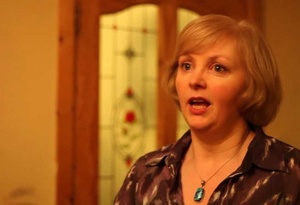
Breda O Brien of the Iona Institute

Breda O’Brien appeared on RTE R1’s Morning Ireland earlier to debate the same sex marriage referendum with newly wed (in London) Labour TD Dominic Hannigan.

Mrs O’Brien, of the Iona Institute, was asked to share her thoughts on whether she objects to parenting (other than a same sex situation) where children are raised by family members.

Audrey Carville: “Breda O’Brien, for generations in this country, grandmothers have helped their daughters raise their children. Do yo do you object to that?”

Breda O’Brien: “No, and I think one of the really good…”

Carville: “Why, what’s the difference?”

O’Brien:
“The reason that I don’t object to that is that our grandmother, helping out in a situation where…”

Carville:
“Not helping out, raising. Living with the daughter, raising the child, what’s the difference?”

O’Brien: “The difference is that that doesn’t do anything to a child’s right to a mother and father. That’s actually the difference.”

Carville:
“That child doesn’t have, in that instance, they don’t have access to their father. So what is the difference?”

O’Brien:
“And we consider that a loss. We don’t normally legislate for…”

Carville:
“What is the difference between those two people, raising that child and two lesbians raising a child?”

O’Brien:
“The difference is that if a child has come into a relationship, where there are two lesbians, it has come usually by one of two means. One, from a previous relationship and the other is by assisted human reproduction. If it’s assisted human reproduction, it means that a child has been deliberately brought into the world without access to one half of her identity.”

Carville:
“But what is the difference for the…”

O’Brien:
“Because that doesn’t apply in the case of the grandmother..”

Carville: “…good of the child. The father in the grandmother scenario, the daughter’s partner, the man who fathered the child, he’s not, he’s never been there…”

O’Brien:
“Audrey, you’re not suggesting, you’re not suggesting that granny and her daughter get married are you?”

Carville:
“What is, no, what is the difference?”

O’Brien:
“You can’t see the difference? Do you think we should change the constitution to allow grandmothers and their daughters to get married?”

Carville: “What is the difference in terms of..”

O’Brien:
“Do you think we can sort that out?”

Carvile:
“…protecting the child and the rights of the child and the good of the child? What is the difference?”

O’Brien: “The difference is if we change the constitution, we are changing that mother/father model. A grandmother, raising a child with her daughter, does nothing to change that model because they’re not asking for rights to be married and to be considered exactly the same as a man and a woman who have brought a child into the world. A grandmother is helping out in a situation where there’s already a loss. Now let me just say, in a situation where the only parents that a child has are two people of the same sex, I think the provisions in the Children Family Bill for Guardianship are excellent, there are a lot of things which are not excellent which would be unconstitutional and I don’t object to that. But we don’t need to redefine marriage in order to achieve those rights, no more than we need to say that granny and daughter need to get married in order to raise the child.”

Transcript of exchange between Breda O’Brien of the Iona Institute and RTE R1 Morning Ireland presenter Audrey Carville earlier

Podcast of show here

Earlier: After Sport

An earlier version of this post misquoted Breda O’Brien. Sorry.

The sofa of balance.

Yesterday: Iona Obsession

Update:

iona1

They think of little else.

In fairness.

Ciarán Ó Raghallaigh writes:

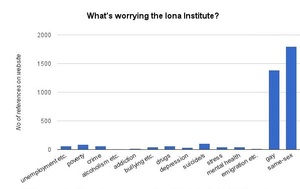
Because I have a lot of free time on my hands and no life, I spent some time last night doing searches on the Iona Institute [Catholic Multi-denomination think tank] website to see how frequently particular words appear on it.

Bear in mind they’re supposedly an organisation concerned with the rights of children and problems facing families and the institution of marriage in Ireland. So I chose words that I thought would be relevant.

I got the data from Google. You just type in each term followed by “site:www.ionainstitute.ie” – the latter part makes the search specific to the site itself.

So, for example, typing into Google “unemployment site:www.ionainstitute.ie” will return the number of references to the term “unemployment”. Ye probably know all this already. I’m just saying it so ye can check the figures for yourselves, if ye wish….

If the occurrence of particular words can be taken as an indication of what they’re concerned about, then their worries seem rather skewed towards one issue: gay people. Under the term “gay”, I didn’t even include words like lesbian, homosexual, homosexuality etc. That would have made the count even higher.

Iona Institute

logoquinnzraytf

Mothers and Fathers Matter is a group set up to say exactly that, ‘mothers and fathers matter’. We support and promote a child’s right to a mothers and fathers wherever practicable. We believe that the Government’s new Children and Family Relationships Bill is unjust because it says mothers and fathers don’t matter to children.

Mothers and Fathers Matter includes among its members David Quinn of the Iona Institute (top), Ray Kinsella (centre), a Pro-Life activist and Professor at the Michael Smurfit Graduate School of Business UCD and Tom Finegan (bottom), one-time assistant to Senator Ronan Mullen.

The website shares the same IP address as catholicbishops.ie, catholicireland.net, dublindiocese.ie, and gettingmarried.ie .

All because teh gays want to adopt your children.

Previously: Not So Fast, David

Keeping It In The Family

Joseph And The Amazing Off-Colour Dream Quote

breda_obrien100103412Breda O’Brien of the Iona Institute (top) and Dr Deirdre Madden (UCC)

Earlier, on RTÉ Radio One’s Today with Seán O’Rourke, Seán introduced an item on surrogacy with the following:

Seán O’Rourke: “And that’s Helen Hayes speaking last month about surrogacy. Now after that interview went out we received a call from Breda O’Brien of the Iona Institute expressing concerns about surrogacy. She’s with me now in studio and in our Cork studio, I’m joined by Dr Deirdre Madden, senior lecturer in Medical Law at University College Cork.”

[Later]

Dr Deirdre Madden: “Thus far, there has been no indication that children born through this means [surrogacy] have experienced any psychological problems. I do acknowledge when they do reach adolescence or when they are older that issue may arise. But as I say, for the moment the results are very positive.

Breda O’Brien: “But Deirdre you know those studies have tiny sample numbers, some of them are self-reporting by parents. It’s the parent’s estimation of the difficulties or otherwise of the children.”

Madden: “But this also Breda was introducing the children’s teachers in school and other adult figures in their lives.”

O’Brien: “In some cases the children don’t know as well. In some cases the children weren’t actually aware. I think the best thing we can say about studies is that they’re inconclusive, that they don’t show any evidence one way or the other.”

[Later]

Madden: “I think it is very paternalistic to suggest that women would not be able to enter into this sort of arrangement with full and voluntary consent.”

O’Brien: “In fact, it’s maternalistic. It’s the desire that women would be protected in the situation and the children be protected as well.”

Madden: “Most women don’t actually feel that the children that they’re carrying are their children, particularly but not only where the child is the full genetic child of the intended parents.”

O’Brien: “So you’re thinking of women as vessels then?”

Madden: “No. I’m saying that the women themselves do not consider the child they’re carrying to be theirs.”

O’Brien: “So therefore, they’re just a vessel?”

Madden: “That’s not how they consider it. They consider that they’re giving a wonderful gift to this infertile couple.”

O’Brien: “Which they are but at what price and at what cost and is it not better to follow the example of other European countries? You’re never going to get rid of it completely but you can send out a very strong cultural message that this is not the thing to do.”

Not Breda’s first or probably last time to debate an expert on Radio One.

Listen here.

Download here.

Previously: What The Man From The UN Said

Dr Peter Boylan and Breda O’Brien: The Transcript

Sasko Lazarov/Photocall Ireland

breda


Irish Times online editor Hugh Linehan is joined by IT columnist and Iona Institute patron Breda O’Brien to discuss the harrowing fallout from the homophobia hoo hah..

Scroll to the 6 minute 40 second mark.

Inside Politics (Irish Times)

Previously: Late De Hate

Leave It Mrs O’Brien

Pic: YouTube

Waters-e1390845844543

In August 2012, the UCD newspaper College Tribune interviewed John Waters for an article on gay marriage. The interview was conducted by the paper’s then editor James Grannell.

Anon writes:

“Quotes from  this interview have been widely circulated on social media in the last week, by Paul Murphy MEP in the European Parliament and by Senator David Norris on Friday’s Late Late Show.  I am sending this because the publication of further details from this particular interview is in the public interest, irrespective of whatever side of the debate any individual falls on. Of particular interest, perhaps, are previously unpublished sections around the 30-33 minute mark.”

We have transcribed the full audio [below] however some parts of the conversation were impossible to discern due to poor sound quality. We are happy to correct any mistakes.

John Waters: “Sometimes I speak to classes of foreign students in a certain language school. In this particular class I noticed recently,they had all Googled me. And they had kind of, you know, a few of them were kind of waiting for me.
Now I think under the kind of instruction of their tutor more than anything, it is not the kind of thing a class would do spontaneously. And, yeah there were certain headings: abortion, gay marriage…and they were kind of like, exactly as you say, they all held the same views, and they were all kind of convinced that I was some kind of backward, kind of, reactionary redneck and they were going to make a joke of me. So I just said okay, em, gay marriage, what do you want to know? So ‘why are you opposed to gay marriage?’ I said, well, in a certain sense I said, you know, it’s not even gay marriage that I’m opposed to: it’s the idea of gay adoption. Because marriage is fundamentally societies way of organizing the the nurturing of children into the next generation. Marriage is the crucible in which children… and we had all that semantic, pedantic, argument that goes on in the whole country, some people blah, blah, blah, bullshit.
And, but I said, you know, where are the children going to come from for gay couples to adopt? Presumably these children are going to have other parents, real parents, fathers and mothers. What is your position on that? Do you have a position? Because I can tell you that the people who advocate gay marriage have nothing to say on this spectrum at all.”

James Grannell: I found that in my interview…

Waters:
“Yeah.”

Grannell: “…they are…”

Waters: “They’re not interested in the words like (inaudible)

Grannell: “No. And it doesn’t really come into their conversation.”

Waters: “Well I would go further and say that actually it is obviously an obstacle (inaudible) the parents.  supply of children for the gay couples to adopt…you know, about adoption initially being to create conditions in which the child who had been deprived of his parents or her parents for whatever reasons: death, incapacity, whatever, to have the same chances as other children by having society replicate, in so far as possible, the conditions of a normative family for that child. Now we have inverted this…”

Grannell: “Yeah.”

Waters:
“…into the idea that the child has become the product, the commodity, that is supplied to different , differently defined alternative families. This is not what adoption is and then I said that, there was this guy who was being particularly vociferous in the front row, and I said to him, you know, supposing you get your girlfriend pregnant?
I don’t know, he might have been from France, but in Ireland, if this happened to a young man. You would find that you had actually zero rights. You have a right to be consulted, which means they’ll tell you – maybe, if they can find you – if the mother says where you are, and they’ll tell you that the child is going to be adopted.
But I can tell you one thing, you do not have the right to adopt your own child. You do not have the right to say that you were child should not be adopted, you know, you have the right to apply for guardianship to the court, which may or may not be granted and if it isn’t granted well then you can forget about it. Do you care about that? Do you care about your own human rights?
So, what I’m saying is that there are lots of arguments that you obviously haven’t heard about this. Don’t think that this is something you can just jump on to become a fashionable person – to become a person with the right opinion. If you’re going to have opinions, by all means, whatever opinions you want, arrive at them on the basis of reason, and logic, and the facts. But don’t be coming to me thinking you’re superior to me because you actually happen to have a different – you know, a certain opinion which you picked up from your fashionable teacher or your fashionable friends. So this is not limited to abortion, which is even more interesting and I go into that in the article in the Irish Catholic. So. And that’s really the general experience. And you find that with politicians as well. Politicians see this as an opportunity to advertise their liberal credentials.”

Grannell: “Do you think that is a big part of it? These people are talking . I know that David Quinn has mentioned it to me and I was talking to Brendan O’Neill in London. And some people have been saying that, at a time when politicians don’t have much moral weight with people, this is something they can latch on to and show that they’re liberal and that they’re all for equality. Do you think that it’s been latched on to by them?”

Waters: “And interestingly it is the more conservative – quote, unquote – who are most vulnerable to that because they’re looking for brownie points. They think it doesn’t matter, they don’t really care, fundamentally, it’s not an economic issue in an obvious way. It’s not something that their careers will live or die on and so it’s an opportunity to buy credit, you know, in Ireland, with the Irish Times. Oh he’s a liberal, on that issue at least he’s on the right side, so we’ll cut him some slack somewhere else, you know. If you’re in Fianna Fail, you need some slack right now. That’s why Fianna Fail in its recent Ard Fheis had a whole movement which swept the board pushing gay marriage when in fact there there is no discussion at all, none, no discussion. And I actually spoke, I was actually at the Ard Fheis, and I actually raised this question and I said hang on, don’t get carried away with this have a discussion about it because there is lots of issues which you should be looking at here and which you won’t get another chance to look at.”

Grannell: “Do you think there is a danger there because in UCD, there is really isn’t any discussion ongoing? Do you think there is danger on a national level as well, that without proper debate, proper discussion, and people actually looking at both sides of the argument, that something that could be cast into law which will prove two or three years down the line perhaps to cause huge issues…”

Waters: “Oh I have no doubt about it and I think it is going to happen and I don’t think there is any way back from it now, because the way that this is being set up, where there is almost a blackmail clause involved, you know, whereby if you don’t support it you are a homophobe and this bullying is actually silencing people and it is preventing any kind of open discussion people are actually afraid to go out now and march on this issue and you are smeared at and ridiculed and particularly at a time of the internet and the way that they use the internet to bully and harass people and demonise people and I think that it is having this effect. So it is eventually going to happen, and of course the consequences will flow and among the consequences I predict will be the whole, this is really a kind of a satire on marriage, that is being conducted by the gay lobby. It is not that they want to get married it is that they want to destroy the institution of marriage because they are envious of it and they see it as a, really, as an affront to their equality.
“It doesn’t mean much, it doesn’t really mean much, this is the interesting thing, when they were fighting for civil unions, and I raised this question that what they really were wanting was marriage, what they what they were really wanting was adoption. They all denied it, oh no no no, that’s completely paranoia we have no interest in marriage at all, this is about our civil rights. Fine, I have no problem with your civil rights, so that’s fine, you’ve got that but the next day they got out of bed and started to campaign for marriage which is purely an attempt to discredit an institution, a normative institution, on which society, on which human civilization, is founded, and inevitably if you do that there will be consequences, and among those will be be that marriage will become really a nothing in our culture, in time.”Continue reading →