



Kenny & Gilmore had to know Ireland would have better leverage post French Pres & parliamentary elections, yet they still went 4 referendum.
— Declan Ganley (@declanganley) April 23, 2012
Tag Archives: Referendum
 A ‘No’ vote in the upcoming May 31st referendum will damage Ireland’s ability to borrow, according to a ‘major international financial institute’ which sez (without a scintilla of irony):
“Our general view on the Irish situation is: here’s your success story, and what we’re hopeful for is that that success story doesn’t get bumped off course.”
The institute, which draws its directors from Deutsche Bank, Commerzbank, Goldman Sachs, UBS, HSBC and Morgan Stanley, has told its members to be on alert for three strands of news from Ireland: economic performance following a new wave of fiscal austerity; opinion polls on the referendum; and “the rise of Sinn Féin” in polls.
“One of the things we notice is: Sinn Féin is quite supportive of taking a tough line on the promissory note issue. That’s something which will make international investors nervous,” (institute chief economist) Mr (Phil) Suttle said.
International investors. Mmf. We owe them so much.
Bankers Warn Of No Vote Risk As EU Treaty Date Set (Irish Times)
No Deal
at That proposed delay on the €3.1 billion cash payment due on March 31?
Not looking good.
More than six months after Dublin first raised the matter with the ECB, the Frankfurt-based institution is pushing back heavily against persistent Irish demands for a concession to ease the cost of rescuing the former Anglo Irish Bank.
Within the ECB, the view remains that alternative avenues are open to the Government to improve its finances, among them reductions in public sector pay and welfare entitlements.The argument is made that average public pay and welfare levels in Ireland are higher than the average in some of the other euro zone countries that are supporting Ireland’s bailout, among them Spain, Slovenia and Slovakia.
Push to get debt burden reduced hits strong ECB resistance (Irish Times)
Meanwhile in other ‘Good Luck With That’ news:

THE GOVERNMENT has moved to quash suggestions from within Cabinet that Europe should cut the cost of Ireland’s bank debt burden to boost support for the fiscal treaty referendum.
The Taoiseach, Tánaiste and Minister for Finance moved swiftly yesterday to declare that there should be no link between the referendum and the Government’s drive to ease the terms of the Anglo bailout.
They were responding to remarks by Minister for Social Protection Joan Burton in which she said a move to restructure the expensive IOUs used to recapitalise Anglo would aid the referendum campaign.
“These are entirely separate matters, in other words, the Irish people are not going to be bribed by anybody,” Mr Kenny told reporters in Brussels.
Yes, quite right.
Wait. What? No! Tell us more about the bribes!
Coalition rejects seeking Anglo concession to secure Yes vote (Irish Times)
Bray Says No
at

 Just no.
Opposite Bray DART station today.
Thanks Scooby

Ah, feck it, it’ll make no difference. Even if Ireland votes against the FU Treaty, it’ll be imposed anyway. It’s what happened when the country voted against Nice in 2001, and against Lisbon in 2008. Brussels won’t take ‘No’ for an answer.
Why Ireland should say FU to the FU Treaty (Daniel Hannon, Telegraph)
While the new treaty appears to enjoy more support in countries such as Germany — where famously frugal taxpayers have been heavily tapped to bail out Greece, Ireland and Portugal — in Dublin and elsewhere, opponents say they see their sovereignty at stake.
“I don’t think the Irish feel we have any sovereignty left anymore,” Shay Moran, a 41-year-old unemployed semiconductor engineer and treaty opponent, said recently at Dublin’s Gravediggers pub, where Irish revolutionaries once plotted against British rule. “All I see is [German Chancellor Angela] Merkel wielding a big stick and telling us what to do.”
Ireland to become a test for Europe’s fiscal accord (Washington Post)
An Irish “no” would not block implementation of the fiscal treaty, as it only needs the backing of twelve euro area countries to come into effect. But a rejection of the fiscal compact would have serious financial and economic consequences. For one, it would mean that Ireland does not qualify for future financial support from the European Stability Mechanism, the euro zone’s bailout fund, since access to the ESM is conditional on ratification of the treaty.
This Time Is Different (The Economist)
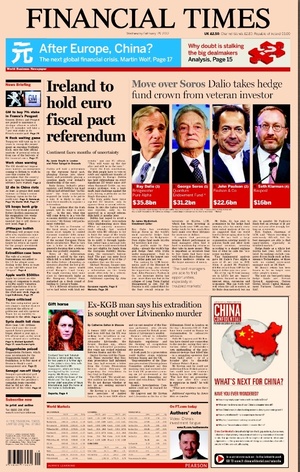
Dublin will hold a referendum on the eurozone fiscal pact, plunging Europe into months of uncertainty and potentially placing a question mark over Ireland’s membership of the euro……A no vote would mean Ireland was not eligible for funds from the European Stability Mechanism, the eurozone’s new bail-out fund. The pact can enter force with the support of 12 of the 17 countries that use the euro, effectively removing any single nation’s veto over the accord. Michael Noonan, finance minister, warned in December that a referendum on the treaty would effectively be a referendum on euro membership.
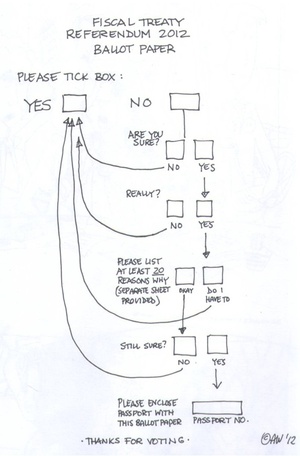 Thanks @Annie West

It’s democracy dude.
It’s supposed to be boring.
Via Merrion Street:
Taoiseach’s statement to Dáil Éireann – Referendum on European Stability Treaty
I am pleased to have this opportunity to inform the House that the Irish people will be asked for their authorisation, in a referendum, to ratify the European Stability Treaty.
I strongly believe that is very much in Ireland’s national interest that this treaty be approved, as doing so will build on the steady progress the country has made in the past year.
That progress has seen international and investor confidence in Ireland rising, leading to many new investments in our country – investments that are creating new jobs for our people.
I want that flow of investment to continue and expand.
Ratification of this Treaty will be another important step in the rebuilding of both Ireland’s economy, and our international reputation.
It gives the Irish people the opportunity to reaffirm Ireland’s commitment to membership of the Euro, which remains a fundamental pillar of our economic and jobs strategy.
More binding and enforceable fiscal rules as a result of ratification will be good for both Ireland and the wider eurozone, and will cement growing international confidence in Ireland’s recovery.
Long before any discussions of a new set of fiscal rules for the eurozone, the new Government had committed itself to legislate for equally challenging domestic deficit and debt rules.
In this referendum, the Irish people can confirm our commitment to responsible budgeting and, in doing so, ensure that the reckless economic mismanagement that drove our country to the brink of bankruptcy will not be repeated by any future Government.
Putting in place this credible commitment to responsible budgeting will be key to keeping interest rates low and unlocking credit availability for investment and job creation. Lower interest rates also mean more resources for the provision essential public services.
The creation of stronger fiscal rules is an essential element of the steps that are needed to ensure stability, confidence and growth here in Ireland, and in the Eurozone.
Throughout the process leading to this new Treaty, the Government has consistently said that the final text would be referred to the Attorney General for her advice as to whether a referendum was required to ratify it in Ireland.
At this morning’s Cabinet meeting, the AG conveyed her advice that, as this treaty is a unique instrument, outside the European Union treaty architecture, on balance, a referendum is required to ratify it.
On foot of this advice, the Government has decided to hold a referendum on this issue in which the people of Ireland will be asked to give their authorisation for the ratification of this treaty.
On Friday, along with other heads of government, I intend to sign this treaty in Brussels.
In the coming weeks, the Government will finalise the arrangements and process leading to this referendum, including the establishment of a referendum commission to ensure adequate public information is provided, a referendum bill which will be debated in the Oireachtas, and draft legislation to provide for the implementation of the treaty’s provisions will be published.
I am very confident that, when the importance and merits of this treaty are communicated to the Irish people, they will endorse it emphatically by voting Yes to continued economic stability and recovery.
I look forward to that debate – one which I believe will produce a result that will be seen in the future as an historic milestone in Ireland’s economic comeback.
Was it something we said? twitter.com/conorjh/status…
— 355⁄113 (@conorjh) February 28, 2012
Could that be true?