Tag Archives: RTE

Earlier today.

On RTÉ’s Morning Ireland.

Journalist Dr Gavin Jennings interviewed Leonard Doyle, spokesperson for the International Organisation for Migration, after a boat bound for Italy capsized off Libya on Monday.

At least 40 people went missing and are presumed dead, while the Libyan Coastguard picked up around 60 people.

Most of the people on the boat were reportedly from Sudan.

A similar incident claimed the lives of about 100 people last week.

From the interview:

Dr Gavin Jennings: “And it was the Libyan Coastguard who came to their rescue, yes?”

Leonard Doyle: “I mean this is a contentious point but yes, the Libyan Coastguard has been intercepting or rescuing, depending on your point of view, for some considerable time now and then bringing them back to Libya where their fate is not always certain. I mean some have gone into detention, some not. In this case, probably not.”

Jennings: “Were there not Italian boats who were also supposed to be available to help as well?”

Doyle: “There is a big issue with search and rescue in Europe at the moment which is what I think you’re alluding to. The European Union has declined to provide the rescue services that were there for a long time, the search and rescue, in the belief that this is an attracting force, bringing, attracting smugglers to push migrants into sea and in flimsy vessels. And we’ve seen a lot of evidence of that.

“At the same time, the European Union has been supporting the Libyan Coastguard and are trying to get them to abide by international law, to follow human rights, etc. It’s not always been the case. As you know there were 150 people killed in an airstrike over a month ago. People had returned after being rescued at sea. So it’s a complicated, difficult issue. We’re going through a very bloody war at the moment. The worst in many years. So it’s complicated.”

Jennings: “And there were two planes that were being used by NGOs to search for migrant boats in the Mediterranean that were grounded this week?”

Doyle: “The political mood is very tough in Europe at the moment when it comes to migration. Even though those crossing the Mediterranean, mostly Africans, are a tiny number of people, the political mood has grown deeply hostile and deeply populist and one of the expressions of that is a crackdown, if you will, on NGOs who are doing very, very important life-saving work, search and rescue operations, SARs its called. It’s, it’s a terrible situation.

“Lives should not be part of politics. Saving people’s lives should not be part of politics. The impression one has from political and media sources is that there’s an invasion of people, it’s tiny. The numbers are tiny, as you mentioned. 54 people survived, that’s not a lot of people.”

Jennings: “Tell us about the scale of numbers, this summer, for example. I mean have recent moves by, for example, in Italy made any difference. Are there less people now trying to cross the Mediterranean as a result?”

Doyle: “I mean it’s hard to pinpoint one country’s actions for creating an effect. But undoubtedly the work, the really good work is being done by the European Union throughout West Africa, in particular, in helping people avoid make tragic journeys is having its own impact. There’s a lot of awareness raising going on, there’s a lot of informing people along the way – of the dangers ahead. And the dangers are terrible.

“The smugglers are the first people to blame, not the policymakers at the end of the day. The policymakers may get it wrong in our opinion, but they’re not the ones who are creating the havoc. So a lot of effort has taken place into investing in the so-called, you know, upstream routes that the migrants take into informing them of the dangers ahead if they go to Libya. That they will be incarcerated, they will be abused, they’ll be tortured and all that sort of thing.

What happens on European shores I think is probably marginal at the end of the day.”

Alternatively…

Listen back in full here

Related: EXCLUSIVE: UN probe finds Sudan staff member solicited bribes from refugees (Sally Hayden, The New Humanitarian, August 15, 2019)

Previously: Into Harm’s Way

‘Our Naval Service Is Part Of It’

Image: Al Jazeera

Chief Medical Officer at the Department of Health Dr Tony Holohan; Lorraine Walsh

This lunchtime.

RTÉ’s health correspondent Fergal Bowers, on foot of a Freedom of Information request, is reporting on correspondence he has seen between the Chief Medical Officer at the Department of Health Dr Tony Holohan and CervicalCheck patient advocate Lorraine Walsh from March of this year.

Ms Walsh, from Galway, who was one of the women caught up in the CervicalCheck scandal last year, cannot conceive due to having had cervical cancer.

She is also one of the Government’s appointees to the CervicalCheck steering group.

Mr Bowers has reported that Dr Holohan – who is co-chairperson of the CervicalCheck Group – wrote to Ms Walsh on March 13  of this year taking issue with comments she had made on social media, and to print media, about him.

He reported the letter said her claims about him were “baseless” and it warned her that if she repeated the claims in public, there would be a “very strong response”.

He also asked her to withdraw the claims.

Mr Bowers reported that the letter was also released to Labour TD and the party’s health spokesperson Alan Kelly, following a parliamentary question and separate FOI request by him.

On RTÉ’s News At One, Labour TD Alan Kelly told Mr Bowers:

 “I sought this information under parliamentary question in early July. The department refused to give it to me. I had to chase this for two months.

“I had to repeatedly go to the Ceann Comhairle and it was only after the Ceann Comhairle wrote to the minister that basically, telling him, that this was against the constitutional responsibilities of a minister, that we’d got to a point where this information was released to me.

“I had no faith that this information was going to be given to me so I had to put in a Freedom of Information request on top of my parliamentary question.

“TDs shouldn’t have to put in Freedom of Information requests because they believe that their parliamentary questions are not going to be answered.”

Mr Bowers told News At One that a spokesperson for the Minister for Health Simon Harris said Mr Harris was not aware of the letter in advance of it being sent from Mr Holohan to Ms Walsh.

Walsh warned over repeating CervicalCheck management criticisms (RTE)

Rollingnews

Yesterday’s Sunday Times; RTÉ’s Miriam O’Callaghan; Conservative MP Marcus Fysh

This morning.

On RTÉ’s Today with Miriam O’Callaghan.

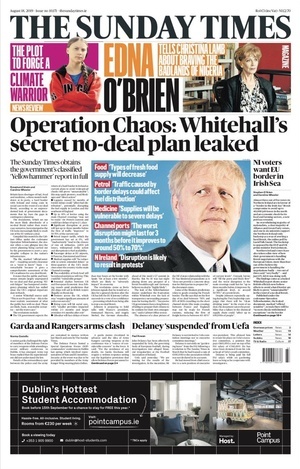
Pro-Brexit Conservative MP Marcus Fysh spoke to Ms O’Callaghan in light of yesterday’s reports in The Sunday Times based on a leaked secret “Yellowhammer” report on the fall-out of a no-deal Brexit.

The newspaper reported that Britain faces “shortages of fuel, food and medicine, a three-month meltdown at its ports, a hard border with Ireland and rising costs in social care” if no deal is made.

During the interview, Mr Fysh alleged that the leaked memo was “left in a pub” for a journalist to find.

From the interview…

Marcus Fysh: “This is a scenario that doesn’t have to happen.”

Miriam O’Callaghan: “How are you going to avoid this? This is your own government’s assessment of what is likely to happen in the case of a no-deal Brexit.”

Fysh: “Michael Gove, who’s in charge of it and his assessment is that it doesn’t have to happen if we do the right things and that the Government is doing those things to make sure that this is not a thing that comes true.”

O’Callaghan: “But what can your government do, realistically do?”

Fysh: “The point is that we need to ready all of those involved in the cross border trade to make the right declarations, so they have the right papers, so that when they arrive at Calais, they can show the transit documents that they need to get through that border efficiently and then I don’t think there’s any prospect in that situation that the Border would fall over in such a disruptive manner which is at the core of all of these worst-case assumptions.”

“But, yeah, we need to make sure that everybody has the right information and is ready to do the right thing so that that doesn’t happen.”

O’Callaghan: “But I mean, even specifically, in relation to this, civil service detail in this report. According to the documents, petrol, import tariffs could inadvertently lead to the closure of two oil refineries while protests across Britain, which require significant amounts of police resources.”

Fysh: “Well I just thing that that’s, that’s a really bad assessment. I can’t see the logic of that position. I think, to be honest, the civil service have questions to answer, as to why this has been leaked and I think it’s part of an establishment effort to try to scare people. The point is that if you have cheap imports of fuel, then the fuel is available, otherwise those refineries don’t have a problem.”

O’Callaghan: “But Marcus Fysh, it’s almost like, with respect, Tory MPs, like you, are delusional. I mean this is your own civil service coming up with this detail. It’s dated this month, this is what they believe what might happen.”

Fysh: “This is what they have left in a pub for a journalist to find. I think that tells you all you need to know about the motivation. It could have come from the civil service, it could have come from anywhere. But the point is that we know that there are lots of people that don’t want Brexit to happen. And have been trying to scare people into not wanting it. And this is their, sort of, last throw of the dice. The reality is that Brexit is going to happen and we need to prepare for it and we need to prepare for it right.”

Listen back in full here

Related: Operation Chaos: Whitehall’s secret no‑deal Brexit preparations leaked (The Sunday Times)

From top: RTÉ Television Centre; Minister for Communications Richard Bruton

This morning.

The Government has agreed to replace the TV licence fee with a “device independent broadcasting charge”.

Speaking on RTÉ’s Morning Ireland, Minister Bruton said the new system must be ‘robust’ and capable of addressing the rapidly changing media and technology landscape.

He said a working group set up to examine the issue had not established whether everyone with a smartphone or tablet would have to individually pay the charge, adding that those details had yet to be ‘worked out’.

A new five-year contract for the collection of the licence fee will be put out to public tender later this year….

Govt announces major reforms to TV licence fee (RTÉ)

Rollingnews

Meanwhile…

https://www.youtube.com/watch?v=3SNHTGq0r7c

Cork/Galway All-Ireland fan shenanigans.

Croke Park, September 7, 1986.

Can you spot Frilly?

Via KillianM2.

A wonderful, constantly-updated bumper Irish telly archive (not only sport) on YouTube.


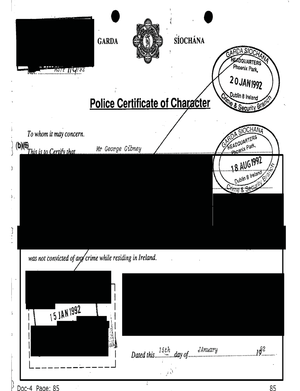
From top: a certificate of character signed by An Garda Síochána for George Gibney’s US visa application in 1992; former Irish swimming coach George Gibney; journalist Irvin Muchnick (right)

This morning.

American sportswriter and journalist Irvin Muchnick spoke to Seán O’Rourke on RTÉ Radio One about former Irish swimming coach George Gibney.

Mr Muchnik is visiting Ireland this week as he launches the second eBook edition of his book about Gibney.

Gibney was charged with 27 counts of indecency against young swimmers and of carnal knowledge of girls under the age of 15 in Ireland in April, 1993.

However, he moved to the United States in 1995, the year after an unusual and controversial decision by the Supreme Court led to the quashing of these charges.

He was also granted a visa during a visit to the United States in 1992 – seemingly aided by a Garda character reference – a year after people who had been abused by him started to speak up and organise themselves.

Justice Roderick Murphy’s later Government-commissioned report into sex abuse and Irish swimming in 1998 concluded that Gibney’s accusers “were vindicated” by the accumulation of Garda evidence.

These accusers included a woman who alleged she was indecently assaulted by Gibney on a swimming trip to Holland in 1990 and, the following year, raped by him in Florida in June 1991.

From this morning’s interview…

Sean O’Rourke: “I gather that you believe that this year, 2019, might signal some changes in this case. Tell me why.”

Irvin Muchnick: “Well, the reason is that widespread scandals in the Olympic sport programmes in the United States have come to light through the USA Gymnastics scandal and there are federal investigations of racketeering and insurance fraud involving USA Swimming , USA Taekwando and other groups and those are the real reasons why 2019 I think is going to be the year of reckoning for George Gibney.”

“We’ve learned from a Freedom of Information Act case that Gibney unsuccessfully applied for American citizenship in 2010, I believe, hoping to inoculate himself from these ongoing serial efforts to get him extradited and brought back for justice in Ireland.

“And in a quirk, he was denied citizenship because he lied on his application about his Irish past but, strangely, nothing happened in terms of his Green Card and his permanent resident/alien status in the United States.

“So, what my new reporting has uncovered is that there’s not just paperwork issues with George Gibney but perhaps other acts he committed while he was in America.

“He was the leader of a church group, medical mission, to Peru that involved a strange Catholic sect called the Sodalitium Christianae Vitae and those are some of the things that are coming to the fore for federal investigators right now.”

O’Rourke: “Coming back, you say he tried in 2010 to get American citizenship but he was declined it or denied it on the basis that he had filed false information?”

Muchnick: “Right. What the Freedom of Information case documents revealed is that US Citizenship and Immigration Services kicked his application back to him and said ‘you want to give this another go?’ because you have to disclose not just whether you have ever been convicted of a crime but whether you’ve ever been arrested, charged, indicted.

“And evidently he didn’t comply because his citizenship application was denied.

“But the weird Catch-22 is that, at the same time, another federal agency in the Department of Homeland Security, Immigration and Customs Enforcement put out a letter that said he could not be removed from the country because he had never been convicted.

“So this is the conundrum that we face this year.”

O’Rourke: “And how is he getting on, living in the United States? I mean you and other people have shone a lot of light on his background here in Ireland and on the questions that have been asked. So how has he been doing? He’s there now over quarter of a century?”

Muchnick: “Right it’s a front-page story in Ireland, it’s kind of crickets in major media. I have a small outlet trying to shine light on this and he’s basically hiding in plain sight. He coached briefly, we think, because of a recommendation from the American Swimming Coaches Association – which should be accountable, as should be USA Swimming.

“But after his Irish past was exposed locally, in Colorado, in 1995, he backed away from his swimming career but he’s had various jobs. He’s now living in Altamonte Springs, Florida, we believe, just north of Orlando.

“And I call it hiding in plain sight.”

O’Rourke: “But is there any reason to believe, I mean, you say, you talk about this background of scandals in gymnastics and taekwondo and US Olympic circles, but why should that, or how might that be brought to bear and turn up the heat on George Gibney?”

Muchnick: “Well the reason is that there are federal investigations looking into all these things. I think the FBI and other federal agencies are a little bit embarrassed that they were asleep at the switch on the gymnastics scandal. So they’re looking to, to make good on that, and clean up the Olympic programmes in some way.

“So I think, paradoxically, by not having this intense focus just on Gibney, he’s marginally out there and I do know that investigators have been reading my reporting and have determined to act on it.”

O’Rourke: “And is there a sense that what he might face would be deportation or would it be extradition?”

Muchnick: “Well it would be extradition. It’s kind of thing where the Americans are saying ‘after you, first’. And the Irish are saying ‘we want you to do something’. The Garda and American law enforcement have to start talking to each other under EU protocols and share information.

“We know that Gibney had one known crime on American soil in 1991 in Tampa, Florida, and so that could be a basis for…”

O’Rourke: “Is that a conviction now?”

Muchnick: “No, it’s not.”

O’Rourke: “Strictly speaking, you cannot say someone has a known crime unless they’re convicted of it.”

Muchnick: “That’s correct and that’s always been the difficulty at getting at this. But my understanding is that in Ireland there’s been a revisiting of that controversial 1994 Supreme Court ruling that effectively quashed his indictment and that could be looked at again. There could be new victims…”

O’Rourke: “There could be new victims coming forward or new claims that will have to be investigated.

“Do you know, as of now, whether there is a request for George Gibney, submitted to the US authorities by the gardai here or by the Director of Public Prosecutions, for his extradition to this country?”

Muchnick: “I think we know pretty clearly there is not one as yet. However, in 2015, TD Maureen O’Sullivan did ask the Director of Public Prosecutions to look at this again. And I understand that that matter is ongoing.”

O’Rourke: “I know that every time this case is discussed, it causes distress to the victims. They must feel disheartened that it drags on. I think some of them have found a way of just putting it behind them in so far as is possible. And accepting that they’re not going to see justice. But, you know, with no apparent resolution, I’m wondering why you continue to pursue it, Irv. Do you actually think you’re getting somewhere?”

Muchnick: “I do and I’ll tell you why in a moment. But I am looking forward to meeting a victim while I’m on my Dublin visit tomorrow. I do understand the pain that they’ve endured for many years and I do understand that many of them are ambivalent at this point, having had their hopes dashed so many times in the past, as to whether this is even good for them to do this.

“But my message to the Irish is that this is not just about the victims, this is about a system of institutions in global sport that enable bad actors, like George Gibney, to do what they do. And so it’s so important to hold accountable Swim Ireland, USA Swimming, most especially the American Swimming Coaches Association and so I hope that we can work together on that, moving forward to clean up sports.”

O’Rourke: “And what about the current climate in which, for instance, you have President Trump speaking out strongly against, I suppose what he would describe, generally, as undesirables. I mean might that somehow contribute to increasing the pressure on George Gibney?”

Muchnick: “That’s a great point and a great question and I think that it’s the real reason there’s hope right now. That even though Donald Trump has weaponised the immigration question and he’s demonised Central Americans and Muslims, not so much white Europeans, there’s still a movement there is some indication that bad guys from Ireland have been sent back, other than George Gibney.”

O’Rourke: “But do you know, or do you know of particular individuals in the United States’ system of immigration and law enforcement, whatever you want to call it, who are on this case?”

Muchnick: “Yes. I know that there are federal agents who are involved in these swimming investigations who are taking a specific look at George Gibney right now.”

O’Rourke: “OK, well no doubt you and we will continue to keep an eye on this situation and bring any developments to our audience. Journalist, investigative journalist, Irvin Muchnick, thank you very much for coming in.”

Muchnick: “Thank you for having me.”

Listen back in full here.

Previously: ‘There Is No Excuse’

Unreasonable Delay

Minister for Health Simon Harris; Quest Diagnostics

Last night.

It emerged that approximately 800 women who had CervicalCheck tests carried out between October 1, 2018, and June 25, 2019, have not received their test results because of an IT issue at a Quest Diagnostics laboratory in Virginia in the US.

It followed one woman affected making inquiries about her own test results.

Most of the women affected were getting repeat tests for the human papillomavirus HPV – which can cause cervical cancer – because Quest had previously carried out HPV testing on the women’s initial smears beyond the 30-day limit.

RTÉ have reported that the HSE told the Department of Health on Wednesday that it became aware of the IT problem in June.

This morning, Fianna Fáil TD Stephen Donnelly told Seán O’Rourke on RTÉ’s Radio One:

We need to understand why the HSE took so long to inform the department. We know last year, when CervicalCheck [scandal] broke, that actually the Department and the HSE had been going back and forth and it was in reference to preparing the minister for the fact that Vicky Phelan’s case was about to break and that that could lead on to knock-on implications as of course it did.

We want to know why the department wasn’t informed. And, indeed, maybe they were informed but they were informed informally.”

“…Why wait until an hour after the Dáil goes into recess to let the information out publicly. Why, if it’s not a big deal, were the minister, or the HSE, a no-show on Morning Ireland this morning?

If this is not a big problem then we need to hear from the political leadership and the administrative leadership to explain that.”

Mr O’Rourke told his listeners that his programme also asked both the minister and the HSE for a spokesperson but neither were available.

Listen back in full here

800 women did not receive CervicalCheck results after IT issue at US laboratory (RTE)

Rollingnews

Clockwise from top left: Graham Norton, Ryan Tubridy, John Humphreys and Seán O’Rourke

‘eoin’ writes

In the UK (population 65m, 13x Ireland), the BBC publishes the list of staff paid £150,000+ (€168,000) a year in the year to April 2019 (that is, for a period which ended three months ago)….

John Humphrys, a titan of broadcasting whose daily 3-hour radio show gets around 5m listeners is paid £290,000 (€325,000)

In Ireland, Sean O’Rourke was paid €308,964 by loss-making RTE in the year to December 2016.

Meanwhile, Graham Norton only gets £610,000 while the mediocrity on the loss-making RTE Late Late Show gets €495,000 (excluding royalties on his book which exploits the Toy Show “jumper” thing)?

Also if the BBC can publish presenter salaries within 3 months of the year end, why does it take loss-making RTE 22 months?

Here’s the full list of BBC on-air stars earning over £150,000

BBC pay: Claudia Winkleman, Zoe Ball and Vanessa Feltz among top earners (BBC)

Related: Vanessa Foran: Reeling In The Year

Robert Shortt

This morning.

Host of the next CRASH.

Via RTÉ:

RTÉ News is pleased to announce the appointment of Robert Shortt as its new Economics Correspondent [replacing Sean Whelan who becomes  the station’s London Correspondent] Robert has been a reporter with RTÉ Prime Time for the last ten years.

He will be responsible for reporting and providing analysis of economic issues across RTÉ News’ television, radio and digital platforms.

Mr Shortt said:

“I’m absolutely delighted to be offered the chance to report on the economy at this critical juncture. Brexit, the challenge of combating climate change and the housing crisis are all issues forcing change and big economic dilemmas. I can’t wait to get started.”

*cough*

Earlier: Everyone’s A Critic

Pic: RTÉ