Tag Archives: RTE

RTÉ One will broadcast a feature length documentary profiling businessman Denis O’Brien next week.

Lawyers.

Set your VHS players.

Gareth Naughton writes:

In ‘Denis O’Brien: The Story So Far’,  RTÉ’s David Murphy follows O’Brien’s business career from early ventures including a home shopping channel which collapsed, his early successes in radio, the launch of telecoms group Esat and the controversial award of the second mobile phone licence.

It includes an interview with Michael Lowry

…Former US President Bill Clinton

..and contributions from former INM executives Gavin O’Reilly and the company’s late chairman James Osborne.

FIGHT/Sue!/Injunct!

Denis O’Brien: The Story So Far will air on RTÉ One on Wednesday, July 4 at 9.35pm.

Pic: Getty

From top: Dee Forbes, Director general of RTÉ and Tony Hall, Director general of the BBC; Vanessa Foran

When RTÉ made their YE 201E available my quick scan had a predictable response; everything is as expected. Glossy, full of talk about themselves, the movements on the balance sheet to reflect the well-known sale of land, and of course Dee Forbes’ salary.

So rather than file it under a Broadsheet standard “nothing to see here” tag I decided to measure a few values against another national broadcaster reliant on statutory licence fees; the BBC.  One presents Financial Statements as Group, the Other as Consolidated. RTÉ have a Calendar Year End, the BBC have a March YE.

While scanning both I was indeed mindful to the size and reach of both organisations, alongside the licence fee income and the global reach of one, and the advertising income opportunities of the other.

Therefore, I only used total income over a full 12 month trading period as a denominator rather than split out, and convert into a single currency needed for a proper drill down. Which would be meaningless to a large degree anyway, as one would be including direct costs for special events ie. Brexit Referendum and both values are compiled from very mixed reporting periods.

So, in so far as a quick drive-by evaluation would allow, here some stats that might be considered as reasonable benchmarks within that industry.

Please also bear in mind, I have only picked off a few to run simple Ratio Analysis calculations against. The purpose of published accounts and reports of any organisation is to allow all stakeholders access themselves and form their own opinions, so here is what was interesting to me.

Some 95% of the BBC’s total expenses in the 12 months ending March 2017 was spent on Content and Delivery; in real terms, 5% is what comes out of their total income to run the organisation’s back office functions.

To put this in context; RTÉ reports a total Income of €337.6 million; of which €27.365m was spent on Acquired Programming; 8% if you are wondering. This does not include Sport Copyrights & Licences if you were wondering that too; 5.5% of total income by the way.

For those who might assume that Acquired Programming refers to content subbed in from local production companies and sub-contractors, let me also provide this figure – €38.62m for Direct Acquired Programme Costs; or 11.4% of total income.

Thankfully the RTÉ report provides an easily interpreted graphic to give you an idea of how many are employed by the Television dept:

An interesting question is how much of its overall programming hours are fulfilled by these Acquired Programming and Direct Acquired Programming expenditure items.

Meanwhile, to get a look at another suite of cost:total income tests here’s one of the old reliables; Executive & Board Renumeration.

Total Board costs as a % of Total Income: BBC .06% (.0006 of total Income) RTE .1% (.001). Dee Forbes’ 338k v Tony Hall’s 467K; one hundredth of RTÉ’s total income: one thousandth of the BBC’s.

That above should be digested alongside with this; Dee Forbes leads an organisation that in its last set of accounts reported €337.6 million income, of which 55% is Licence Fees, and employs (average WTE for year) 1,924 people.

Whereas Tony Hall is responsible for almost 21,000 employees (over 10 times more than Ms Forbes) and for an organisation that collects st£3.74billion from UK Licence payers and earns itself another st£1.2billion (again way over 10 times more than Ms Forbes.)

As a % of income and staff complement there is absolutely no arguing the value of money lapse just on this benchmark alone. But I would add that Tony Hall is probably being short-changed.

Yes, I know this is flame-throwing. But it is worth noting nonetheless that straight away the TV Licence Payers in the UK get significantly more out of their National Broadcaster than the Irish Licence Payer.

RTÉ is on a road to nowhere which only exposes the Irish Taxpayer to further financial risks. It needs to radically change every way it does business and at every level within the organisation. It continues to achieve cost cuts and they have the graphic to prove it:

But even this alongside the carving from the Land & Buildings on its balance sheet, they are only fooling themselves if they think realising cash here is all they need to do. The entity’s costs are still not under control when it is having to sell its silver rather than innovate.

Commissioning a new season of a series they have not already managed to sell on is pointless and not in any way strategic or wise programming; you can also read this as using tax payers’ money to invest further in a loss-making product.

They need to develop products they can export and they need to relocate from probably the most valuable real-estate in the country instead of this piecemeal selling off from Financial Year to Financial Year. But more importantly they need their own programming to win back their viewers.

The most watched show in YE 2017 was the Late Late Toy Show; which at least is their own format, albeit older than me, probably.  But its viewership is not loyal since the Toy Show is followed in the top 10 by a series of GAA All-Irelands and World Cup Play-Offs; all of which they have to compete for. Notably, the only scripted show in last year’s top ten was Mrs Brown/s New Year’s whatever. That probably makes my point.

If you are interested there is one measure between the two that is exactly spot on and nose to nose; both reports are a 192 pages long.

Vanessa Foran is a principal at Recovery Partners. Follow Vanessa on Twitter: @vef_pip /a>. Vanessa will be on Broadsheet on the Telly tonight at 10pm.

Footnote: Vanessa writes: The BBC Management and Talent personnel don’t seem to suffer from the shyness their counterparts in RTE do when it comes to declaring their income. Here  is a tidy and well-presented transparent document detailing everyone employed or engaged by the BBC in Year Ending March 2017 in the 150K brackets.


RTÉ Director general Dee Forbes and 2015 salaries paid to the station’s top presenters

Ms Forbes told TDs that RTÉ currently has “inadequate resources” and seen a drop of more than €100m in the annual funds available to it between the years 2008 and 2016.

Social Democrats TD Catherine Murphy said the list of top 10 earners gave “the impression that RTÉ has shedloads of money” adding that it was difficult to argue that RTÉ was “short of money”.

Ms Forbes defended the sums paid, saying it was 1pc of RTÉ’s total cost base. She pointed out that it was incumbent on presenters to ensure strong audiences in order to be attractive to advertisers.

Ms Forbes also said there was a “competitive market place” for broadcasters who may go elsewhere…

Good times.

RTÉ chief defends paying salaries of up to €495k to stars (Cormnac Quinn, Independent.ie)

Pic via RTÉ

Last night.

On RTÉ Radio One’s Late Debate, presented by Sarah McInerney.

The panel was: John Paul Phelan, Minister of State for Local Government and Electoral Reform; Dr Rory Hearne, of Maynooth University Social Sciences Institute; Fianna Fail TD for Kildare North James Lawless; Jennifer Bray, Deputy Political Editor of the Times Ireland edition and Emmet Ryan, business and technology reported at the Sunday Business Post.

During an item on housing, Dr Hearne (again) laid out steps he believes would help ease the housing crisis.

He added that the local authorities in Dublin have enough land to build 20,000 houses and, elsewhere across Ireland, local authorities have enough land to build 40,000 houses.

Dr Hearne asked: “Why is that public land not being used to build affordable houses?”

Mr Phelan went on to give updates on the most recent quarter – saying commencements are up 40 per cent, planning applications are up 20 per cent and that planning laws have been changed.

Dr Hearne specifically asked Mr Phelan how many of these new home will be affordable housing for people on an average wage.

After a pause, Mr Phelan responded: “I don’t know.”

Watch back in full here

INM logo; Denis O’Brien (right) and former INM chairman Leslie Buckley

This afternoon.

Further to an alleged data breach at Independent News and Media.

It’s being reported that INM has written to individuals who may have had their data searched.

David Murphy, of RTE, has seen one of these letters.

He told Claire Byrne on RTE’s News At One earlier:

Claire Byrne: “What does it [the letter] say?”

David Murphy: “Basically Clare, what it is is INM setting out the timeline of events, what it knew, what it didn’t know and it has also outlined the new information it got from the Office of Director of Corporate Enforcement which is hoping to appoint inspectors to investigate business affairs at Independent.

“So, in a nutshell, really what it says is that the letter says to people that their data may have been searched.

Initially the company was informed that this search was looking for a long-term service contract but now it’s been informed by the Director of Corporate Enforcement that the search may have been more extensive and for a different purpose.

“And it says that there was a list of names and or people of interest and that the individuals who’ve received the letter were on that list.”

Byrne: “This is the 19 people that we’ve heard of.”

Murphy: “This is the 19, exactly.”

The company says it doesn’t know if any searches were undertaken or for what purpose but it says, based on the limited information currently available to INM, it seems possible that there were searches done.

The company said it didn’t know to whom any of the searches, search results, would have been provided.

“It says, in the letter, that information related to you may have been put at risk of an unauthorised disclosure which would have consisted of emails to and from INM and also digital files held on its servers where any reference to a named individual, as of October 2014.

Byrne:So if you’re one of the 19, if your name popped up anywhere on their system, regardless, outside of your email exchanges, they’re saying, that’s included as well.”

Murphy:That’s included. So it’s not just emails sent by an individual in INM, it’s also emails they would have received or emails sent by an external person who’s on the list going into INM, so you can see it’s actually quite broad in terms of the way the search could have been conducted.”

Byrne: “OK, and the email [letter] aswell firmly points the finger at who they believe was responsible here?

Murphy: “That’s right so what it says here is very clearly that the information was provided to a third party service provider under the instruction of the then chairman of INM. Now Leslie Buckley, last Friday, who was the chairman at the time, issued a statement because a lot of this material has arisen from an affidavit which is being lodged in the High Court by the head of Corporate Enforcement Ian Drennan.

“And Mr Buckley has said that he is going to defend robustly each and every allegation and he also was very disappointed by the way in which this information had come into the public domain as opposed to being raised in court where it could be perhaps challenged by someone’s legal representative.

“But today he’s saying he’s not commenting on the letter.”

Byrne: “Ok, but we will hear more about this in five days time, if not before, but in five days time, we have that court hearing.”

Murphy: “So, in five days time, the Director of Corporate Enforcement is due to go into court and outline his reasons why he thinks inspectors should be appointed into INM. With any court case, you never really know, sometimes, they’re adjourned, but that’s the date that’s in the legal diary.”

Byrne: “OK, David Murphy, thank you very much for that.”

Listen back in full here

INM confirms Buckley role in alleged data breach (RTE)

Next Thursday, April 12.

At 6pm.

In the Edmund Burke Theatre in Trinity College Dublin.

A seminar about “fake news”, chaired by RTE’s Bryan Dobson.

RTÉ writes:

Chaired by broadcaster Bryan Dobson, this seminar will ask: what is fake news?; how can we identify it?; what can be done to combat it?; and how can we ensure our valued news services are trustworthy, and not fake?

Participating speakers include Sile Lane (Head of International Campaigns and Policy at Sense About Science), Aine Kerr (cofounder of Nevalabs), Kate Shanahan (Head of Journalism, DIT), Eugenia Siapera (Professor at DCU), Fionnan Sheahan (Editor of the Irish Independent) *cough*, Dr Linda Kiernan (Lecturer at Trinity College), RTÉ, and Ian Power (Exectutive Director of Spunout.ie)….

To register for tickets to this free event email audiencecouncil@rte.ie. Strictly two tickets per person.

FIGHT!

Fake News: How True? An event of the RTÉ Audience Council (RTE)

Letter in Belfast Telegraph threes week ago

This morning.

Following an interview on RTE’s Today with Sean O’Rourke…

The Irish News reports:

Mary McAleese says her youngest brother was “seriously, physically, sadistically abused by Malachy Finegan” at St Colman’s College in Newry.

The paedophile cleric has been accused of a catalogue of sexual and physical abuse against boys on church premises and at the school. He was never questioned by police or prosecuted and he died in 2002.

Fr Finegan worked in St Colman’s from 1967 and was president of the college from 1976 to 1987.

Speaking on RTÉ radio Mrs McAleese said her “baby brother”, who will celebrate his 50th birthday next year, had been abused by the priest for the entire time he attended the school.

“My baby brother, the youngest of nine children, was seriously, physically, sadistically abused by Malachy Finegan.

The former president said four of her five brothers went to the school “and my wonderful, beautiful, and as you can image the youngest of a family, so incredibly loved by all of us, to think that he suffered and never felt that he could tell anyone”.

My mother, almost 90 years of age, had to discover that from the Belfast Telegraph three weeks ago.”

In the clip above, Mrs McAleese told RTE:

“The very first complaints about Malachy Finnegan go back to the 1970s, not the 1990s at all, but go back to the 1970s which means there was a body of information that was well known to people who were in a position to do something about it but didn’t.”

Mary McAleese says youngest brother was abused by Fr Malachy Finegan (The Irish News)

McAleese calls for independent inquiry into handling of Finnegan abuse (RTE)

Pic: RTE and Brendan Hughes

Taoiseach Leo Varadkar and editor of the Irish Independent Fionnan Sheahan

This morning.

On RTÉ’s Today with Sean O’Rourke.

On the show’s Gathering slot – Mr O’Rourke was joined by Fionnan Sheahan, editor of the Irish Independent, Sarah Carey, a columnist with Times Ireland edition, Independent Senator Ronan Mullen and Fine Gael Senator Catherine Noone.

During the slot, they discussed the Strategic Communications Unit.

Readers will recall how a series of recent articles about the unit, by Ellen Coyne, in the Times Ireland edition, has led to Taoiseach Leo Varadkar saying he may disband the unit.

From this morning’s exchange…

Fionnan Sheahan: “… a centralised unit to go about taking major policy initiative and actually explaining them over a concerted period of time. So if there are, if it was valid to set it up in the first place…I’m failing to see why Leo Varadkar is now backing off and saying ‘well, you know, we have to get rid of the whole thing’.”

Sean O’Rourke: “Well he’s not quite saying that. I mean he’s sort of holding it out there as a prospect that has to be looked at.”

Sheahan: “But I think he misses the point, when he attacks the Opposition for bringing this up – he’s actually missing the point about the nature of politics at the moment…”

“It is actually, there’s a valid reason why Micheal Martin and other Opposition leaders brought this up and it is about pure politics.

“The next election is not really about Fine Gael versus them, it’s about undermining Leo Varadkar. He is the one who is currently in the position where he is racing ahead of his own party in terms of his popularity ratings.

His biggest problem this week is not actually the Strategic Communications Unit, it’ll play out in the Premiere Hall in Thurles tomorrow night when Fine Gael are trying to pick a candidate for the next general election. There are seven candidates in the field, none of whom are regarded as a frontrunner, none of whom actually, people on the ground are saying, are going to win a seat regardless and they probably won’t be the primary candidate.

“I think that’s Leo’s problem. He has, he’s found himself in a position where his big issue is going to be getting candidates who can actually -…”

O’Rourke: “Ok, look, to come to you Sarah Carey, Brian Murphy, the Taoiseach’s most senior advisor – and this emerged in an email that Hugh O’Connell had in the [Sunday] Business Post last Sunday – he says the costs could be enormous and can easily be spun, however inaccurately as a vanity project. So they knew what they were letting themselves in for here.

Sarah Carey: “Yeah, they did and it’s the job of political advisors to see around corners and to see how something that you might want to do could be criticised. Now I agree with Fionnan, in terms of the need for a strategic communications unit to roll out Government policies, exactly like that auto-enrolment.

“And indeed yesterday, I was at a seminar at the ESRI about behavioural economics and healthcare and how the HSE is trying to do the same thing with changing how they communicate with people and with their users and strategic communications is actually vital to that.

“Of course the suspicion here is and was borne out somewhat by the way these Ireland 2040 ads were placed in newspapers in a commercial basis but were requested not to be treated as commercial but to look more like editorial that therefore this unit is actually just being used to promote Fine Gael and so they absolutely need to be way more careful about that – that it really is seen as Governmental projects and not Fine Gael promotion.”

Hmmm.

It should also be noted that last week, Ms Coyne, speaking about when the story broke, told RTE:

“…the initial reaction from Leo Varadkar was to claim that my story and similar reporting by Justine McCarthy in The Sunday Times was inaccurate.

“That led to a very heated exchange in the Dail during Leaders’ Questions on Tuesday and up to the unbelievable moment on Wednesday when Leo Varadkar went into the Dail and said on the public record that, actually, my story had been filled with anonymous sources who were secretly Fianna Fail candidates which is completely untrue.”

In addition…

Readers may recall how Ms Coyne, in the Times Ireland edition on February 27, reported:

“A drive to cut hospital admissions during the winter flu crisis was among the publicly funded campaigns that local papers were instructed to present as a news story, The Times can reveal.

The HSE was given final approval over journalists’ copy during the initiative, run by Mediaforce, the same agency used by the government for Ireland 2040 and Creative Ireland campaigns.

“To create advertorial content, local newspaper journalists were sent to interview staff at a number of HSE injury units. The interview was arranged by the media agency. It is understood that in at least one case, the journalists had been working in-house while others were freelancers.

Mediaforce told journalists that the advertisements should be laid out like a normal news page. Yesterday, The Times revealed that the same firm told editorial staff that advertorials had to look like normal news stories. Correspondence seen by The Times shows that after journalists wrote the interview it was laid out on the page, often labelled as a “special feature,” and the HSE was allowed to request amendments.”

HSE campaign to cut hospital admissions during winter flu crisis pushed as genuine news (Ellen Coyne, The Times Ireland edition)

Previously: “They’re Loud And They’re Growing”

From top: George Gibney, RTÉ Montrose; a tweet yesterday from Johnny Watterson

Johnny Watterson was one of the first journalists to write about former Irish swimming coach George Gibney in the 1990s.

Mr Watterson has written a 3,000-word article on Gibney for tomorrow’s Irish Times.

RTÉ has reportedly declined an ad from the newspaper promoting the piece because it used the word ‘paedophile’.

Gibney was charged with 27 counts of indecency against young swimmers and of carnal knowledge of girls under the age of 15 in April, 1993.

He sought and won a controversial  High Court judicial review in 1994 which quashed all the charges against him.

After this, Gibney left Ireland for Edinburgh, Scotland and then the US.

Gibney was granted a visa during a visit to the United States in 1992 – seemingly aided by a Garda character reference – a year after people who had been abused by him started to speak up and organise themselves.

In February 1998 the then Sports Minister Jim McDaid appointed Dr Roderick Murphy, SC, to investigate child sex abuse in swimming.

The inquiry was ordered to examine how complaints about Gibney and fellow coach Derry  O’Rourke were handled.

In the end 70 witnesses, including 20 victims, 12 parents, seven coaches, and a number of officials from the IASA and individual swimming clubs took part in the inquiry.

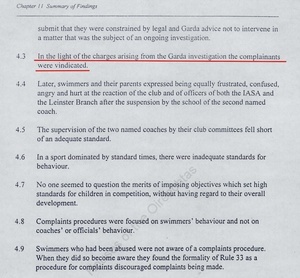
And, while neither coach was named in either the terms of reference or the eventual report, the conclusion was certain.

From the report, Dr Murphy stated:

“In light of the charges arising out of the Garda investigation the complainants were vindicated.”

Previously: ‘Time To Bring The Gibney Nightmare To A Close’

Who Is Protecting George Gibney?

Meanwhile…

On Wednesday…

US journalist Irvin Muchnick reported:

The president of the board of directors of the American Swimming Coaches Association, Don Heidary, yesterday told this reporter he had never heard of George Gibney and that the controversy surrounding him preceded Heidary’s involvement with ASCA.

At the same time, Heidary did not utilize the opportunity to issue even a ritualized denial of the possibility that ASCA might have helped set up Gibney for employment in America as he was facing allegations of sexual abuse, which would culminate in a 27-count criminal indictment in Ireland.

My email exchange with Heidary follows an essay he wrote for the website SwimVortex under the headline “The Real Culture of American Swimming.”

It began: “Over the past forty years, I have coached in the summer-leagues, at the high school level, and as a proud member of USA Swimming. What I have seen, and have been blessed to be a part of, is a culture that is anything but predatory, abusive, and certainly not profit-driven.”

I noted to Heidary that I believe his own club, Orinda Aquatics in California, was where one of my daughter’s teammates at nearby Bear Swimming migrated in 2008 after the teammate, at 16, was twice raped by Bear head coach Jesse Stovall, who was chaperoning her on a trip to Florida for a national meet.

In 2010 Stovall pleaded down criminal charges so as to avoid prison, and was added to USA Swimming’s banned list.

I wrote Heidary: “Since you are president of the ASCA board, I ask for your assistance in the mystery of who wrote and who brokered the letter offering George Gibney a coaching job in the United States in the early 1990s while he was facing dozens of criminal charges of child sex abuse in Ireland.

“In his opinion, in my recently settled Freedom of Information Act lawsuit, U.S. District Court Senior Judge Charles R. Breyer took pains to point out that I am someone who ‘suspects that the American Swimming Coaches Association greased the wheels for Gibney’s relocation.’” (And I pointed Heidary to the almost fully redacted copy of Gibney’s job offer letter, which submitted at the time of his 1992 American visa application, here)

Heidary replied:

“I’m sorry I can’t help with this. Your email is the first I have ever heard that name and I have never heard anything related to this issue. In the early nineties I was coaching a summer-league and high school team in Orinda and not affiliated or involved with USA Swimming or the American Swimming Coaches Association.”

In a follow-up, I said that Heidary was not answering the question I was posing. The question, I persisted, does not concern his personal resume or even his level of knowledge of Gibney — the most notorious at-large sex criminal in global sports history — but rather the historical involvement of ASCA, the organization Heidary leads.

As Concussion Inc.’s coverage through the years has pointed out, ASCA executive director John Leonard told us: “We do not have an organization that deals directly with children, nor is that part of our purpose in any way, shape or form, according to our formative documents from 1958 and thereafter.”

Helping coaches obtain visas is a central part of ASCA’s business model.

Heidary did not respond to the follow-up. This article is being forwarded to the entire ASCA board for further comment.

American Swimming Coaches Association President Doesn’t Deny Possibility of ASCA Involvement in the Coaching Offer to George Gibney That Coincided With His Successful 1992 U.S. Visa Application (Concussion.net)