
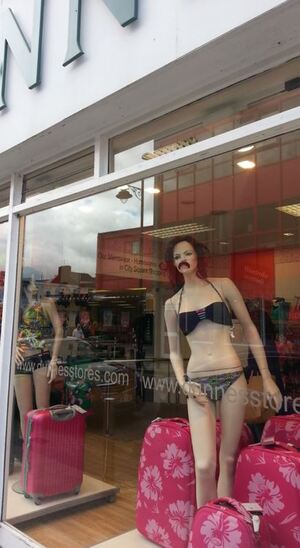
Cormac writes:
Dunnes, Waterford city..



Cormac writes:
Dunnes, Waterford city..

It is with sadness that i’ve resigned my position on the board of Dublin Pride #dublinpride #pride13
— Louise Hannon (@LHannon_Fotos) June 24, 2013

Louise Hannon’s announcement has come about as a disagreement has been played out on Facebook this morning between LGBT Noise and Dublin Pride.
How did it unfurl?
LGBT Noise told on their Facebook page this morning “of an unprecedented decision by the board members of Dublin LGBTQ Pride to bar LGBT rights organisations and community groups from speaking at Pride.”
They added:
“The rationale for excluding rights groups and community groups by Dublin Pride is unclear. Initially we were told by Dublin Pride that we should have signaled our wish to speak back in March. We were not informed of this requirement in March. However in recent days the Board of Pride had said that their decision was based on an online survey. They wished to restrict the number of speeches given at the Merrion Square event based in this survey. We were told by the Board that they wanted to keep the post-parade event as an entertainment only event. Pride have offered the opportunity to speak, without any amplification, as the parade is gathering at the Garden of Remembrance. Attempting to speak to a crowd of thousands of people who are busy organising themselves at the start of the parade without a sound system or platform is not a credible offer.”
Dublin Pride replied on their Facebook page, including the following:
“At no point have commercial concerns impacted upon the political aspect of Pride. This year we have been very successful in attracting more sponsorship, which will help deliver a top quality event, but at no point have sponsors, or the team, done anything to silence the campaigning aspect of pride in lieu of financial considerations.”
“Last year was our first at the Merrion Square location and afterwards we asked you for feedback so we could improve the experience for everyone. We asked for feedback on what we got right, what we got wrong and what you would like to see changed. The overwhelming response was that there were too many speeches at the Merrion Square part of Parade Day.”
“We debated at length how to respond to this feedback, while still maintaining the spirit and purpose of the Pride Parade for everyone involved.”
“We decided to organise a traditional ‘rally’ style forum at the start of the Parade where community groups will stand up and make speeches to energise the assembled crowd and give everyone a sense of why we are marching and how our voices still need to be heard to effect the changes in society we all desire.”
“We will then march to Merrion Square where the Grand Marshall Anna Grodzka will give a keynote speech on Transgender equality issues with introductions by the Dublin Pride chairperson and of course, the one and only, Panti (who is our host once again). We decided to focus on a single issue this year on the main stage – that of transgendered rights which have been neglected for so long. To further emphasis the struggle faced by the trans community we selected a transgendered MP Anna Grodzka as the grand marshall. We felt it important not to dilute this message on mainstage by having multiple issues discussed which is yet another reason to have the Rally at the start of the parade.”
“It was thought this format of “Rally – Parade – Celebration” would be one that would give the day a real sense of purpose and celebration, the two key aspects of Pride.”
“Up until last week, we had not heard from Marriage Equality/LGBT Noise until they emailed us asking for details of their timeslot. At that point the new format was explained to them. We offered to meet with them to discuss their requirements and logistics for the rally.”
“At every stage, Dublin Pride have tried to be inclusive and accomodating to the entire community.”

 The residents of Harty Place, Dublin, indulge in a Street Feast knees-up yesterday in what was to be a dance to the gods of nom and neighbourliness
Marie Green (above centre) and Leo (cat) have lived in Harty Place, Dublin for more years than they care to remember.
Both can recall a time when there was barely a damn hipster in the street let alone a whole conga-line.
The Harty party was among 150 steet feasts around the country sponsored by Centra to “rediscover neighbourliness and long-lasting friendships within communities.”
Fair play though, in fairness.

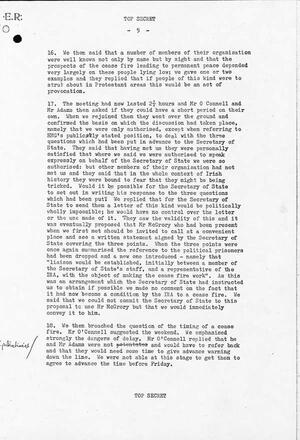

20 June 1972- Ballyarnet,Co Derry- A secret meeting was held between the PIRA and British secretaries office to discuss a cease fire.
— ConflictNI (@ConflictNI) June 24, 2013
41 years ago this week, a Provisional IRA delegation consisting of a 23 year old Gerard Adams met representatives of the British Secretary of State on the outskirts of Derry city. Notes from the meeting detail Adams’ respectful approach to the British addressing them as “Sir”.
Their behaviour and attitude appeared to bear no relation to the indiscriminate campaigns of bombing and shooting in which they have been prominent leaders.
British propaganda or was Gerry just there to make the tay?
YOU decide.
Via ConflictNI
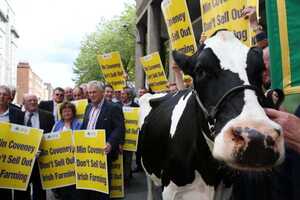


 And their livestock.
Scenes from the farmers protest today on Kildare Street against CAP reforms.
Name those breed of cows/bulls/sheep, anyone?
(Sam Boal/Photocall Ireland)

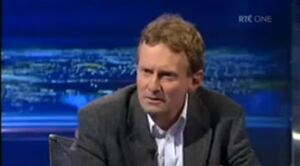
We were so young.
The Prime Time exchange between Brendan Keenan,of Independent newspapers, and UCD professor of economics, Morgan Kelly, just hours after the banking guarantee on the night of September 29/morning of September 30, 2008 was revealed.
Go to 1.30
Miriam O’Callaghan: “Morgan Kelly, professor of economics at UCD, what’s your reaction to this guarantee?”
Morgan Kelly: “My reaction is very negative. Initially, when (late former Minister for Finance Brian) Lenihan announced the €100,000 deposit guarantee, I was very optimistic. Had we not had that we would have had queues outside banks yesterday. However what we need to ask is, what the problem here, as Brendan (Keenan) said, is foreign banks are afraid to lend to Irish banks. They’re not afraid to lend to banks in other parts of Europe. We need to ask ourselves ‘what’s going on here?’ The underlying reason is that Irish banks have made very big loans to developers and, above all, the builders. They’re losing money on these, they’ve a lot of bad debts. They’re covering them up. But international institutions know they’re there. That’s why they’ve stopped borrowing.”
O’Callaghan: “But what would the alternative have been Morgan Kelly? Like, if they hadn’t done this today. I suppose they could have done a form of nationalisation. Are you saying they shouldn’t do anything?”
Kelly: “No. They need to do what has been done everywhere else as individual banks run into problems. The government goes in and, first of all, sees if they need to survive. A lot of the banks in the US have just been let go. And we obviously need to keep our retail banks going. There are some non-retail banks that could have been let go, nobody would have missed them. But what you need is, for Government to come in, offer new capital to the banks, in return for a share of ownership and recapitalise them. That is a real big problem here. Irish banks have made big losses on their loans. They’re short of capital…
Brendan Keenan: “We don’t quite know if that is the real problem. Banks insist that they don’t need capital from the Government, they don’t want capital from the Government. They can trade their way through this, if they can access the normal funding. And that’s where all of the discussions have been, for the last three or four weeks.”
Kelly: “The banks of the world disagree with them.”
Keenan: “The other banks have gone to their governments saying ‘give us money or we go bust’ The Irish banks are not saying that. They’re not asking for money.”
Kelly: “No, we have to ask them, if this was simply the problem of liquidity, what we would have seen is that Irish banks’ share price today would have exploded. Instead what we have is that Irish banks’ share price, this evening, is slightly lower that it was yesterday morning for the three main retail banks – AIB, Bank of Ireland, Permanent TSB. It’s not liquidity is a problem for these guys, they’ve bad loans. They’re huffing and puffing and pretending it’s not going on. The example for us should be what happened in Sweden. Nearly 20 years ago, they had a big property bubble, just like ours. At the end of it, banks lent a lot to developers and builders, they went under. The Swedish government moved in decisively, made these banks realise bad debts, took them over and ended up not losing money. And that’s what we need to do here. The alternative, the Finns did the same thing. Like here, they said ‘oh we know what’s going on here, things are fundamentally sound’, they ended up losing about 10% of their national income, bailing out their banks.”
O’Callaghan: “So you don’t view it as a pre-emptive strike by our government?”
Kelly: “Well it was basically they didn’t really know what to do and they decided an Irish solution for an Irish problem. Effectively, the situation is, it’s like you have a stupid kid who keeps going out and smashing up his car.”
Keenan: “I think the difficulty is, we know what the Irish banks’ bad loans are, they’re going to be about 1% of their loan books.”
Kelly: “No, that’s complete nonsense. What we, we have a situation. Irish banks lent…
Keenan: “You disagree with Deutsche Bank…”
Kelly: “Yes.”
Keenan: “…you disagree with…”
Kelly: “I disagree entirely yes. They have €25billion in loans to builders. All the ghost estates you can see around the place, that is the capital of the Irish banks right now. They’re going to make horrific losses on these.”
Previously: To Cut A Long Story Short

http://www.youtube.com/watch?v=K49BrGVR9zE
Kieran Murphy, editor of UCC student mag Motley, writes:
Today we’re launching a drive for contributors for the website. Normally it’s only been UCC students who contributed to it but I believe that with our new website we’ve the scope to cater to more readers and writers, so anyone and everyone can sign up and write for the website!
G’wan.
They don’t care, like. They love it.

Ah me oul flour…
Should’ve got it right first time.
It’s the yeast they could do.
Kenny understands ‘rage and anger’ over Anglo revelations (Judith Crosbie, Irish Times)
Thanks Evelyn Leen


Jason Allemann’s wonderfully bonkers LEGO walking (or, more accurately, scuttling) machine, inspired by Theo Jansen’s giant kinetic Strandbeest sculptures.
You can build your own, if you’re so inclined.
