

Unnamed location, Co Galway this evening.
Thanks Galway SEO



Beauty: a masterclass in subtle digital animation directed by Rino Stefano Tagliafierro who sez:
A series of well selected images from the tradition of pictorial beauty are appropriated, (from the renaissance to the symbolism of the late 1800s, through Mannerism, Pastoralism, Romanticism and Neo-classicism) with the intention of retracing the sentiment beneath the veil of appearance.
http://vimeo.com/83843825
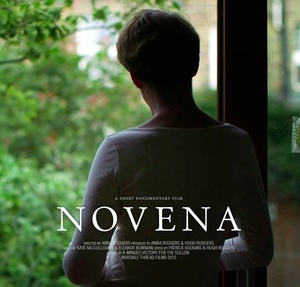
Novena.
A short Irish documentary/work in progress YOU can help finish.
Ah go on.
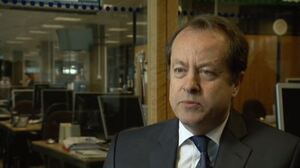
“Not many readers will know that a High Court case will often consist only of the Judge reading the sworn written evidence (affidavits) of both sides and judging the case on that basis alone. Significant portions of the written evidence may be drawn to his attention by the lawyers, but no witnesses will be questioned in the witness box. The number of cases being dealt with summarily is on the rise…”
Edmund ‘Ed’ Honohan, Master of the High Court (above), in yesterday’s Irish Times on the dangers of High Court claims being struck out early without the opportunity to go to a full hearing.
We asked Legal Coffee Drinker, what’s it all about.
Broadsheet: “Legal Coffee Drinker, what’s it all about?”
LCD: “Mr Honohan is referring to the jurisdiction of the High Court to strike out proceedings. This jurisdiction is inherent in the nature of a court but is also dealt with in Order 19 Rule 28 of the Rules of the Superior Courts, which provides that the Court may order any claim to be struck out if the documents submitted stating the claim (the pleadings) disclose no reasonable cause of action or if the claim is frivolous and vexatious.”
Broadsheet: “What’s his difficulty?”
LCD: “He believes Judges are striking out cases where they don’t believe the facts as stated in pleadings.”
Broadsheet: “That sounds serious.”
LCD: “If true, this involves judges deciding on disputed questions of fact without an oral hearing.
Broadsheet: “ And is he right?
LCD: “He doesn’t give any specific examples other than informal discussions between colleagues. Of course applications to strike out are preliminary applications brought on motion and a written judgment is not always delivered in such cases. This makes it difficult to ascertain the basis on which a strike-out has occurred.”
Broadsheet: “He raises another issue and that is striking out on the basis of the facts pleaded, in circumstances where the facts as pleaded are incomplete due to lack of knowledge on the part of the witness or their lawyer. What does that even mean?
LCD:” The wording of Order 19, requires the decision to strike out to be made on the basis of the case in the pleadings. I don’t think a judge dealing with striking out proceedings can reasonably be expected to conduct an inquiry to see if there are any additional facts which might make the case a better one.. The question should be whether the facts before the court at the time of the application to strike out disclose a good cause of action and that is all.”
Broadsheet: “And why should we care?”
LCD: [pause] “Striking out of proceedings is a serious matter because it denies an individual their right to litigate. On the other hand, what has to be taken into account is that proceedings cost money to defend. Costs orders usually follow the event so that if the action fails the defendant will in theory be entitled to recoup their costs. However that’s in theory. In practice, particularly in High Court proceedings where the costs are very high, an unsuccessful plaintiff may not have enough money to pay the other side’s costs. This is a difficulty.”
Broadsheet: “I’d say!”
LCD: [Drains coffee] “In the circumstances, striking out a claim which cannot – on the facts as stated by the Plaintiff – legally succeed, would not appear to be unfair. Deciding on disputes of fact without an oral hearing would however be a different matter. If this is in fact what is happening it would indeed appear to be of concern. Striking out proceedings – denying the right to litigate, is a serious matter. Although not required by the Rules, there is an argument to be made that a a matter of practice written judgments should be given in all High Court striking-out proceedings and published on the courts.ie website. [drains coffee] This would enable monitoring of a process which, though necessary, needs to be kept under strict review if the constitutional right to litigate is to be adequately protected.”
Broadsheet: “Much to think about there. Thank You Legal Coffee Drinker. Keep us posted if you can on any developments in this matter if that suits?”
LCD: “Bye.”
(RTE)


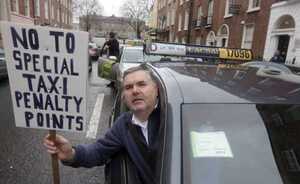
Taxi Drivers on Dawson Street, Dublin and streets surrounding the Dail this afternoon protesting against “the oversupply of taxis in the city” as well as decreased profits.
(Laura Hutton/Photocall Ireland)

A short by the hellopluto artist collective…
…about what’s inside a man’s head while going thru the “process” of ideation and creation.

In the mid 1920’s, cinematographer Claude Friese-Greene travelled around the UK with his (at the time) high tech colour film camera to create a famous series of films called The Open Road, subsequently restored and circulated by the BFI.
Last year, filmmaker Simon Smith retraced Friese-Greene’s journey through London, mimicking the timing, angles and location of the original sequences shot for shot.
If you’re at all familiar with London, the side by side comparison above is somewhat awesome.


[Top: (l-r) Doctor Sorcha Knowles, Colin the Floor Manager, a guinea pig and Professor Mike McCork. Above: The Brain Freeze crew above: (l-r Director Ian Benjamin Kenny (far left), Lighting Cameraman Brian Moore (middle front), Compositing and Production Paul Madden (middle back) and puppeteer Liam Geraghty (far right)]
Brain Freeze. A 13-part, Irish-made, puppet-based comedy science show for kids… with the characters interacting grouchily ‘backstage’.
Liam Geraghty writes:
I just wanted to let you know about Brain Freeze – a new 13 part comedy science show for kids that starts on CBBC [Children’s BBC] next Wednesday January 22 at 5.55pm.
It’s an Irish production, shot in Dublin and developed for CBBC by director Ian Benjamin Kenny, producer Colm Tobin, writer Aidan O’Donovan, producer Paul Madden and a brilliant team of voice over actors, writers, animators and crew. I was the puppeteer for it.

“I am a Roman Catholic diocesan priest, have been so for over 30 years, and I am gay. I came out to myself six years ago, I have since come out to my family and a small number of close friends. I am delighted that Mary McAleese has spoken out about the issue of being gay. I agree with all she has said. I feel she has spoken out for me and many priests like me, who are gay. She is a voice for us, as we are not free to speak out. I live in constant fear of being found out or being outed. I don’t believe that I’m ‘intrinsically disordered’ as my church would have me believe.
That term is insensitive, offensive and deeply hurtful to me, as I’m sure it is to others like me. The people in my parish tell me that I am a gentle, compassionate and sensitive priest. If Jesus was to sit down with a group of gay people, I am absolutely certain that their first experience would be a welcome and a reassurance that they are loved unconditionally by him. Why is it then that their first experience of my church is of condemnation, rejection and judgement. The content of its teaching and homosexuality and the way it communicates it seems very cold – clinically and pastorally insensitive. It’s approach is too simplistic and does not take into account the complexities and uniqueness of each person’s life. It seems that instead of helping to ease and lift the many sufferings of gay people, we are adding to them. I have no doubt Jesus would not approve.”
You could always LEAVE?
Further to the comments made by former President Mary McAleese – that the Catholic church is in denial about homosexuality – RTÉ reporter Brian O’Connell spoke to and was in correspondence with a number of Catholic and Church of England gay priests.
Their words were broadcast on RTÉ’s Today With Seán O’Rourke this morning and included the testimony (above) and another man who told how his order organises retreats for gay priests.
Mr O’Connell said:
“On these retreats, they stand around the altar in a group and they share their stories and their experiences and, for them, it allows them to be true to themselves and he said when they’re standing in front of a congregation, a couple of days later during Sunday mass, they feel that they’re being somewhat true to themselves. He also had the experience that his orientation isn’t a problem, as long as he remains celibate, that’s within his order. He has fallen in love at times over the years and he left the church for a period, but was always drawn back. He told me actually about a recent case where a gay man in his parish came to see him and was telling him about the struggles he had around his sexuality. And this priest actually decided to open up to his parishioner and he told him that, well, he too was gay. And, he said, this made things so much easier for his parishioner and gave him a comfort and he was able to talk more openly with him.
And, right at the end of our chat, Seán, I asked him did he feel conflicted about being part of a church that has such strong views on homosexuality. And his answer, which I wrote down, I thought was quite elegant. He said to me ‘we’re told in the gospel that the truth will set you free. The official church has not asked to know our truth. One problem with the church today is that it keeps on answering questions people are not asking. As a gay priest I am being told things about myself, by people who are either ignorant or in denial and don’t do anything to find out what it is like for me. That, to my mind, is what is really sinful’. I thought that was a good way of summing it up.”
Listen back here
Previously: How Does She Know?

