You’ve come to the right place.
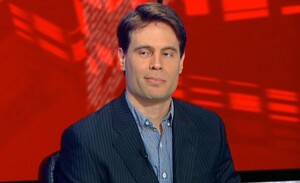
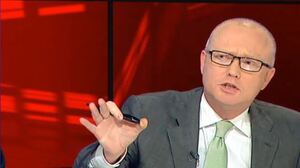
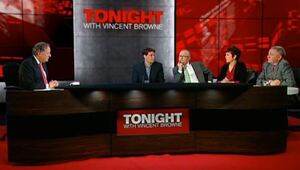
Dr Julian Mercille (top), UCD lecturer and author of The Media and the Irish Economic Crisis: A Political Economy; Dan O’Brien (2nd pic), former Irish Times economics editor, now with the Irish Independent, Andrea Martin (bottom second right), media lawyer, and Frank McDonald (bottom right), Environment Editor of the Irish Times appeared on Tonight With Vincent Browne last night.
Under discussion?
The role of the media in the property crash/financial crisis.
Gulp
Vincent Browne: “Going back to the media itself, the fact that the Irish Times, the Irish Independent, the Examiner, the Sunday Business Post and the Sunday Tribune and the other Sunday newspapers all were making substantial, were getting substantial revenues from the property sector. And all of them ran property views that were laudatory of all the properties that went on sale, which of course was a nonsense. That must have contributed substantially to the property boom.”
Dan O’Brien: “Ok, I’ll put it like this, media organisations…You ran..you set up a news magazine I think in 2004 that coincided with the boom, if someone came to you and said ‘we want to advertise a legal product, your commercial department says ‘yeah, well, fine, there’s nothing illegal there, we’ll just take in the advertising’. The commercial people in a media organisation…”
Browne: “But that’s not what happened. That is not just what happened. They didn’t just take in the advertising, they ran supposedly independent editorial features on the property sector that lauded the properties that were being advertised.”
O’Brien: “That’s all part of the kind of.., you know, when you’re advertising something. But in terms of the hard coverage of, of what went on then, I honestly don’t think that journalistic…you know, RTÉ ran its future shock show, Frank’s paper ran the UCD economist [Morgan Kelly], David McWilliams was writing in the Irish Independent. So there were people. So the idea that everybody shut down…”
Browne: “Nobody said everybody. This is…I’m just making the point that journalists abandoned their independence in writing about property at a time when large advertising…”
O’Brien: “Well most journalists weren’t writing about property.”
Andrea Martin: “There’s something we need to be aware of here and that is that we need to distinguish between print media and the TV media. The print media is beholden to the commercial interests, to keep the paper afloat. TV and broadcast media is regulated in a way that requires it to be fair and impartial and objective. If less, even this station is subject to that requirement, regardless of the fact that it’s beholden to its advertisers.”
Browne: “Completely meaningless.”
Martin: “But no, what this, what this means is..I’ll tell you why it’s meaningful. There were people, there were commentators within the sector, there was George Lee who produced an excellent series in 2006, predicting exactly what was going to happen.
Browne: “Once, right yeah, OK.”
Martin: “He did.”
Browne: “These were once-off..”
Martin: “Eddie Hobbs, Eddie Hobbs was saying there was going to be no such thing as a soft landing. What happened was is that there is a media consensus, a media and political unholy alliance that made these people out to be eccentrics, sidelined them, dismissed them and that is what caused that problem.”
Julian Mercille: “It was the same. If anything, TV was worse than the press. I did a study, the paper you [Vincent] referred to. Prime Time had 700 shows between 2000 and 2007, about 1% of those shows talked about the housing bubble and most of them were saying that there was no housing bubble. So TV was the same as the Press, if not worse. It’s not any different.”
Martin: “It can be held to account. I’m not saying that TV is better otherwise, what I am saying is that there were, there’s a different between print media and TV, and there ought to be. Also there were voices and they were completely sidelined.”Continue reading →