







MORE to folly.



MORE to folly.

Geoffraffe writes:
A huge number of teachers were not paid today. When the payroll sector was contacted they said it was due to a backlog in processing appointments over the summer. Some teachers may not be paid for 6 weeks!!! It’s not as if they didn’t know that teachers would be appointed. This happens every year. This is the public sector that we work in.
Anyone?


From top: 1911 Canadian dollar; Luke Flanagan
Did you know about ‘Dublin’s Newsboy Millionaire’?
Read all about it.
Esteemed historical blogger Sibling of Daedalus writes:
Young Luke Flanagan (no relation), summoned before the Dublin Children’s Court on February 8, 1911 looked just like any other Dublin tenement boy – undersized – looking 4 years younger than his actual 15 years.
Without a shirt and with a threadbare coat pinned across his chest, his crime was also typical of many tenement boys – that of selling newspapers without a licence.
But Luke differed from the average such boy in one important respect.
According to Police Constable 86C (one of Dublin’s famous Tall Constables), who had summoned him to court, he was generally known as the ‘Dublin Millionaire Newsboy’, having inherited a large sum of money from a relative in Canada, which he would come into when he reached the age of 21 years.
Giving evidence in court, Luke’s mother, Mrs Rooney, said that she had married Frank Flanagan, the son of a Dublin solicitor who had subsequently emigrated to Canada. Frank was now dead, and she had remarried.
Luke, their only surviving child, lived with his mother, her new husband, and a ‘foster brother’, also a newsboy, in a tenement flat off O’Connell Street.
Some years before, her deceased brother-in-law, John, who had gone to Canada with his father, returned bringing news of Luke’s grandfather’s death, and a legacy of £1500 (a substantial sum in 1911) left to Frank and passing to Luke as his surviving heir.
The question was, where was the money?
Mrs Rooney – described by all sources as a woman of excellent character – thought perhaps it might have been paid into the Court of Chancery in Ireland.
This caused consternation among Dublin citizens, who were outraged at the thought of a young man of such expectant fortune – described by one paper as a thin, weakly youngster with a wistful face – being neglected by the Court and left to fend for himself on the streets of Dublin.
British newspapers took up the cry of outrage, and soon the story spread as far as Canada itself, and San Diego, Texas. In fact, Luke’s was perhaps the first Irish news story to go viral.
Matters quietened down however, when the Irish Court of Chancery released a statement saying that no money had ever been lodged with it on behalf of either Luke Flanagan or his grandfather’s estate.
Luke Flanagan was convicted of trading without a licence and obliged to pay 2s 6d to the poor box. It is not clear whether he ever got his legacy.
Was the Court of Chancery being entirely honest? Did wicked Uncle John make off with the money? What happened to Luke’s newspaper business in the Rising of 1916?
Anyone?
Luke Flanagan pic: Evening Herald

Earlier today.
Kildare FM reported that a gay couple, Jacinta O’Donnell and Geraldine Flanagan, have stepped down from the church choir at the Catholic parish church, St Michael’s, in Athy, Co. Kildare (top).
The station reported:
Jacinta O’Donnell and Geraldine Flanagan, who married in July, have stepped down from the church choir and other church music activities, due to what they say is the level of pressure placed upon them and the church by a local church activist Anthony Murphy [of newspaper Catholic Voice].
Mr Murphy is strongly opposed to gay people being active in the Catholic church in what he calls leadership roles.
Mr Murphy has also conveyed his views to parish priest Canon Frank McEvoy, whom the couple says has been supportive of them.
Kildare FM also reported that, a few days after Ms O’Donnell and Ms Flanagan got married, Mr Murphy sent Ms O’Donnell the following text:
Jacinta, I hope you will now have the decency to resign from the church choir and as a eucharistic minister, following the events of last Wednesday [their wedding day].
Further to this, in an interview with Shane Beatty, on Kildare FM, Jacinta O’Donnell told Mr Beatty:
“Well, we’ve been mulling over [the decision to leave] it all summer. When we were made aware of Anthony Murphy’s feelings and when we saw some of the very negative and, I suppose, hateful stuff really that was on his Facebook page, etc, and then when I got the personal text message from him.”
“Geraldine and I, you know, we, the only thing we’ve ever tried to do is provide a music ministry and the whole idea behind that was to enhance the eucharist and we felt that, bringing this trouble to the church door would be really futile and negate anything that we were trying to do.”
“So we thought about it long and hard and it was, and still is, a very difficult decision that we came to. We’re both very upset by it.”
“…we understood that there were going to be protests or some form of demonstrations, you know, to basically encourage us to leave, shall I say. And we felt that the ordinary people, that were just going along to their weekly mass, you know, didn’t need to be subjected to this.”
“And it was going to defeat the entire purpose of our whole reason to be there in the first place and I think we felt we had more respect for the house of God then to have that brought to its door or because of us and we felt that the easier thing to do would be just to walk away.”
Meanwhile, Mr Murphy told Mr Beatty:
“This is not about personalities. Well clearly, you know, the way the choir operates in Athy, Jacinta and Geraldine are positioned on the altar, in the sanctuary, you know, on a stage almost, sharing the stage with the parish priest.”
“You can not have a contradiction where the church teaches one thing and people who are right next to the tabernacle, the blessed sacrament, contradict all of that teaching.”
AUDIO: Controversy In Athy As Gay Couple Step Down From Church Music Activities (Kildare FM)
Pic: Flickr
UPDATE: EXCLUSIVE: Athy Couple At Centre Of Choir Controversy Make Their Return Tomorrow Saturday (KFM)

This afternoon.
Con Kennedy tweetz:
Paddies spotted at the ‘Irish Corner’ at La Vuelta.
Any excuse.
Name that man in black, anyone?



Horinouchi House in Tokyo, Japan, a very modestly sized (56 m³) house that makes the most of its tiny footprint, designed by Mizuishi Architect Atelier. To wit:
Slightly reminiscent of a submarine’s periscope, the Horinouchi House’s triangular-shaped exterior allows it to fit snugly into its modest plot of land. Inside, the home is spacious and incredibly well lit, succeeding in making it feel much larger than it actually is. Its lower level houses a master bedroom and bathroom, along with a kitchen and dining room, while the upstairs quarters are primarily reserved for communal activities — think a den or living room.


Vertiginous highlights from the Instagram account of 23 year old Russian photographer Angela Nikolau.


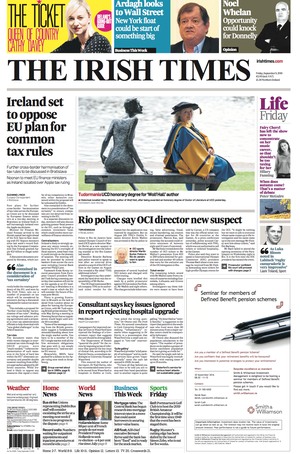
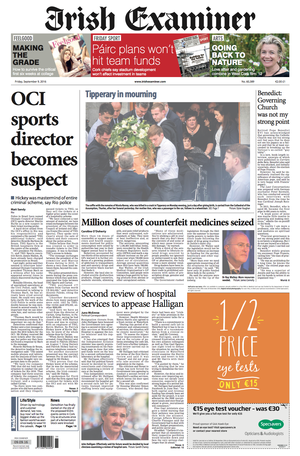
Emails (above) from Pat Hickey (top left), who has stepped aside of his role as president of Olympic Council of Ireland, to president of the International Olympic Committee Thomas Bach (above right)
Brazil’s Globo News has obtained a copy of an email in which Hickey gives Thomas Bach a comparison of the ticket allocations received by the Olympic Council of Ireland (OCI) for the London 2012 and Rio 2016 Games. Hickey states that the OCI received 84 tickets for the opening ceremony in London but only 38 for Rio.
He also delivers a “wishlist” to Bach demanding 980 extra tickets, including a further 150 for the opening ceremony, an extra 200 tickets for the men’s 100m final and 500 more tickets for the men’s football final.
“We found enough evidence linking Hickey to this plot to sell tickets by a company that was not authorised,” prosecutor Marcos Kac told the Associated Press. “These are tickets that were sold for up to $8,000 [about £6,000].”
…Police have said that he plotted with businessmen to transfer tickets illegally from Pro 10, a sports company, to hospitality provider THG Sports, which was a non-authorised vendor and allegedly sold them for high fees. Police investigators said that the scheme was planned to bring in $3 million.
IOC chief absent after link to ticket scam (The Times)
Further to this, Mr Ziegler tweetz:
Re: Hickey’s ticket request to Bach, why would Olympic Council of Ireland want 500 tickets to the football final (Ireland not in tourament)?
Images: Globo News
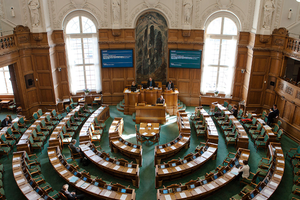
Inside the Danish parliament Christianborg Palace in Copenhagen, Denmark
Luke Harding, in The Guardian, reports:
Denmark has become the first country in the world to apparently buy data from the Panama Papers leak, and now plans to investigate whether 500-600 Danes who feature in the offshore archive may have evaded tax.
Denmark’s tax minister, Karsten Lauritzen, said he will pay up to DKK9m (£1m) for the information, which comes from the Panamanian law firm Mossack Fonseca. He said an anonymous source approached the Danish government over the summer.
The source sent over an initial sample of documents and the government reviewed them. After concluding they were genuine, it secretly negotiated support for the controversial deal from political parties in parliament, the minister said.
“Everything suggests that it is useful information. We owe it to all Danish taxpayers who faithfully pay their taxes,” Lauritzen said, admitting that he had originally been “very wary”.
He added: “The material contains relevant and valid information about several hundred Danish taxpayers.”
There you go now.
Panama Papers: Denmark buys leaked data to use in tax evasion inquiries (The Guardian)
Pic: Wikipedia
Thanks Nelly

Yesterday saw Sony reveal long-rumoured hardware updates to its ridiculously successful PlayStation 4 console at their #PlayStationMeeting event in New York, after a solid year of conjecture.
To say it’s been roundly negatively received is an understatement, as hardcore gamers object even more strenuously than usual to being taken for eejits.
$300 gets you a slimmed-down version of the current hardware, while $400 gets you a slightly shinier box with (partial) 4K compatibility among other perks.
PS4 hovers just outside the top 10 best-selling videogame consoles of all time, approaching the lofty heights of Nintendo’s records for the NES and Wii machines, and even its own industry-defining efforts with their first two boxes.
All this in three or so years, completely wiping the floor with Microsoft’s tempestuously-launched XBox One and Nintendo’s unfairly-ignored Wii U in the home-console marketplace.
Sony’s move here leaves us with a small few questions, like what they’ll do with the preponderance of “old” PS4 stock to be had (any surplus units can of course be sent to Karl’s den the Broadsheet office to be given a good home)?
Why should anyone subsequently pay up for the newly-repackaged PS4 Slim when it just does what the “old” box did without a price cut, and why does this PS4 Pro, a machine aimed at adopters of Ultra HD/4K tellies, not support 4K Blu-ray movies?
But these are small fry compared to the overall question: what, precisely, are Sony and Microsoft (whose XBox One is also getting a steroid injection next year) playing at?
This whole situation, console companies on the pig’s back and blind to their own failings, should be familiar news to any gamer or tech hack of the last three decades, because right up until this generation, the following story has been wheeled out any time a games journo has needed a lazy cautionary tale…

In the nineties, it’s safe to say that Japanese/American outfit Sega were the men who would be kings of the vidya roost.
Having placed Master Systems in every Toymaster and Quinnsworth in the land in the late eighties, their massively-successful Megadrive console (above) was the must-have item of an entire generation, recovering from a slow 1989 launch to claim a place under tellies worldwide off the back of Sonic the Hedgehog.
So, when talk of the next generation of consoles began, the pressure was on Sega to succeed, and their Japanese division began developing hardware that would lead the company into the new millennium, Sega Saturn, now a cult classic.
The American division was not so thrilled about the rapidity of expansion, however, as after a hard sell, the Megadrive finally had a massive user base on which to capitalise.
But with Sony’s upcoming PlayStation seemingly arriving from the future in glorious 3D and upsetting the natural order of the games market, the decision was taken in Sega of America to bump up the Megadrive’s specs and satisfy existing console owners at the same time, while Sega of Japan worked on the real successor…

…the result was the 32X (above), a supremely ill-advised expansion that clipped into the cartridge port of the Megadrive, and ran games designed exclusively for itself, rather than beefing up older games.
The privilege would set gamers back another $200, on top of the cost of their existing machine, and in a few truly unfortunate cases, would also need the similarly-greedy (and near-defunct) Mega CD drive, another $200.
All of which, when stacked atop each other, needed separate plugs in the wall for each component. Separate versions of certain games were released, and there were one or two rather underwhelming exclusives, but as talk of the next games generation proper became announcements, deals and reveals, the expansion quickly disappeared into the ether, along with new titles, lining bargain buckets within months.
Early adopters were furious, casual consumers and parents were confused as to whether the Saturn or 32X was the next big thing, and the whole kerfuffle cost Sega untold amounts of momentum right at the worst possible time.
Later that year at E3, Sega, looking to bounce back from all this stupidity, made the surprise announcement that their next-gen Saturn would be on sale immediately for $399.
It was rushed out overnight as market exclusives to big chains, much to the fury of other stockists, who then refused to pick up the machine and its paltry line-up of available games.
The same evening, Sony delivered the blow that would ultimately finish Sega’s console racket off, cutting the announced price of their new PlayStation by a hundred dollars to $299 in a succinct keynote speech.
The Saturn was a great console with a solid library of games that remains a favourite of core gamers to this day.
But it had its head cut off early by the aforementioned boardroom fumbling, exacerbated by both the disappearance of a Sonic the Hedgehog sequel intended to bring in casual gamers and kids, and the rush announcement two years later of its similarly-doomed successor, the Dreamcast,.
The Dreamcast would eat it by 2000, and Sega ceased home hardware development the following year, while Sony’s PlayStation 2 became the biggest-selling games console in history.
The fall of Sega to this day is a lesson to hardware manufacturers across all sectors, mostly in the virtues of temperance and patience at the top.
A successful company gets a bit big for its britches and expects the audience to stump up again for a half-concocted expansion/repackage, midway through the current hardware cycle, off of brand recognition and awkward lurches into new technology the hardware can barely manage.
Sounds familiar, alright.