
Yearly Archives: 2016

CrOKXbQWYAA8caH

RTÉ’s Southern Correspondent Paschal Sheehy (left) with Apple CEO Tim Cook

This morning.

On RTÉ One’s Morning Ireland.

A pre-recorded interview between Apple CEO Tim Cook and RTÉ’s Paschal Sheehy was broadcast.

At the beginning of the interview Mr Cook talked about how Apple first set up in Ireland in 1980, how its workforce grew from 60 to 6,000 – before describing Apple’s relationship with Ireland as a “37-year-old marriage”.

He said:

“Like any marriage, you go through a pothole here, there, but we stuck together and we stuck together because we’ve always felt so close to the community there and to the people there. And every time I go, it’s just like a, it’s getting a shot of joy being there.”

Hmm.

From the rest of the interview:

Tim Cook: “Apple has always been about doing the right thing; never the easy thing. You know we had a very difficult thing in the beginning of this year with fighting the US Government over the privacy and security of our customer – that wasn’t easy to do but it was the right thing to do..”

Paschal Sheehy: “So, to you mind, has Apple done anything wrong here? Does Apple have anything to apologise for?”

Cook: “No. We haven’t done anything wrong and the Irish Government hasn’t done anything wrong. What we have done together is, you know, built a great relationship that is great for the community and, by the way, let me be very clear on this because I think there’s been a lot of misinformation and false information out there. We’re subject to the statutory rate in Ireland, of 12.5% – we paid $400million in taxes to Ireland in 2014 which is one of the years that is getting a lot of discussion. That, from our understanding, is about 1 out of every $15 of corporate taxes that were paid in the entire country and I understand there’s around 40,000 or so companies there and so we believe we’re the largest taxpayer there. And we’re proud to be. We very much want a great citizen in the communities that we live and work in.”

Sheehy: “Ok.”

Cook: “Go ahead.”

Sheehy: “Can I ask you so, some direct questions? Were you given deals that were only available to Apple and weren’t available to any other companies?”

Cook: “No, not a single time.”

Sheehy: “Were you treated differently to everyone else? Were you given special treatment? Or sweetheart deals?”

Cook: “No. Never.”

Sheehy: “And the European Commission yesterday [Wednesday] said, Commissioner Vestager said that, in 2014, Apple paid an effective corporate tax rate of 0.005% – that’s €50 out of every €1million profit you made at one of your subsidiaries, Apple Sales International which is based here in Cork. Do you accept this?”

Cook: “No, it’s a false number. I have no idea where the number came from, it is not true. Here is the truth: In that year, we paid $400million to Ireland and that amount of money was based on the statutory Irish income tax rate, of 12.5%. In addition to that, because our folks there, our 6,000 employees, do various functions for all of Europe, if we sold a product in another country, there was also, in addition to that $400million, income tax paid in that specific country, you know, dependent on what rate they charge.

And what’s even larger, in terms of the actual dollar value is, as you probably know, our worldwide profits are subject to additional US income taxes and the current US federal rate, which your viewers may be interested in, is 35% and we provisioned several billion dollars for US and so, when you sort of zoom out and look at this, I know there’s a lot of numbers and so forth, but here’s the way I would kind of describe it, at a summary level. In 2014, our worldwide income tax rate was 26.1%.

I recognise some people would hear that number and think it should be higher. I also recognise that some people hear it and think it should be lower. Others look at it and say, ‘hey that sounds about right. But I would like it to be paid to different countries or allocated to countries in a different manner to the way it is. I think, actually, discussions on all of those are fair discussions and reasonable people could agree and disagree on those. But I think we could all agree: that that conversations should be about future taxes, not retrospective taxes. The EU Commission’s overreach, in this regard, is unbelievable to us. We’ve never heard anything like it. It’s sort of like playing a sports game, winning a championship and then, later, finding out that the goals count differently than you thought they did.”

Sheehy: “OK, so…”

Cook: “You know, it lacks any level of fairness.”

Sheehy: “That comes to the crux of your difference with the European Commission and we’re probably not going to be able to resolve that there. So just, for a moment, leaving aside the legality of your tax arrangements, can we address the moral issue. You said there that, in 2014, you paid $400million in tax in Ireland, another $400million in the US, a total of $800million but given the billions of dollars in profits your company makes every year, do you regard this as Apple paying its fair share?”

Cook: “Let me correct something Paschal that you said that I think is very important. We paid the $400m to Ireland and we paid $400m to the US and we provisioned several billion dollars for the US, for payment as soon as we repatriated and, right now, I would forecast that repatriation to occur next year and so it’s not true that we paid just $400m or even just $800m. The number is materially larger…”

Later

Cook: “The tax system itself is so complex. You could stack up paper from your floor to your ceiling and the tax code, you’d have to carve out, you’d have to blow out the ceiling to stack the tax rules up. This is not a system that we think is good and I think the bulk of the people in the world – even some of the people that wrote it – also don’t think it is. And so, the good news is there’s actually work going on that I now worry about, going forward. But there’s work going on that many countries have participated in to make this system simpler and more straight forward and I hope that that work goes forward.”

Sheehy:Several politicians here in Ireland have said that there should be no appeal, that this is money which Apple owes to Ireland and this is money which is badly needed for public services like hospital beds and new schools or perhaps even paying the national debt here which is huge. What do you say to those people?

Cook: “Well I think all those things, they’re very, very important for people. But  I think it’s very  important. First of all, it’s Ireland’s decision, it’s not mine but, from my point of view, if I were sitting there, here are things that I would think about: It’s clear, I believe to the Irish Government, because they’ve been very clear, it’s clear to us and it’s clear to the US officials as well, that have looked at this, that what was done was very consistent, that there were no special deals and so I think it’s important that, you know the Government stand strong on that because the future investment for business really depends on a level of certainty, a level of, you know, not where there’s floating laws, people need to know that the rule of law will be upheld. And so, where it might feel good for the moment, if you think about the long-term for the country or, broadly, the union, I think it’s very important to uphold these principles and not retroactively change them.”

Sheehy: “And what if the Government here decides that it’s not going to appeal the decision? For whatever reason, I’m not sure how up-to-date you are with developments here but we had a special meeting of the Cabinet today to discuss this issue. That Cabinet decided to defer the decision and will meet again on Friday [tomorrow]. And even prior to that Cabinet meeting, there were certainly hints that this decision and a decision on whether to appeal or not, may expose fault lines within the Irish Government here. And it’s not guaranteed that there will be a decision by the Irish Government to appeal this decision.”

Cook: “Yeah I look at it, much like I said before, is that: we’re very committed to Ireland. We’ve been committed for 37 years, we have a long-term romance together and I’m pretty confident that the Government will do the right thing. And I think the right thing here is to stand up and fight against this overreach and clearly the sovereignty of the country is at stake and the rule of law and the certainty of law is at stake and I think when those large values, those principles are at stake, we all have to stand up and fight for what’s right.”

Listen back in full here

Earlier: A Tax On Our Sovereignty

Anything Good In The New Yorker?

Previously:  This Is Not Complicated

Pic: Paschal Sheehy

catherineharriswhite

mike

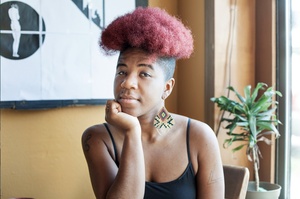
From top: Catherine Harris White; Mike McGrath Bryan

Catherine Harris-White, classically-trained singer and composer, formerly of Sub Pop-signed soul outfit THEESatisfaction, currently performs solo under the pseudonym of SassyBlack, a purveyor of what she calls “electronic, psychedelic soul” and “hologram funk”.

Before her only Irish appearance on her current European tour next Saturday at AMP in Cork, and in the first of a new arts interview series, Catherine tells Mike McGrath Bryan, from the ‘sheet’s music desk, about her new album, the creative process, and more.

Mike McGrath Bryan: “You’re just off the back of the release of your debut solo album No More Weak Dates, back in May. How have you found the reaction to it thus far?

Catherine Harris White: “The response for my album has been really positive. People seem to really dig it, as well as relate to it, which is what I really wanted for the record. It was a new experience to create an album on my own and I’m enjoying the fruits of my labor.

Mike: There’ve been comparisons made in certain quarters with yourself and some of the greats: Ella, Erykah Badu, etc. and there are certainly cases to be made for same. But your production and songcraft is so out there, so sci-fi, in places. How do you handle all the heady talk, first off, and can you go a little into detail on fitting that classic jazz/soul voice into your own soundscape?

Catherine: Those are some great comparisons, and I am honored by them. I love space. I love to explore sounds and their meanings. I find it comical when listeners are overwhelmed by my compositions. It makes me giggle because I got them to feel an emotion, and maybe some discomfort that in the end most really enjoy. I am here to entrance, to bring you on a journey. I’m a story teller, so whether through production or my vocal expression, a story will be communicated. That’s what SassyBlack is here for.

As for my vocalizing, it’s really easy for me to sing over my production. The melody, beat and lyrics come together pretty much simultaneously. Jazz is one of the freest expressions I have. The variation of styles within it ranging from bebop to swing to straight ahead to free jazz itself, is inspiring and leaves space for my voice to truly thrive.

Mike: Your previous outfit, THEESatisfaction, and your work with Shabazz Palaces, all released on Sub Pop. How did it all come to pass, and compare/contrast working with the (relative) security of a label and releasing independently?

Catherine: Working w/ Sub Pop was something celestial. It still feels like a dream. They noticed the group because of all the work THEESatisfaction was doing. We were just making that much noise in Seattle, people couldn’t ignore it. Shabazz & THEESat made space for a lot of similar sounding groups that were pushing the envelope in the city and Sub Pop recognized it.

While I do miss working with a label, the adrenaline rush of making what you have work is refreshing. It keeps me going because I have to keep going, there’s no other option. If I want to reach a certain level in my career I have to make it happen because no one else is going to do it for me. It helps to keep my eternal flame fueled and lit.

Mike: Moving into assuming the name SassyBlack, what were the biggest changes for you, working solo and independently, both in terms of creativity/”the process”, and in terms of logistics with recording/touring?

Catherine: The biggest change for me was trusting myself. I am used to bouncing my ideas off of someone else, looking for some sort of confirmation that I am doing the right thing. Working on my own, there is not much room for self doubt, so I trust my instincts. If the music feels good today and tomorrow and a week from now and it makes me feel a special joy, I know that song is worth focusing on. Especially if I hear it and forgot I made the song, that’s when I know it’s right.

Recording is much easier. I have been in studios recording since I was 14 when I was in choir, so I am very familiar with how to create the feeling I want. Touring is waaayy easier. It’s just me right now. Me and my laptop and controller. I should give them some names by now, maybe Gina & Maxine. They are sassy like me, and need to be treated a certain way to perform at their top levels. So I try to speak kindly to them and make sure they have time to rest.

Mike: The album was preceded by a few EPs and a single in the years prior, including a diversified Christmas EP entitled Blackest Winter. How was it to take ideas and concepts and put them out there in more concise packages on an ongoing basis, compared to the established album cycles?

Catherine: I want to be a perfectionist but something between my Leo and Virgo self will not allow that. So I spend a lot of time creating (music, writings, hats) and they don’t go anywhere but to a folder or a playlist on my phone. The projects I have released are a small portion of the works I create which I think it the case with a lot of musicians. Honestly I want to & will be releasing more music throughout a 12 month span. I have so many feelings and situations I am working through, and I’m constantly changing, so I feel like my music should reflect that.

Mike: No More Weak Dates, as mentioned, released earlier in the year, and was entirely self-produced, composed and performed. What was the process of doing so like, and how do you direct someone in mixing and mastering your work after being so involved up to that point?

Catherine: It was a very interactive, vulnerable experience. I had never worked with my mixing engineer Sam Anderson before. We had played festivals and shows around the city together in our respective bands in the past but never hung out or anything like that. He reached out to me about singing on a song and I dug his vibe, so I asked if he would mix what was then a small EP. He agreed and the EP grew into an album.

My creative process has been so private, almost too private because then I wouldn’t share it or play my music for anyone. Music is a spiritual and intimate experience for me so to share that is to share my rawest self, flaws and all. When working with Sam, we both had to be patient to learn how to communicate with one another. Listening was a must. Also we had to become friends. He knows me in a special way, because he has heard my music in its purest form and was open to it, and I allowed space in my spirit for his criticism and opinions on my soul.

Mike: New Boo came with an accompanying short film, can you take us a little through the concept and production?

Catherine: I was blessed to work with a few kind folks who believed in my sound and visual. Melany Bell, Joey Dunn & Dave Wilson are special, patient people. It came together incredibly organically. Dave, Joey and I got together with some rough ideas Dave had for the song and we brainstormed. Once we had the idea of compiling many dating interactions into one experience at a friends event, things began to fall into place with ease. I did all the casting to match the personas we discussed. The process and short are a new space for me which I will continue to venture into.

Mike: You’re heading on your first European excursion this autumn, including a Cork stop – what are your thoughts before heading out on the road?

Catherine: I am excited and nervous. My career as SassyBlack has me traveling often on my own and I love it. It’s also reaffirming. I work really hard and feeling that people see my work is inspiring. I’m actually on the plane to Berlin right now, thinking about the beginning of this grand adventure. I’m really excited to see what the audiences will be like.

SassyBlack plays the AMP Venue in Cork on Saturday September 10th as part of The Sudden Club, with support from Lakerama, and DJ sets from Stevie G and Caoilian Sherlock. Tickets on sale now.

90428303

Pat Kenny and Colette Fitzpatrick are to host a new current affairs show every Wednesday night on TV3

Further to  the launch of TV3’s Autumn schedule.

Turlough writes:

Can any of your readers working in television explain why TV3 now wishes to copy RTÉ in the area of current affairs. The Vincent Browne show was genuinely innovative…but we really don’t need a Prime Time lite…How Pat Kenny and Colette Fitzpatrick could be seen as an alternative to what we are getting already on RTÉ is beyond me….

Anyone?

UPDATE:

Turlough adds:

I’m not having a go at Colette who seems very nice…

Pic: Brian McEvoy

Thanks Eamonn

Screen Shot 2016-09-01 at 13.50.23

Actors Cillian Murphy and Jamie Dornan with Late Late Show host Ryan Tubridy, middle

Further to yesterday’s Olympic-themed Late Late post.

Tomorrow”s guest list now includes Anthropoid co-stars Cillian Murphy and Jamie Dornan [in a pre-recorded live interview], in which Dornan tells host Ryan Tubridy:

“The fame aspect that comes with being a working actor does not intrigue me in the slightest. I think something like being Irish helps, and my friends. There’s just no allowance for it… In your life, no matter what happens or how much notoriety you gain through your work, the fundamentals of your life don’t change. I hope not. 

“Your wife, your kids, your family and your friends, all that stuff, the stuff that makes you, doesn’t change. On nights like this when you go to a premiere and it all seems crazy, it’s all very heightened but every day is totally normal. It’s just a job, you go to work and do your job and then that’s it.”

Snore 

*Swoon*

The Late Late Show is back on RTÉ One at 9.35pm.

Previously: Staying In Friday?

Thanks Gareth Naughton

90428077

Ireland’s economic transformation in the course of the past thirty-five years was remarkable in many ways. Up until the early nineteen-eighties, Ireland’s income per person was one of the lowest in Europe, right alongside Greece’s. Unemployment was well above sixteen per cent for much of the nineteen-eighties.

The country’s income began to hurtle upward after 1995. Dell, Intel, and Microsoft joined Apple in Ireland. Large pharmaceutical firms also came…

Hurrah!

…But, alongside this “real” economy, Ireland developed a fantasy one, based on exploiting accidental quirks in European and global markets.

Oh.

This helped fuel a local housing and finance bubble that exploded, causing long-term pain…

Nnngggh,

But both before the financial bubble and afterward, Ireland’s primary global sales pitch was that the country offered multinational firms a twofer: you can get your tax avoidance and a qualified, English-speaking workforce all at the same time.

G’wan the twofer.

…Ireland’s modern growth came at a relatively benign time in the global economy. Economists and pro-trade activists called it “The Great Moderation.” The world was going to be more global, richer, happier. Everybody was going to look a lot like Ireland. In that world, who cares if some countries turn a blind eye to tax-avoidance schemes? We’ll all be richer in the future and can sort the grubby business out later.

Stop now.

….A secure Ireland, one that will be economically healthy for years to come, needs to be built on a “real” economy, one based on strong investment in innovation, manufacturing, and valuable services that other people want to pay for. It needs to be based on things done in Ireland, by people who live in Ireland—who pay Irish taxes.

FIGHT!

How Apple Helped Create Ireland’s Economies Both Real And Fantasy (Adam Davidson, The New Yorker)

Rollingnews

Atlantic Surf Tee by Tonn Surf T-Shirts at The Irish Workshop (2)

surfwave

Ride West Tee by Tonn Surf T-Shirts at The Irish Workshop (2)

Phwoar!

Allison from The Irish Workshop, online home of Irish crafts and special things, writes

Unfortunately we can’t turn you into a Baywatch star overnight, but we can offer you a much simpler option than hitting the gym: Tonn Surf‘s stylish beach-themed T-shirts.

Tonn Surf takes the beach-clothes aesthetic and puts an Irish twist on it, with designs featuring Irish surfing destinations and bits of Ireland’s surfing history. Trust us, it’s so much more palatable than a protein shake.

FIGHT!

Tonn Surf T-Shirts

Atlantic Surf Tee

Wave Tee

Ride West Tee

The Irish Workshop

Irish-made stuff to broadsheet@broadsheet.ie marked ‘Irish-made stuff’