


Yesterday, students at Bridge Farm Primary School in Bristol turned up to find a mural painted sometime the previous night by elusive local boy Banksy, along with a thank you note for naming one of the school houses after him.



Yesterday, students at Bridge Farm Primary School in Bristol turned up to find a mural painted sometime the previous night by elusive local boy Banksy, along with a thank you note for naming one of the school houses after him.


This morning.
Goldfish Telecom writes:
A fire on the Drogheda to Dublin train. Fire crews now in attendance. Passengers evacuated at Clongriffin [Donaghmede]…
Top pic: Emmett
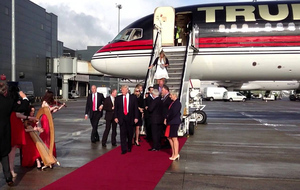
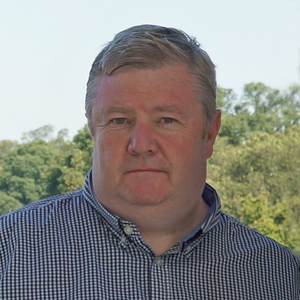
From top: Donald Trump arrives at Shannon Airport; Derek Mooney
Many of Donald Trump’s potential voters are not blind to the fact that the few solutions he offers are unworkable or that he has no grasp of foreign policy.
They are using him as much as he is using them.
Derek Mooney writes:
“Donald Trump looks as if he was playing a President in a porn movie.”
This was Scottish comedian Frankie Boyle’s scathing put down of the Donald on BBC radio four’s News Quiz last Friday.
Maybe it is something to do with the Donald’s addiction to calling everything ‘huge’ (or as he says it: huuuuuge ) and lauding his own achievements with outlandish superlatives but Boyle’s taunt perfectly captures Trump’s OTT and hammy public appearances.
Trump’s emergence as a real contender for the White House has surprised most pundits including – if one of his former publicists is to be believed – himself.
How could this gauche, egotistical, property dealing demagogue tear up the US presidential campaign playbook and beat a string of long established Republican hopefuls?
Hard though we may find it to comprehend from this side of the Atlantic; but part of the Trump phenomenon is that he has teed-up this US presidential election to be a fight between the Washington insider: Hillary Clinton and the outsider: Trump.
Though we may find it difficult to conjure up the image of Trump as an outsider, but in the contest of Clinton Vs Trump, that is what he is.
The term “outsider” is a relative one, not an absolute. It is nothing to do with his history, background or experience, it is about the attitude and outlook he conveys.
Trump does not embody the outsider spirt, but he speaks to it – bluntly – to rally many millions of ordinary middle Americans who, rightly or wrongly, feel that they are now outsiders.
Since the 1970s the American middle class has shrunk from 61% of the population to 50%, while the American dream has become an increasingly distant prospect for the majority.
Many voters believe that America has lost its way and believe Washington is to blame. So, Trump paints the former First Lady, Senator, Secretary of State and member of the newest US political dynasty as a member of the Washington elite and a part of their problem.
It is hardly a new tactic. First you paint your opponent, particularly if [s]he is an incumbent, as out of touch and elitist and then contrast yourselves with [s]he while reciting your voters complaints back at them.
But what Trump has done is a few steps beyond that. He is riding a zeitgeist that he didn’t create, but that others have missed.
Many of his potential voters are not blind to the fact that the few solutions he offers are unworkable or that he has no grasp of foreign policy. They almost embrace these failings.
They are using Trump as much as he is using them.
He is the battering ram with which they can break what they perceive as a broken and corrupt political system. It is why (and how) you can have the seeming incongruity of some Sanders supporters telling pollsters that they are willing to back Trump now that Hillary has beaten Sanders.
Though the analysis and solutions on offer from Senator Sanders differ huuugely from those hinted at by Trump, the core message is the same – America cannot tolerate more of the same.
Things have to change.
The insider versus the outsider analysis also applies in Ireland, particularly an Ireland still coming to terms with the economic upheavals of the last decade.
It explains, in part, the last election results and the massive losses suffered by Labour and Fine Gael.
The Irish Labour Party’s problem is that it has too many insiders and is now led by the arch insider. Though its one “token” ministerial outsider, Alan Kelly tried hard to portray himself as an outsider, but as I mentioned in a Broadsheet piece a few weeks ago, his fast-tracked “rise without trace” to the top makes him an insider.
Meanwhile, Labour’s former BFF, Fine Gael, is also replete with insiders, both generational and aspirational – by aspirational, I mean those whose career paths has followed the line: college – YFG – FG research office – TD’s parliamentary assistant – Ministerial Sp/Ad – TD – minister, without any stop offs in the real world.
With his capacity for kicking against the traces, Leo Varadkar is possibly the closest thing that FG has had to an outsider since John Deasy.
On the other end of the spectrum, Sinn Féin and the various alphabet left alliances are, on the surface at least, full of political outsiders. Though, in the case of SF, it is hard to portray yourself as a complete outsider when your leader predates the electrification of the Howth/Bray rail-line and shares Trump’s penchant for the outrageous tweets.
Traditionally, in Irish Politics, the Independent TDs have been the outsiders. In particular, people like Neil T. Blaney or Jim Kemmy, who broke away from their parties or Tony Gregory who described party politics as strangling.
Which of today’s much larger crop of Independents from the Healy-Raes to the McGraths to Ross, Halligan and Zappone will still be regarded as outsiders in two or three years time will be interesting to see.
Which brings us to Fianna Fáil: Ireland’s outsider insiders.
For most of its history, there has been something of the outsider edge to Fianna Fáil, indeed the party has been at its most successful when led by outsiders, such as Ahern and Lemass.
Even Haughey, for his love of horses, fine dining and hand tailoring had a bit of the outsider/arrivisté about him – especially when contrasted with Garret Fitzgerald’s professorial, relic of aul’ deceny.
As I said earlier, in the context of Trump’s positioning of himself, being the outsider is a relative position, not an absolute one. It is how Michéal Martin’s Fianna Fáil has repositioned itself on the political spectrum.
Compared to Enda Kenny’s Fine Gael and Joan Burton’s Labour, Martin is – despite his long experience around the cabinet table – more of an outsider.
Not only has he has learned the lessons of the crash, he demonstrated over the course of the last election and in the weeks since that he has grasped that we need to change the way we do politics and that what kind of worked in the 90s will not work today.
Derek Mooney is a communications and public affairs consultant. He previously served as a Ministerial Adviser to the Fianna Fáil led government 2004 – 2010. Follow Derek on Twitter: @dsmooney

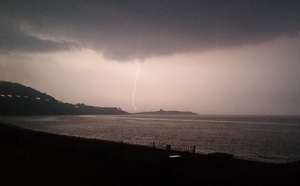
Michael McCutcheon writes:
Thought you guys might like this. Taken by me over Killiney Bay at about 10.30pm last night…

Oh Boland – new split tape and gigs this week
What you may need to know…
01. Oh Boland are a three-piece indie/pop band from Galway. Jangles and riffs in equal measure.
02. They’re on the road all this week in support of A Litany of Failures, their new split cassette via Little L Records. Also appearing on tour (and on the tape) are Belfast lads Junk Drawer, Broadsheet faves Shrug Life, and That Snaake.
03. Streaming above is the video for most recent single, Where’s the Beach?
04. Tomorrow night sees all the bands involved with the aforementioned release play McHugh’s in Belfast, they’ll be at Sweeney’s in Dublin on Thursday, and wrapping up with a show in Galway at the Roisin Dubh on Saturday night.
Verdict: Straight-ahead, no-nonsense but likeable tunes.

Sorry in advance for the sporadic postage during the next hour. Normal service will resume shortly.

Democratic presidential candidate Hillary Clinton speaks at a rally in Lynwood, Califorinia yesterday.
Are you feeling a certain frisson
Now the big game finally on?
There’ll be some first rate
And highbrow debate
Between Hilary and the Don.
John Moynes
Pic: John Locher/AP
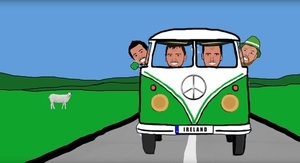
Na Fianna – Je Suis Irelandais
All proceeds go towards sending the Irish Homeless Street League Team to the Homeless World Cup in Glasgow from July 10-16.
Euro songs to broadsheet@broadsheet.ie marked ‘For Euro Consideration’

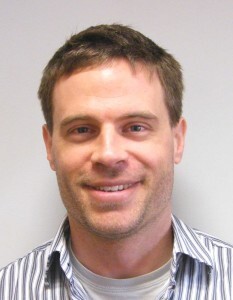
From top; Minister for Justice Frances Fitzgerald; Dr Julien Mercille
The government is now using the pretext of gangland crime to boost its own powers.
Dr Julien Mercille writes:
The wave of gangland crime continues. As expected, the government is now using this situation to further increase its powers over citizens. It’s called building a “Big Brother” State.
Indeed, last week, the Tánaiste and Minister for Justice and Equality, Frances Fitzgerald, outlined a series of worrying policies that the government intends to push through.
The measures include:
(1) Steps to facilitate the “interception of communications and for covert electronic surveillance”
This is exactly what Edward Snowden has been campaigning against to protect our privacy against governments that seek to snoop in our personal conversations and communications.
As of now, we already have a Big Brother State in Ireland because the government and the police can access at will the metadata about all our emails and phone calls, which are conserved for two years.
Karlin Lillington has written truly excellent reports on this in the Irish Times here and here, just like Digital Rights Ireland’s TJ McIntyre .
(2) Boost Garda powers by giving them more money and spreading their institutional reach: “all necessary financial resources will continue to be made available” to the police and international links with Spain, Belgium and the Netherlands will be explored to address international dimensions of crime.
Also, An Garda Síochána will establish a special Task Force focusing on criminals.
The problem with all this is that they’re the most ineffective ways to deal with drug problems, as I explained in previous articles here and here.
The most effective solutions are to provide adequate treatment to addicts, along with prevention campaigns. Reducing the demand for drugs will decrease the number and gravity of criminal acts that are caused by drug trafficking.
(3) It will now be easier for the Criminal Assets Bureau to seize assets and cash held by those suspected of crimes.
This called “civil forfeiture” and is used in some other countries as well. The significant part of this policy is that assets and cash can be seized before someone has been formally indicted in a formal trial. The proposed measures will lower the value of property and cash that may be seized from €13,000 to €5,000 (property) and from €6,500 to €1,000 (cash).
The danger with civil forfeiture is that it opens the door to abuse by law enforcement agents. They can use suspicions as a pretext to seize goods and cash from vulnerable people.
This is exactly what happened in the US, where the practice is used. There, police have literally stopped people on flimsy pretexts and taken their cash, cars and houses, which are then sold in an auction. The proceeds go back to the police departments, who use this practice as a good way to increase their own budgets.
There is an excellent article here on the subject. Of course, it is usually minorities that are arrested and have their property confiscated. Sure they can always launch lawsuits against the police to recover their property, but it is often prohibitively expensive, so that people tend to give up.
Such behavior on the part of Irish enforcement authorities may not be as extreme as in the US, but the Justice Department specified that the proposed measures would allow the Criminal Assets Bureau to target “the proceeds of crime held by middle to lower level actors in localised organised crime activity”, in addition to the assets of higher level actors.
It thus sounds like small dealers who got involved in drugs because of unemployment, and who are not responsible for orchestrating trafficking, will now be targets.
(4) A second Special Criminal Court will be established
The problem here is that Ireland’s Special Criminal Court has been denounced by a range of international and humanitarian organisations, including the United Nations and Amnesty International.
Special Criminal Courts open the door to abuses by the government in the appointment of judges for example, which can be political. The courts also can be less transparent and arbitrary.
In summary, the government is now using the pretext of gangland crime to boost its own powers.
There are well-known, effective ways to address drug violence, including treatment of addicts and decriminalisation of drugs, but the government is not interested in them—in other words, it is not interested in seriously addressing the problems.
It is more concerned with increasing its own (arbitrary) powers.
Of course, all of the above measures could be defended in theory.
For example, we could imagine, in theory, a government truly dedicated to the well-being of Irish people, which would only seize assets of dangerous criminals without formally finding them guilty of anything; which would establish Special Criminal Courts only in very specific circumstances while using them sparingly and impartially.
We can also imagine a police force truly dedicated to tackling white-collar crime as much as petty crime. And we can imagine a government that only snoops on emails and phone calls made by real criminals.
If all that was the case, one could argue that those measures would make some sense.
However, the real world teaches very different lessons.
Why open the door to governmental abuses of power? Why do so especially when there are well-known solutions to the problems we face that do not involve giving any more arbitrary powers to the government?
It is interesting that politicians who regularly claim to be in favour of “small government” and “cutting government waste” have become cheerleaders for more government bureaucracy and more government power over our lives.
Julien Mercille is a lecturer at University College Dublin. Follow him on Twitter: @JulienMercille
