Yearly Archives: 2016

For those who threw rocks and made use of a bolthole, they salute you.

Joe Donnelly writes:

We have a very long and rich heritage of Irish songwriting that deals with colonial oppression by the British. For centuries the folk tradition has cultivated hundreds of ballads and songs of protest and anger. Irish people have always gathered together to sing; it’s part of our identity as a community. This playlist, using the 1916 centenary as a platform, builds up a brief history of some of these songs.

Needs more “broad black brimmer”.

Troid!

Listen here.
Commemorative 1916 Spotify Playlist (TXFM)

90407065-1

Michael-Taft

From top: Enda Kenny at government buildings this morning to convene his last cabinet meeting of this government term; Michael Taft

What many won’t say:

The road ahead is bumpier than you think.

Michael Taft writes:

So the economy is back in recovery mode but under the Government projections we are not going to bounce back to pre-recession levels of living standards.

Lower your expectations, sisters and brothers, the recovery is setting in. Let’s take a historical look at two indicators of living standards.

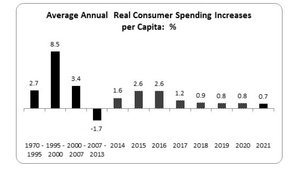
1) Consumer spending:

Between 1970 and 1995, a period covering two slump periods punctuated with growth, real consumer spending averaged 2.7 percent annually per capita.

Between 1995 and 2000 (the good phase of the Celtic Tiger, based on investment, manufacturing and exports), real consumer spending averaged 8.5 percent annually per capita. That was a strong performance, with employment rising, increasing wages and the ongoing shift to a modern enterprise base.

Between 2000 and 2007 (the bad speculative phase) real consumer spending averaged 3.4 percent per capita. A little better than the pre-Celtic Tiger period but as we know, unsustainable.

Then the recession hit and consumer spending fell by over 10 percent. However, as always happens, the economy recovered. In the textbook alphabet, there would be a burst coming out of the recession, representing pent-up demand, and then things would settle back down to past trends.

If the Government projections come true, this will not be the case.
1

We are in the middle of a bump which should continue into this year. However, the Government estimates that it will fall off rapidly in 2017 and remain below 1 percent into the next decade.

It is worth noting that while in 2015/2016 consumer spending increases by €1,000 for every man, woman and child, by 2020/2021 consumer spending increases by less than €300.

2) Public spending:

But this might not be so bad if the Government increased its spending on public services, or government consumption. If, for instance, the Government introduced affordable childcare, reducing fees by half, then the savings to the households could be redirected to other areas of consumption; similarly with free health care.

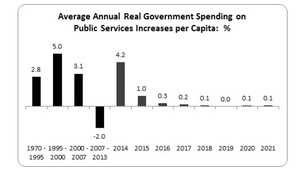
Let’s look at Government spending on public services.

Between 1970 and 1995, real government spending on public services averaged 2.8 percent annually per capita.

Between 1995 and 2000, real government spending on public services averaged 5.0 annually per capita.

Between 2000 and 2007, it rose by 3.1 annually in real terms.

Recession time and public service spending fell by 16 percent up to 2013.

So what is the government projecting going forward?
2

In 2014, government consumption rose by 4.2 percent but this was largely a statistical fluke, factoring in productivity gains from the Lansdowne Agreement. In subsequent years there is effectively no increase at all.

Therefore, there are three principles that should guide the next government.

First, investment; driving investment increases productivity and enterprise expansion which, in turn, increases wages and employment. This is a more sustainable approach to consumption. Pumping consumer spending through tax cuts in the hope that this will increase investment (through business confidence, etc.) is misplaced – as Michael Burke shows here. Pumping consumption in a small open economy like Ireland’s is even more problematic; without stronger export growth, this can lead to reduced growth due to imports.

Second, prioritise public services over tax cuts. If the state provides free healthcare, this reduces costs for many households which can redirect the saving into other areas. It also makes this service more accessible to people who otherwise couldn’t afford costs in the private market. This makes for a more equitable approach to consumption.

Third, redistribute: if you take €100 million from higher income groups and redirect it to low income groups, consumer spending will rise as the latter spends almost everything they get. Therefore, prioritise income supports for those out of work and the low-paid.

There is rising uncertainty in European and international markets. If anything can see us through this, it is a programme that focuses on our economic infrastructure, provides services collectively (reduced cost, greater participation) and promotes income equality. This is a long-term approach.

Right-wingers, Fine Gael in particular, are proposing to reduce our tax base while starving economic and social investment.

If this short-termist, electorally-populist formulation isn’t a recipe for instability it is hard to know what is. And as a set of policies designed to enhance living standards, it is a bust. Progressives should put forward a different, more economically responsible programme.

Investment, public services and equality: how’s that for a campaign theme?

Michael Taft is Research with Unite the Union. His column will appear here every Tuesday. He is author of the political economy blog, Unite’s Notes on the Front. Follow Michael on Twitter: @notesonthefront


Screen Shot 2016-02-02 at 12.31.39

This morning.

A short timelapse video of polar stratospheric clouds in Dublin by Ian Carruthers.

Ian writes:

“A brilliant sight to witness, dancing across the sky like a rainbow at sunrise.”

Meanwhile…

unnamedScreen Shot 2016-02-02 at 15.40.17

Bray, Co. Wicklow, 9.30 this morning.

(Thanks Marsupial)CaNRcIPWIAAuNid

Alan Morton tweetz:

“Nacreous clouds and the church of the Holy Trinity, Dublin.”

90407067

Merrion Street, Dublin 2 this morning.

Yesterday: Is This Normal?

mailo:lucindaPodcastCover Tunein

From top: Renua candidate Mailo Power with party leader Lucinda Creighton; William Campbell

Waterford Renua candidate and hotel owner Mailo Power talks to William Campbell of the Here’s How [current affairs] podcast on her party’s controversial flat tax plan.

William writes:

Mailo Power defends her party’s plans for taxation. People on six-figure salaries will get huge tax cuts, someone on €200k get an extra €45k in their pocket. People lower down the scale? They get an incentive to work harder…

Fight!

Listen here

Screen Shot 2016-02-02 at 11.16.08

Mattress Mick

Humans of Dublin is an ongoing project by photographer Peter Varga comprising portraits and short quotes about anything from passers by on Dublin streets

Pete recently photographed Dublin bedding baron Mattress Mick who proved his humaneness with the following:

“When I was in my late teens I met a girl, and she became very, very special to me. She was my first love. We were together for quite a while, but I guess we were just too young… We met too early. She wanted to do other things, so she decided to go different ways. We kept in touch on and off for a long time, but after that, I hadn’t seen her for years.”

“I knew she got married, I knew she had children. Some of her friends kept in touch with me, so I always knew what was going on. She was always very special to me, and never really left my thoughts. A few years later somebody told me she developed cancer.”

“I actually met her about two years before she died. Her friends organised a reunion but I didn’t think it’d be the last time I saw her. One Sunday afternoon, out of the blue, a friend of hers called me and said, ‘Hi Michael, I have someone here that wants to talk to you.’ She said, ‘Hi, it’s me, Kathy. I just would like to say goodbye. I know I’m going to die soon, and I wanted to let you know you were very special in my life too.'”

“Every time I think about that phone call I get very sad. It was the nicest phone call I have ever received in my whole life. It meant so much to me. That someone who knew they were terminally ill and hadn’t a lot of time could actually think about me, and tell me that… I guess it is true, it’s never too late to tell somebody how you feel. She died that week, but she’ll always be in that very special place in my heart.”

Mattress Mick (Humans of Dublin)

Meanwhile…

-1

Mattress Mick and Mrs Mick, happily married for over 30 years.

Until she read the above

Mmf.

Pic: VIP magazine

Screen Shot 2016-02-02 at 11.04.01

Director General of the HSE Tony O’Brien

You may recall how the HSE repeatedly told the Public Accounts Committee it had apologised to ‘Grace’ – the mute woman with intellectual disabilities who suffered extreme physical and sexual abuse while she was in a foster care home from 1983 until 2009.

The Irish Examiner, on Monday, January 25, reported that the whistleblowers involved in the case claimed the HSE, in fact, had not apologised to Grace.

On Saturday, January 30, the HSE released a statement admitting no official apology had been given to ‘Grace’ or her mother – or the 46 other people who had contact with the foster home over the years.

Further to this, Fianna Fáil TD and chairman of the Public Accounts Committee, John McGuinness, on Today with Seán O’Rourke, said:

“We got a letter into the Public Accounts Committee, from the HSE, which basically rubbished the report that was written by the Irish Examiner, and referring to the apology as one of ‘for the poor quality of service’. These individuals, allegedly, were raped, abused and treated in the most abominable way and then, after that, we received, the following week, we received, the Public Accounts Committee received a letter from the agency concerned and they said they were being treated as despicable today, their treatment, as it was on day one when they raised this issue. What does that say about the protectors of those who are weakest, the HSE?.”

“Those that discovered this, that were professional enough and brave enough to come forward, did so, the whistleblowers. Unfortunately, the system within the HSE served them very badly and the whistleblower legislation, it would appear, is not worth the paper it’s written on. Because the whistlebowers fear for their professional futures.”

“We want to hear [from HSE director general Tony O’Brien] the full truth, we want to hear him tell us exactly what he knows from beginning to end, as much as he can – because we know there’s a Garda investigation going on. What we don’t want is for them to hide behind that investigation…”

HSE director general Tony O’Brien will appear before the Public Accounts Committee at noon today.

Related: Foster care scandal: The drip-drip of misinformation and mistruth (Irish Examiner)

Previously: No Saving Grace

‘What Was In The Records?’

Mark Stedman/Rollingnews