
Yearly Archives: 2017

Readers will recall the withdrawal of the Bank of Ireland mortgage ad.

Yesterday economist Jim Power and Journal.ie journalist Aoife Barry spoke to Pat Kenny on Newstalk about the matter.

Further to this… Mark Paul, in today’s Irish Times, writes:

Barry, who is 34, was critical of the ad and generally represented those outraged on social media – she even sports a presumably ironic snowflake in her Twitter handle. Power, who is of a slightly older vintage, was broadly dismissive of the backlash. He recalled selling his Mini to help gather a deposit to buy his first home. Kenny read out a stream of messages from listeners, mostly critical of Barry for being oversensitive.

Kenny then read a message aimed at Power. “I’m outraged at Jim Power suggesting I sell my car to buy my house,” read Kenny, adopting a deliberate tone of mock indignation. The tweet was obviously a wind-up. “Not everyone has a car. So insensitive of Jim… signed, Snowflake from Cork.”

Barry is from Cork, and has the lilt to prove it. The message was obviously a dig at her, and seemed supportive of Power. But he didn’t see it that way. Power, normally as rational and genial as economists get, reared up in indignation. For real.

“I didn’t suggest anyone sell their car, I sold my own car,” he retorted, his voice faltering with anger. He hit out at people for “bitching” and said we were “all free to do what we want”. We couldn’t see the blood rising up the back of Power’s neck. But we could almost hear it. Kenny hadn’t the heart to tell him he had simply missed a joke.

There it was, peak Irish media discussion about millennials and social media. One of the country’s soundest economists, outraged over a misconstrued message that was poking fun at the outrage of “snowflakes” on Twitter, whose original outrage was sparked by a bank, which made a not-very-outrageous ad . . . about a mortgage product.

When ‘snowflakes’ attacks: Home truths for Bank of Ireland (Irish Times)

Further to this…

You may recall a piece written by Kathy Sheridan in The Irish Times last September, in which Ms Sheridan responded to online criticism of the coverage of the killing by Alan Hawe, 40, of his wife Clodagh Hawe and their three children Liam, 13, Niall, 11, and Ryan, 6, in Ballyjamesduff, Co. Cavan.

Mr Hawe also took his life.

After Ms Sheridan’s piece was published, The Irish Times’ opinion editor John McManus tweeted it, saying:

On the same day, in response to Mr McManus’s decision to specifically refer to Ms Sheridan’s sex, Aoife Barry, assistant news editor at The Journal, tweeted…

In response to Ms Barry’s tweet, former Sunday Business Post journalist and writer Siobhán Brett tweeted…

Then. Several days later, Ms Barry was alerted to the fact that Mr McManus had added Ms Barry to a Twitter list, entitled Snowflakes:

As was Ms Brett…

There you go, now.

Previously: The Story Of Why

Aislinn Ní Uallacháin, of Ali Coffey Casting, writes:

AC Casting is looking for male rugby players for a new ad campaign. No acting experience needed! Must be comfortable in the front/second row of a scrum. Very nice fee if chosen.

Who we’re after: Guys should be aged 20s-40s. We’re looking for characterful, interesting guys who look like they play a lot of rugby – crooked noses, weather beaten faces are all great.

They should be confident guys, up for a laugh who aren’t camera shy.

They should have a Southern Irish accent, we’re particularly looking for some guys who have a Munster accent.

We’re also looking for a woman aged 55+ so if anyone’s mam/aunt/friend would like to apply with them, let us know.

The casting will be held in Dublin city centre next Wednesday August 30 in the evening so that people can come from work. There will be a possible recall on Friday, September 1 and you would need to be available for the shoot which will be one day on either September 5, 6 or 7.

How to apply: Email auditions@alicoffeycasting.ie and put ‘Rugby’ in the subject line.

Make sure you include:

1. A few pics of yourself. Preferably a full length shot and one where we can see your face clearly.
2. Let us know what rugby position you play.
3. A bit about you – if you have any acting/performance experience let us know, though this is not necessary.
4. Where your accent is from.
5. A contact mobile number.

As is always the case, time is tight and spaces are limited so do get in touch asap.

SCRUM!

Ali Coffey Casting

Dr Jessamyn Fairfield

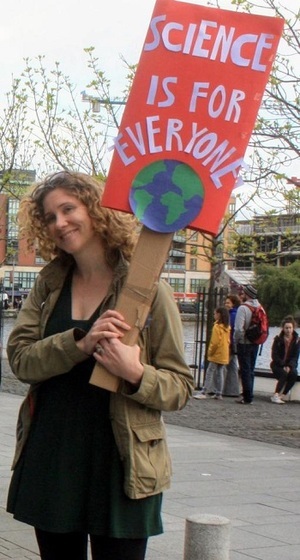
Dr Jessamyn Fairfield is a lecturer in the School of Physics in NUI Galway director and compere of Bright Club in Ireland, the co-organiser of Soapbox Science Galway, and an established improviser and comedian.

Dr Fairfield writes:

I’m a physicist and a science communicator, and I’ve had a lot of unique experiences in my life as a result of those passions.

But I never expected to be detained at UK border control for three hours, and eventually denied entry and sent back to Ireland, just for doing science communication.

You see, although I have lived and worked in Ireland for the past six years, I have an American passport and no special privileges in any other part of Europe.

And I have been all over Europe as part of my job in Ireland: to attend research conferences, be hosted as a visiting researcher in another lab, speak on panels, and give public lectures and science comedy performances as to engage the public with science.

I came to Europe as a postdoctoral researcher and am now a lecturer at NUI Galway, running my own research lab and a plethora of public engagement events.

Mobility is a critical issue for physicists. We may need to travel for a conference, to visit collaborators, or even to move abroad to start a new career stage

But when I showed up in Cardiff to do a science comedy show as part of a festival, I was stopped at the border. I was not going to be paid for my performance, and had paid for my own travel out of pocket.

However the border agents considered the festival ticket and parking pass that I had received (for an event I was to speak at) as a form of payment in kind.

This is equivalent to saying that invited speakers at a conference are paid if their conference registration is covered, and nothing I (or the festival organisers who were phoned) could say convinced them otherwise.

Throughout this process I was left alone for long stretches, told not to use my phone, and all my travel documents (from both the US and Ireland) were taken off me. It’s a process that is designed to make you feel powerless, and it works.  Finally I was fingerprinted and photographed, served with refusal paperwork, and sent back to Ireland.

There is now a black mark in my passport indicating I was refused entry to the UK.

This is especially ironic given my next planned trip to the UK will be to collect the IOP’s Mary Somerville Prize – a significant public engagement award that I am honoured to receive for my efforts to communicate science to the public.

And yet apparently I am not allowed to do public engagement activities, not just for free but at my own expense, in the UK.

Mobility is a critical issue for physicists. We may need to travel for a conference, to visit collaborators, or even to move abroad to start a new career stage.

Recent political developments such as Brexit and the travel ban in the US have been rightly criticised by researchers around the world for failing to account for how necessary the free movement of people is to science today.

Early-career researchers who can’t obtain travel visas easily are at a heavy career disadvantage. This is why mobility was a core issue of the recent March for Science.

To me, this is also indicative of how toxic our conversations about immigration in general have become. The border patrol officers I dealt with were as kind as they could be to me, but they were tasked with enforcing a system where all immigration is considered negative. Never mind that immigrants are often young, hard-working, and full of ambition.

Never mind that immigrants drive social change, spark innovation, bring new perspectives, and in fact draw less on social safety nets than citizens do (both because of their demographics and often because they aren’t allowed to).

Never mind that in science, many researchers move internationally, often multiple times, and in fact a huge number of Nobel Laureates are immigrants themselves.

The narrative we hear about immigration often seems to have a Schrödinger’s Cat quality to it: immigrants as lazy welfare cheats, who are also stealing our jobs.

We should respect just how much immigrants contribute, scientifically and otherwise, to the countries they have chosen to call home.

I hate that this disrespect starts at a very early stage: the recent story of the Afghan girls’ robotics team who were initially denied entry to the US for a robotics competition is heartbreaking. I was glad to see the decision reversed, as setbacks to girls in science and engineering are plentiful enough already.

I’m an immigrant, a physicist, and a science communicator, and I’m working hard to make the world a better place. Ireland has been welcoming, for me at least, so I’m doing a lot of that work here.

But if other countries want talented young people to come enrich their societies, they should actually make that possible. Otherwise we’ll go somewhere else.

Science shouldn’t stop at the border (Dr Jessamyn Fairfield, Institute of Physics blog)

Thanks Neil Curran

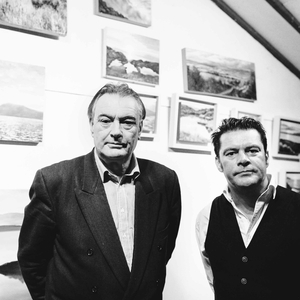
Ian Bailey and Olaf Tyaransen

Via Hot Press

Ian Bailey, is to make an exclusive appearance with a public interview with at the Hot Press Chatroom at Electric Picnic.

Bailey was arrested twice in relation to the 1996 murder of French film producer Sophie Toscan du Plantier, however he has never been charged and has always strongly protested his innocence.

Appearing at the Hot Press Chatroom at 2pm on Saturday, September 2 Bailey will be interviewed by Hot Press journalist Olaf Tyaransen, in a conversation that will offer an absolutely fascinating insight into one of the most debated cases in modern Irish history.

Earlier this year, Tyaransen carried out a comprehensive interview with Bailey in Hot Press, which laid bare the toll the case has taken on his life. You can read the article in full at the link below.

Ian Bailey to make exclusive appearance at Hot Press chatroom at Electric Picnic (Hot Press)

Pic: Kathrin Baumbach.