
Yearly Archives: 2017

This afternoon.

In the Dáil.

During Questions on Promised Legislation.

Sinn Féin deputy leader Mary Lou McDonald spoke about the late Dara Quigley and her question was responded to by Minister for Justice Frances Fitzgerald.

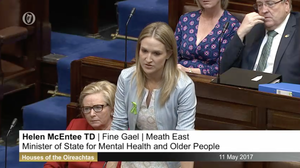
Mick Barry, of the Solidarity-People Before Profit party, also spoke about Dara and Fine Gael’s Minister of State for Mental Health Helen McEntee responded to him.

Their exchanges:

Mary Lou McDonald: “Tánaiste, yesterday, the Taoiseach indicated that you would be more than happy, in fact delighted, it seemed, to come before the House and make a statement on the matters surrounding Templemore and some of the issues that we touched on and Leaders’ Questions. You also indicated that you would be quite happy to take questions in that regard. So I want to know, when you propose to do that.

“And can I also say, Tánaiste, when you take to your feet  on that occasion, I would like you also to shed some light on the case of Dara Quigley. A young woman who died by  suicide on April 12. She had been detained by gardaí some days previously, under the Mental Health Act. She had been walking naked on a Dublin street when detained and Garda CCTV footage of this detention  was posted on Facebook. A really deplorable and revolting turn of events and something that has brought great hardship to her family and clearly brought very, very great distress to Dara. So we mark her passing and when we talk about Garda culture and reform and accountability, I suppose this the rawest end, the sharpest end of deplorable, a deplorable culture of humiliation and disregard for human beings.”

“So, Tánaiste, I hope that you will, as the Taoiseach promised, come before the House, make your statement, take questions and I hope also that you might shed some light on the accountability that will be held for the life of Dara Quigley.”

Frances Fitzgerald: “Well, in relation to the individual case that you mention, deputy. Everybody would be totally disturbed and appalled by the story that has been reported in the media and actions are following on from that. As you know, that has been reported, there is an investigation and there is a GSOC inquiry but, just to say, of course our thoughts are with, are with that young woman’s family, given the appalling and very, very sad sequence of events. No doubt, the business committee can discuss the question of ministers appearing before the Dáil and, certainly, I want to make the point that, I don’t want to cut across in any way the work that the Public Accounts Committee is doing in relation to Templemore.”

Mick Barry: “There has been media comment on the circumstances leading up to the death of the journalist and blogger Dara Quigley. Very serious questions have been raised about the Garda Síochána and their treatment of the most vulnerable in society. I want to leave those questions for another day.”

“Today, I want to ask you a question on dual diagnosis. Dara suffered and struggled with both addiction and mental health problems. She received help from many agencies but what was available was not sufficient. A particular problem was the lack of dual diagnosis services for psychiatric and addiction problems are treated together in a professional and properly funded manner. My question to the Tánaiste: does she see a legislative pathway to addressing this problem?”

Helen McEntee: “Just to join you in offering my condolences to her family and to her friends. This is, you know, it’s an absolutely terrible situation and it’s deplorable what has happened consequently since. The issue of dual diagnosis is something that we haven’t dealt with in the past and we know that in a significant number of suicides, there is a link between drug or alcohol use as well. We’re currently developing a clinical programme on the issue of dual diagnosis.”

“We’ve appointed a national clinical lead who will be working to develop a programme which means that if somebody is suffering from either a drug or alcohol problem that is leading on to a mental health problem, that there will be a clear clinical pathway for our doctors and nurses within our acute hospitals but also in our primary care settings so there’s work well underway and we’d be hoping to continue that into the year.”

Watch Dáil proceedings live here

 Peter Thompson finishes his 44th Marathon in 44 Days in 44 Countries in Dublin on Sunday.

Want to join a great act of personal courage undertaken for the benefit of others?

Free Sunday?

Ultan Mashup writes:

Don’t stay in this Sunday tweeting outrage at #Marian. Get your Dublin running shoes on.

Peter Thompson is finishing his 44th Marathon in 44 Days in 44 Countries in Dublin this Sunday – 14 May 2017 – in aid of mental health charities.

As well as supporting Peter, you can also fly the flag for mental health awareness in your own way closer to home.

START: Sunday at the Radisson Blu Royal Hotel, Golden Lane, Dublin 2 @ 12:30 hours
FINISH: Market Bar, Fade Street, Dublin 2 (about 16:30-17:00)

The route: City Centre / North Strand / Clontarf Seafront/ Dollymount Beach / Howth Lighthouse / Clontarf Seafront / Alfie Byrne/The Point/Docklands / Grand Canal/Portobello / Camden Street / MARKET BAR – FINISH

If you want to run the last 10km only joinb us in at Wind/Sail monument in Clontarf about 15:15-15:45. Or, if you want to just armchair it on and cheer him after the fact, I am sure he would love a pint of Irish hospitality at the Market Bar in Dublin!

Hic.

Marathons For The Mind

This morning.

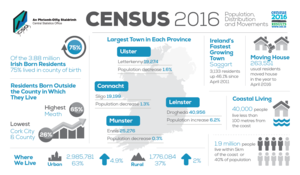
The Central Statistics Office released new figures in relation to the movement of the population within Ireland.

It reports:

In April 2016, 44% of the State’s total urban population lived in Dublin, while 11% lived in CorkSligo was the county with the biggest change in the rate of urbanisation, increasing from 37% to 40% over the five years.  Forty-one towns had a population of 10,000 or more, with 27 in Leinster, nine in Munster, three in Connacht and two in the three Ulster counties.  62.7% of the population lived in urban areas in April 2016.

37.3% of the population lived in rural areas in April 2016.  The largest rural population increase was in County Cork with 6,946 persons followed by Kildare which saw its rural population increase by 4,025 persons.

Drogheda, with a population of 40,956 (up 6.2% since April 2011) remained the largest town in Ireland.  Swords (39,248) and Dundalk (39,004) complete the top three.  Ennis (25,276 persons) remained the largest town in Munster.

Sligo with 19,199 persons was Connacht’s largest town, while Letterkenny (19,274 persons) was the largest town in the three Ulster counties.  The latter three towns experienced a slight decline in population since April 2011.

263,551 usual residents (aged one year and over) moved in the year up to April 2016, down 3.5% on the 2011 figure of 273,239.  Of these, 94,182 moved in Dublin, with 18,716 moving out of the county.  The top destinations were Kildare, Meath and Wicklow.  The number of households moving in the year up to April 2016 fell by 4% to 110,204.

Read the full report here

Earlier today.

Prince Charles has a go at hurling in the grounds of Kilkenny Castle.

Charles and his wife the Duchess of Cornwall Camilla Parker-Bowles are currently on a three-day State visit.

Video: Sean Defoe

Previously: To Your Stations

Robin Hill apartment complex in Sandyford, Dublin; Leaders’ Questions on Tuesday

You’ll recall the Tyrrelstown amendment.

It was added to the Planning and Development (Housing) and Residential Tenancies Bill 2016 before Christmas.

It had originally proposed that where a landlord proposes to sell 20 or more units in a development – within six months – the sales would be conditional on existing tenants being able to remain in the property unless there were exceptional circumstances.

During a Seanad debate on this amendment, the number was changed from 20 to five.

But on foot of advice from the Attorney General, the Minister for Housing Simon Coveney  increased this figure, from five to 10.

Readers may also wish to note how director of advocacy Focus Ireland Mike Allen in January stated that “a third of families who are becoming homeless in Dublin are becoming homeless because their landlord has been forced to sell up“.

Further to this.

Richard Boyd Barrett spoke about the Tyrrelstown amendment in an interview with Seán O’Rourke on RTE Radio One this morning, in regards to an apartment development, called Robin Hill, in Sandyford, Dublin 4, which went into Nama and was then subsequently sold to Cerberus.

Dún Laoghaire-Rathdown County Council requested to buy 15 of the apartments in May of last year but was told it would have to buy the entire complex.

This morning, Jack Fagan, in The Irish Times reports that the complex is on sale, in one lot, from today with a guiding price of €14million.

According to Mr Boyd-Barrett, some of Robin Hill’s tenants are now facing eviction.

During the Seán O’Rourke show:

Seán O’Rourke:I quote the minister [for housing Simon Coveney] from what he said yesterday. He said, and this is regard to protecting people who are there in an apartment block being sold. He said, if 10 or more properties are being sold in one sale, then people who have tenancies in the apartments affected get protected through that sale and I said I’ve asked Richard, in other words you, to send me the details of any cases or any individual issues he has. Now surely that reflects an openness on the minister’s part?”

Richard Boyd-Barrett: “No, first of all, when I raised this issue on Tuesday, the minister did not contact me and ask me, he didn’t in the Dáil, or afterwards, ask me for the details of Robin Hill. That’s simply not true.”

“Secondly, what the legislation refers to, actually means is, that the vulture fund or landlord can evict nine people and then six months later, by the way, the legislation will allow them to evict another nine people. And six months after that, another nine people.

“So, this figure of 10 – which was never explained why we had to include it. We, at the time of the legislation sought to bring that down to zero. In other words that, if you were selling a multi-unit development, you would have to sell it with the tenants in situ and guarantee the security of tenure and the Government resisted that, for reasons I don’t understand but it now seems for reasons that benefitted vulture funds who are trying to profiteer at the expense of tenants they want to evict or massively increase rents.”

Meanwhile.

On Tuesday.

In the Dáil.

Readers may wish to recall the exchange Mr Boyd Barrett had with Taoiseach Enda Kenny during Leaders’ Questions, in respect of Robin Hill.

Richard Boyd Barrett: “I will cite a very concrete example of how decisions the Government made in the past six months have contributed directly to this shambles and the hardship that follows. Robin Hill, a development of apartments in Balally in Sandyford, was originally built by the McEvaddy brothers in 2008. The development, which consists of 52 apartments, went into NAMA at some point.

For most of the time it has been in NAMA, at least 15 and possibly as many as half of the apartments have been empty while the housing crisis spirals out of control. In May 2016, Dún Laoghaire-Rathdown County Council asked whether it would purchase 15 of the vacant units. It was told that it could only buy the entire block.

Shortly after the Project Eagle scandal broke in September, NAMA agreed the sale of Project Gem, which included these apartments, to the vulture fund Cerberus. The sale, which was one of the biggest sales of property in the history of the State, went through.

Since then, Cerberus has moved to start evicting the tenants in a block that is still half empty. Of the 21 remaining tenants I have met, five are to be evicted in June.

Others whom Cerberus feels it cannot evict straight away have been told they must pay an extra €250 per month in heating and hot water charges that were previously included in the rent. They were never charged for that previously. In other words, this is a back-door rent increase of about 20%.

These empty units are sitting there while we have record numbers in homeless accommodation with evictions to follow. This would have been avoidable if NAMA had not sold this development to a vulture fund but had given it to the local authority as it requested and if the Minister for Housing, Planning, Community and Local Government had ensured his Bill before Christmas included a provision to prevent new owners from evicting tenants when apartments are sold, as we warned would happen, or finding back-door ways to ratchet up rents. Is it not the truth that the crisis is avoidable and has resulted from the Government’s policy failures?”

Enda Kenny: “No, it is not the truth. The problem here is the supply of houses throughout the country. Anyone can understand that there is real pressure in certain segments of the housing sector. The Deputy can nod his head if he likes. I read a report this morning that said that 49 houses priced between €400,000 and €700,000 were snapped up inside a day by those who could afford them. There are no difficulties in certain areas.

It is true to say that there is a serious issue here. A total of 40,000 vacant units have been bought by the State in the past five years.

Boyd-Barrett:A fantasy figure has just appeared, namely, that the State has apparently purchased 40,000 houses. The more accurate truth is that NAMA has flogged off thousands of homes or, worse, as the Balally example indicates, has sat on empty properties in public ownership and when local authorities sought to purchase them, it refused and chose to sell them to a vulture fund instead.”

The vulture fund is now moving to evict people, bypass the Minister’s totally inadequate legislation and ratchet up the rent on tenants it cannot immediately evict. I suspect, and the tenants fear, that they will be evicted in phases because under the Tyrrelstown amendment, no more than ten tenants may be evicted at one time, which is leading to landlords evicting tenants en bloc. That is almost certainly the case and the Taoiseach allowed it to happen by selling apartment blocks.”

“How many more Balallys are there? How many more in Project Gem? How many more people will get eviction notices from vulture funds to which NAMA sold properties at a massive discount rather than give them to the local authorities. There are 50,000 empty properties in Dublin. The Balally situation indicates why there is a supply problem in spite of that. That is the real issue. It is not an absolute supply problem, it is a man-made one resulting from the behaviour of NAMA and the vulture funds, which are sitting on empty properties, evicting people in order to inflate property prices and rents and make more profit from the misery of those they evict or who cannot afford to rent such properties.

Kenny:Let me clarify what I meant when I said that 40,000 properties have come back into use.”

Bríd Smith: “That is not what the Taoiseach said.”

Pearse Doherty: “That is not what was said.”

Kenny: “I take the Deputy’s point. One thousand properties were purchased by the State at a cost of €203 million.

Doherty: “One thousand.”

Aengus Ó Snodaigh: “That is 39,000 fewer than the original figure the Taoiseach gave.”

Transcript via Oireachtas.ie

Listen back to this morning’s Today With Seán O’Rourke here

Listen back to yesterday’s interview with Minister for Housing Simon Coveney here

Dundrum complex with 51 apartments guiding for €14m (Irish Times)

Pic: John Fleming Architects

Broadcaster Joe Duffy

On The Late Late Show

Via the RTÉ press office:

Broadcaster Joe Duffy will join Ryan to chat about taking the pulse of the nation on Liveline as he revisits some of the standout stories that had the entire country roaring at their radios. Viewers will find out what happened next.

Paul Costelloe will chat about going from working as a door-to-door bible salesman to becoming one of Ireland’s most famous fashion designers. He’ll chat about surviving the recession and crafting some of the world’s most famous dresses as personal designer for Princes Diana.

As Guns N’ Roses prepare to rock Slane again, The Late Late Show will be looking back at some of the huge gigs that defined a generation with Lord Henry Mountcharles. From The Rolling Stones and U2 to a gig that Bruce Springsteen will never forget, he’ll be giving viewers the inside track on staging some of the biggest concerts Ireland has ever seen.

*places telly on barbecue*

The Late Late Show, Friday, RTÉ One at 9.35pm.

Pic: RTÉ