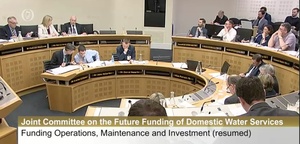
Angela Kerins before the Public Accounts Committee in 2014
The Public Accounts Committee will have to pay two thirds of former Rehab boss Angela Kerins’ legal costs after her failed High Court action.
Ms Kerins lost her personal injury claim against PAC [concerning two days of grilling about payments to the charity] after the court said it could not make any judgment on utterances made inside the oireachtas (see REDACTED for details).
So…why are ‘we’ lumbered with the bill?
Legal Coffee Drinker writes:
Order 99 Rule 1(1) of the Rules of the Superior Courts provides that the
“costs of and incidental to every proceeding in the Superior Courts shall be in the discretion of those courts respectively…”.
Order 99 Rule 1(4), further provides:
“…the costs of every issue of fact or law raised upon a claim or counterclaim, shall, unless otherwise ordered, follow the event…”.
This gives the courts a wide discretion in relation to costs which has been limited by rules laid down in case law.
The leading case is the decision of the Supreme Court in Dunne v Minister for the Environment [2008] 2 IR 775. The issue under appeal was whether or not an individual who had brought an unsuccessful legal challenge to the construction of a motorway near a site of archaeological interest should be entitled to their costs.
The Supreme Court held that that the normal rule was that the costs of every proceeding followed the event but that the courts always retained discretion in relation thereto.
There was no fixed rule or principle determining the ambit of that discretion and, in particular, no overriding principle which determined that it had to be exercised in favour of an unsuccessful plaintiff in specified circumstances or in a particular class of case.
The fact that a plaintiff was not seeking a private personal advantage and that the issues raised were of special and general public importance were factors which could be taken into account along with all other circumstances of the case in deciding whether there was sufficient reason to exercise a discretion to depart from the general rule that costs followed the event.
However, the two principles, in themselves, were not the determining factors in any category of cases which could be described as public interest litigation.
In that case the Supreme Court overturned an order awarding the unsuccessful applicant his costs, saying that:
“undoubtedly the fact that a plaintiff is not seeking a private personal advantage and that the issues raised are of special and general public importance are factors which may be taken into account, along with all other circumstances of the case, in deciding whether there is sufficient reason to exercise a discretion to depart from the general rule that costs follow the event.
However, insofar as the learned High Court Judge may have considered that the two principles to which she referred are in themselves the determining factors in a category of cases which may be described as public interest litigation, I do not find that the authorities cited support such an approach…”.
Recently United Left TD Joan Collins was awarded 75% of her legal costs in her unsuccessful challenge to the promissory notes issued by the Minister for Finance in favour of Anglo Irish Bank and the Educational Building Society.
The three-judge divisional High Court ruled that it was an exceptional case which merited a departure from the normal rule regarding costs. Given the exceptional nature of the litigation, it awarded her 75%.
In that case, Joan Collins had no ‘private personal advantage’ in the success of her legal claim. The Kerins case is different in this respect.
However the decision in Dunne, while acknowledging that lack of private personal advantage might be a factor to be taken into account in deciding on costs, did not absolutely rule out an award of costs in such a case.
The test which is applied in deciding on costs is ‘exceptionality’ – something which still leaves a lot of discretion to the trial judge.
In the Kerins case, the court appears to have regarded the issue involved as of sufficient public importance to override the fact that the case was of private personal advantage.
FIGHT!
PAC must pay two-thirds of Kerins’ legal costs (RTÉ)
Pic: Oireachtas.ie