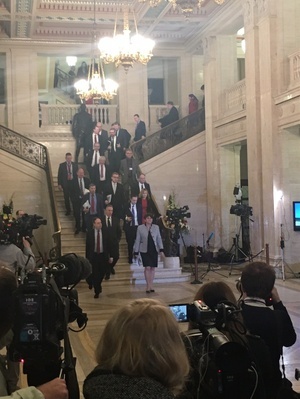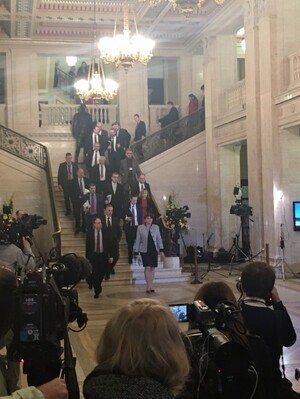

From top: Outgoing First Minister Arlene Foster arrives with DUP members to talk to the media at Stormont this morning; Derek Mooney
With the prospect of the DUP and Sinn Féin returning as the main parties of Unionism and Nationalism in Northern ireland it is hard to see how a viable new Executive can be formed within the time allowed.
Derek Mooney writes:
Where the collapse of the Northern Ireland Executive has been about an absence of trust and respect, the next six weeks will be about patience – not least the patience of the electorate.
Voters, in most mature democracies, do not like unnecessary elections, and tend to punish the party that caused one. Whether that rule holds in a polity that is closer to pubescent than mature will be interesting to see, but it is already clear the DUP is not as bullish about its prospects as it was. We saw that in Arlene Foster’s Stormont Hall presser just before midday.
The last Assembly election was just eight months ago, the Brexit referendum was held last June. Barring a snap Westminster election, the good voters of Northern Ireland were not anticipating having to drag themselves down to the polling stations for another two years, at least, until the May 2019 Local Elections.
They were expecting almost three campaign free years, but now DUP intransigence and mismanagement has plunged the Six Counties into crisis and sent the two governments scurrying about when they were already barely coping with Brexit.
But as tetchy as the voters may be about having their period of political rest disturbed, their patience will really be tested if the DUP – and by extension Sinn Féin – attempt to run the 2017 Assembly campaign along their traditional routes.
The DUP lambasts Sinn Féin which helps Sinn Féin convince the nationalist community that it is the only bulwark against DUP hegemony. In turn, Sinn Féin slams the DUP, which helps the DUP to convince wavering UUP supporters that they must rally to them to stop the Provos getting the First Minister’s job.
It’s a symbiotic campaign tactic has worked for both in the past, but at a cost: to the smaller parties and to voter confidence.
As I have discussed here before, voter turnout in elections in the North has been dropping with nationalist voters staying away slightly more than their unionist neighbours.
The Brexit turnout was the exception. Though only seven weeks after the Assembly election; it saw voter turnout jump by a whopping 8%. In other words, about 90,000 people who were not motivated enough to come out and vote for any of the candidates running for the Assembly, were moved to come out and vote on the issue of remaining in the EU.
The question this time around is whether the new circumstances will dictate a new voter strategy? Will people still vote the way they did last May and will the 90,000-extra people who voted on Brexit have the motivation they require to come out again and vote.
Perhaps some of them will after they hear Prime Minister Theresa May say tomorrow that she is happy to accept a hard Brexit and a hard border across this island as a price worth paying for keeping his grip on the Tory party.
A six-week campaign of deep silo-ed orange and green rhetoric from both big beasts will test the voters resolve and patience.
If their patience is exhausted and we get, as I suggested last week, a situation where the DUP and Sinn Féin return as the main parties of Unionism and Nationalism, albeit with reduced numbers, then it is hard to see how a viable new Executive can be formed within the time allowed.
If that is the case, then the Secretary of State can call another election, except this time the existing executive doesn’t continue into a caretaker/acting capacity, instead we get a return of direct rule.
This is a problem. Given that the Executive has effectively collapsed due to absence of real parity of esteem, it would test the patience of nationalist voters, from across the spectrum, to see the political instability triggered by DUP intransigence result – even temporarily – in direct rule from Westminster, especially one so driven by Brexiteers. This is not in our interests either.
There is also a sound practical political reason why direct rule is a bad alternative. If you want to get all the parties to come to their senses and break any likely deadlock, then don’t threaten as a default something that one of those parties does not view as something to be avoided at all costs.
There is, as Colum Eastwood and the SDLP have suggested, an alternative. It is one that Governments had already envisaged for such a deadlocked scenario: it is: Joint Authority, though back then they called it Joint Stewardship.
In Armagh on 6 April 2006 the then British Prime Minister, Tony Blair and the then Taoiseach Bertie Ahern, issued a joint statement on the then deadlocked political situation.
In April 2006, the two Governments concluded that the people of Northern Ireland should not be asked to vote repeatedly in elections to a deadlocked Assembly and proposed cancelling salaries and allowances for MLAs pending “a clear political willingness to exercise devolved power”.
More specifically, at Point 10 of their statement the two Governments agreed:
“…that this will have immediate implications for their joint stewardship of the process. We are beginning detailed work on British-Irish partnership arrangements that will be necessary in these circumstances to ensure that the Good Friday Agreement… is actively developed across its structures and functions. This work will be shaped by the commitment of both Governments to a step-change in advancing North-South co-operation and action for the benefit of all.”
Significantly adding at Point 11 that:
“The British Government will introduce emergency legislation to facilitate this way forward.”
Perhaps the two Governments, but more especially our own Government, should be considering this approach now as a way of bringing some political leaders to their senses before everyone’s patience is tried.
One last word on patience. Though I am no fan of his and I have had no problem criticising him here and elsewhere, it must be said that Martin McGuinness showed considerable patience and perseverance over the past few months as he used his personal leadership skills to hold an increasingly fractious Executive together.
Derek Mooney is a communications and public affairs consultant. He previously served as a Ministerial Adviser to the Fianna Fáil-led government 2004 – 2010. His column appears here every Monday. Follow Derek on Twitter: @dsmooney
Pic: Hannah Gay