Author Archives: Admin

1

2

34

Stories from Irish National School children, 1930s

Mmf.

Harry Molloy writes:

Thought people might be interested in this from Duchas [a project to digitize the National Folklore Collection of Ireland], if not then I’m sure your windowless basement office will enjoy.

It’s stories by primary-aged schoolchildren transcribed from every National School in the 1930s.

Amazing hand writing and you might find a grandparent :-)

The Schools Collection (Duchas.ie)

Screen Shot 2016-08-11 at 13.41.25

Paul Colgan, Economics Editor with UTV Ireland in a report broadcast yesterday

Paul Colgan, on UTV’s Ireland Live yesterday, reported the following:

If you’re not resident in Ireland and you have a lot of money on your hands, there’s all kinds of entirely legal ways of channeling your investment through Dublin and not paying tax.

One way is to put your money in an ICAV, short for Irish Collective Asset-Management Vehicle – it’s one of several special tax structures that were designed to bring investment jobs to Ireland by allowing investors to register their activities tax-free legally.

They were designed to help manage investments made elsewhere. However, over recent months, concerns have been raised that ICAVs are being used in investments made on Irish soil. Foreign investors are legally able use ICAVs on Irish proper and pay no tax.

The Minister for Finance said in April, that his department would examine their use of property deals and would seek to close any potential loopholes.

Ireland Live News has gone through the Central Bank’s register of ICAVs, to see what they’re being used for. We cross-checked the names that have been registered with the Central Bank with publicly available information, on those same investments.

And, it turns out, that over 10 per cent of over 200 registered ICAVs, set up to date, are being used to buy or develop property here in Ireland.

Big players, like the global real estate investment firm, Hines, is using an ICAV to invest in its significant Cherrywood development in south Dublin. And businessman Denis O’Brien transferred ownership of the LXV building on Dublin’s Stephen’s Green into an ICAV last year.

Even Nama, the State’s bad bank is using an ICAV, it’s using it to develop big chunks of Dublin’s docklands as it’s teamed up with a US investment firm called Oaktree and they’re redeveloping sites like this one into offices and apartments.

The ICAV is called Targeted Investment Opportunities and it’s registered with the Central Bank and when sites like this come on to the market, they’re expected to fetch hundreds of millions of euros.

A Nama spokesman said that this was entirely legitimate and any money that Nama might now save on tax will ultimately be returned to the taxpayer by way of surplus.

Efforts by Revenue and the Department of Finance, meanwhile, to close possible loopholes, in tax structures, are ongoing.

Watch the report in full here

Thanks Mark Malone

Screen Shot 2016-08-11 at 13.04.52 Screen Shot 2016-08-11 at 13.05.04 Screen Shot 2016-08-11 at 13.05.14

‘sup?

Siobhán, from Dublin Zoo, writes:

Dublin Zoo is delighted to announce the birth of seven (!) African painted dogs. This brings the total number of African painted dogs at Dublin Zoo to eleven.

Dublin Zoo’s new arrivals were born five weeks ago. In preparing for the birth, the female excavated a deep burrow in the ground and, for weeks, the animal care team could only guess what was happening.

It is not until the newborns open their eyes, approximately three weeks after birth, that she brings them to surface to the sunlight.

…Also known as African wild or hunting dogs, African painted dogs have a unique coat pattern, making them easily identifiable. It is estimated that approximately only 6,000 African painted dogs remain in the wild today.

Mmf.

Screen Shot 2016-08-11 at 12.38.04

Joey, from Culture Night, writes:

The Culture Night 2016 programme has been officially launched today, ahead of the main event on September 16.

There will be 3,000-plus events taking place across the island of Ireland, with over 40 towns and cities set to take part. Most of the events are unticketed, but others can be booked via the listings here.

Yay!

Cpk3UnvXgAAg2TWCpk3VaxWcAAQlYN

This afternoon.

A Repeal The 8th banner on the Cathedral of Our Lady Assumed into Heaven and St Nicholas in Galway.

Díobháil writes:

In the early morning hours of [today], feminist pro-choice activists Díobháil (Bíonn Díobháil a dhéanamh againn: We make mischief) struck again and dropped a banner from Galway Cathedral stating “Repeal the 8th – Free, Safe, Legal” demanding access to abortion.

For too long, the Church and the State have controlled our bodies and our choices. It is time to finally end the unholy alliance of Church and State.

While Díobháil respects peoples’ personal religious beliefs, these should not be imposed on others, and the vast majority of people in Ireland agree (Amnesty International’s Red C Poll found that ‘82% of people polled who describe themselves as religious believe their religious views should apply to them and not be imposed on other people).

Let us not forget, St. Brigid was our first abortionist, and this is why we demand “Take your rosaries off our ovaries!”.

We are not vessels, we are not incubators, we will not be silenced.

Thanks Díobháil

Meanwhile…

jess

This morning.

Belgard Luas station.

Thanks Reppy

Meanwhile…

ghostbusters

Dame Lane, Dublin 2

Thanks Barry H

nasa_hebesnasa_0 nasa_valleynasa_dunesnasa_kolharESP_046586_1640 ESP_046562_1005
Every month, the Mars Reconnaissance Orbiter (MRO), launched in 2005, sends images back to Earth.

A recent batch of more than 1,000 photographs coincided with the Martian equinox when the sun shone directly onto the planet’s equator, revealing clear views of a surprisingly diverse, multicoloured terrain normally shrouded in darkness.

View the complete image set here.

mymodernmet

Screen-Shot-2015-07-28-at-10.52.55

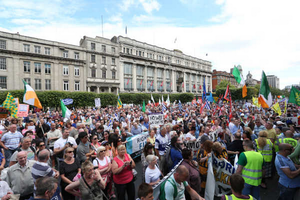
Irish Water protesters outside the GPO in Dublin on June 20, 2015

This morning, the Irish Independent‘s environment editor Paul Melia reports that Irish Water will need approximately €300million from the State to make up the cost of suspending water charges.

He also reported that Irish Water is to rerun its public information campaign to “convince” people to pay.

Mr Melia spoke to Katie Hannon earlier on RTÉ’s Today with Seán O’Rourke show.

From their discussion.

Katie Hannon: “According to documents seen by the Irish Independent, as the phrase goes, the Government has been informed that Irish Water is going to require almost €300million to compensate for the suspension of water charges. The Department of Housing, Planning, Community and Local Government said the shortfall would be made up for in 2016 but haven’t announced their intentions for the next two years. Additionally, Irish Water believes that it is going to have to launch an enormous and costly campaign to convince the public of the need to pay for water services if charges are re-introduced after March of next year when the current period of suspension will have run its course. Paul Melia, environment correspondent for the Irish Independent has been writing about this and he joins me on the line now. Paul, welcome.”

Paul Melia: “Thank you.”

Hannon: “Almost €300million is what you’re saying the cost will be upfront. Can you break that figure down for me?”

Melia: “Certainly, these are financial projections that were provided by Irish Water to the department in June and what they’re saying is that, for 2016, there’s going to be a revenue shortfall of €123million or so. Now this figure isn’t new, we know this figure and that’s basically because charges are going to be suspended, have been suspended for the second half of the year. So, Irish Water says this is the cash shortfall we’re going to have. Now, the Government has said that they will make up that difference and, you might recall, there was a water conservation grant last year which cost €110million. This shortfall of €123million – there’s a gap there of somewhere of €13million, up to €20million that the Exchequer will be able for this year. So that’s all been addressed and sorted out. There’s no funding issue for this year. Where it gets interesting is that Irish Water has come up with two scenarios. A scenario if billing returns next year and a scenario of no billing returns. And what they have said to the department is: if billing resumes from the second quarter of next year, which is expected, or sorry, that’s when a decision will be made, there will still be a revenue shortfall of about €125million now this is because there will be no billing for the first three months, so there’s about €65million or so missing there. And then, also, the balance is made up of they believe that people just won’t pay, that they’re going to have to go back and re-engage with householders and say to them: ‘look, we’re Irish Water, this is the job that we have to do and this is how we have to pay for it’. So, their public information campaign starts all over again.”

Hannon: “And tell me Paul, before I let you go any further, remind people how much has already been spent on convincing people that they need to pay for water?”

Melia: “Well I mean there’s been two, certainly in May, there was a report, Irish Water had spent about €350,000 on outside public relations, this was on top of their fully-staffed press office which I think has three people in it. And then there was an expensive advertising campaign last year as well which talked about basically how water came from the clouds to the tap essentially, that cost about €650,000 or so. So there’s about €1million all in, there’s probably more than that. But that’s certainly, more or less, what’s been spent to date. So, they’re talking about rerunning a lot of that stuff again. If the charges come back in…

Hannon: “Of course, just to stop you there again, ‘if’ is a very big if there, isn’t it? Because certainly the political temperature would indicate that that is a very big if.”

Melia: “It certainly is. I mean I think more than 100 TDs in the Dáil are opposed to water charges in any way shape or form and this expert commission that the Government has established, that’s meant to look at the long-term funding model for Irish Water, in other words, how will the day-to-day operations, which cost in or around €1billion a year, plus the capital expenditure programme be funded. They’re due to report back at the end of March of next year. And then they will recommendations with the Dáil committee. That Dáil committee then will examine that and it will make recommendations to the Dáil itself and it will be put to a vote. So TDs will ultimately decide whether or not domestic water charges are reintroduced or whether they’re abolished permanently. As you said, the political temperature at this stage certainly is that they’re not going to be reintroduced.

Listen back in full here

Irish Water needs €300m to make up for loss of charges (Irish Independent)

Rollingnews