
Author Archives: Bodger

From top: President Michael D Higgins Fianna Fáil TD Marc MacSharry; Comptroller and Auditor General Seamus McCarthy

This morning.

At the Public Accounts Committee.

PAC member Fianna Fáil TD Marc MacSharry raised an allowance of €317,000 that the person holding the office of the President of Ireland is entitled to per year.

The committee was told the figure was set by statutory instrument in 1998, when Mary McAleese was president.

It was also told the €317,000 annual allowance is not audited, not taxed and doesn’t need to be surrendered.

From this morning’s proceedings…

Marc Mac Sharry: “Can I ask the C&AG, are you aware of an amount of €325,000 per year in the president’s establishment – the detail of which is not open for you to audit.”

Seamus McCarthy: “Yeah, I think it’s something less than that. I think the official salary of the president is…”

MacSharry: “No, no, not the salary, I’m not talking about salaries at all. And I don’t want to talk about the president either.”

McCarthy: “No, yeah, I’m aware of the other allowance which is…”

MacSharry: “So what is that?”

McCarthy: “It is…”

MacSharry: “How much…”

McCarthy: “I don’t have the figure off hand. It’s paid through the finance accounts, the Central Fund of the Exchequer.”

MacSharry: “Do you know what amount that is, per year?”

McCarthy: “I don’t, I don’t think so deputy…”

Sean Fleming [chairman]: “What the title?”

MacSharry: “I don’t think it has a title. That’s why I’m trying to get some answers. I asked the C&AG are you aware of an amount of money, in or around €325,000 per year, I’m not talking about salaries here. Which is not open to the C&AG…”

McCarthy: “It’s a payment, I think, for 2017, the figure is €317,000.”

MacSharry: “€317,000.”

McCarthy: “It’s a payment under the Presidential Establishment Act 1938 as amended.”

MacSharry: “Ok. So the Presidential Establishment Act, a payment under that, of €317,000, in terms of 2017…”

McCarthy: “It’s an allowance.”

MacSharry: “That’s an allowance for the president. Sorry, so that, so it’s renumeration then is it?”

McCarthy: “No, well, it’s an allowance. Yeah. It’s not pensionable.”

MacSharry: “Right. It’s not a salary.”

McCarthy: “It’s not a salary, it’s an allowance.”

MacSharry: “It’s an allowance.”

McCarthy: “An allowance.”

MacSharry: “And you don’t audit that?”

McCarthy: “I don’t audit that. I audit the issuing of the payment from the Central Fund.”

MacSharry: “You audit the issuing. So what’s involved in auditing the issuing of…”

McCarthy: “Ensuring that the amount that’s paid over is not in excess of the amount that is provided for in law.”

MacSharry: “And in this act, if we look it up, does it say €317,000 or how’s that amount…”

McCarthy: “A statutory instrument from 1998 set the figure at €317,000 and it hasn’t changed since 1998.”

MacSharry: “Ok. Do you know the number of that statutory instrument by any chance?”

McCarthy: “97.”

MacSharry: “Ok. €317,000 per year. You’re saying it’s an allowance but it’s not renumeration. So, in ten years, that’s €3.2million or thereabouts?”

McCarthy: “Obviously, yeah.”

MacSharry: “Do you know what it’s used for? Does that act prescribe…”

McCarthy: “No, it doesn’t prescribe what it’s use for…”

MacSharry: “Ok. So. €317,000 per year allowance, not audited, we don’t know what it’s used for and it’s not prescribed in law. Is that correct?”

McCarthy: “The purpose is not prescribed in law.”

MacSharry: “It’s purpose meaning it’s use – what it’s used for?”

McCarthy: “Other then that it is a payment that can be made to the president, that’s what the law says.”

Later

MacSharry: “What we have – €317,000 per year, provided under an act, we don’t know what it’s for, it’s an allowance. We don’t know what it’s purpose is for, it could be spent, theoretically, on anything, it mightn’t be spent at all, presumably. Is this an amount that’s surrender-able at the end of the year or…”

McCarthy: “No. It’s not surrender-able.”

MacSharry: “Ok, so it’s an allowance for unknown items, or unknown purposes, not audited and presumably not subject to taxation because it’s not salary or whatever.”

McCarthy: “That’s correct yeah.”

Later

MacSharry: “Is it reasonable to say, and I know sometimes my language is a little bit flippant but is this a €317,000 payment on the blind? That no-one passes any remote oversight, notion, idea, look, at what it’s spent on? Is that the case?”

McCarthy: “I don’t know, deputy.”

Later

McCarthy: “I do have a piece of information which may be relevant. In 2011, an amount of €357,000 was returned to the Central Fund at the end of the previous president’s [McAleese] presidency.”

MacSharry: “That would indicate then…sorry, just because it’s on the same thread…that this €317,000 can be paid per annum, be accumulated and then, if there’s amounts left over, as would seem to be the case in 2011, the balance was refunded to the Central Exchequer. Ok. But still, whoever was the incumbent, or whoever was responsible at that time, we don’t know what the money was spent on per year and we still don’t.”

“We want to get the procedures but we do know the Secretary General of An Taoiseach doesn’t know, the C&AG is not responsible and doesn’t know and the Department of Finance Secretary General, according to yourself, the C&AG, also doesn’t know, or doesn’t have a role in auditing that amount of money. So I think that’s significant.”

Follow PAC proceedings live here

The Four Courts in Dublin

This morning.

At the High Court before Judge Richard Humphries.

A single mother, who was the foster carer for a baby born prematurely with severe health difficulties for more than a year, will challenge the actions of Tusla in the hope that what she claims happened to her won’t happen to anyone else.

In March of last year, the mum-of-two, who has fostered more than a dozen children in the past, responded to a call-out from Tusla for a volunteer to sit with the baby in a hospital, and cuddle it, as, Tusla said, the then three-month-old baby hadn’t had any significant human contact since it was born.

As time went on, the mother began fostering the baby and underwent specialised training to learn how to feed and care for it.

She sought to adopt the baby but she was told it was the birth mother’s wish that the child be adopted by a married couple. However, Tusla organised for her to have a legal consultation on the matter.

In April of this year, while the child with severe special needs was recovering in hospital following surgery, the mother claims it was abruptly removed from the hospital and given to a couple in the process of adopting the child.

The adoption process in regards to the child is not yet complete but it’s expected to be finalised in several months.

However, by seeking a judicial review of how Tusla handled the case, the mother wants to stop the adoption process which Tusla has started with the couple and she’s also seeking an order compelling Tusla to consider her application to adopt the child.

She claims Tusla didn’t follow procedure, didn’t provide for a proper transitioning period and didn’t give her adequate notice of what was going to happen.

She also claims the best interests of the child were not served in how Tusla handled the case.

An internal Tulsa investigation into the matter is also already under way.

Related: Single mum takes Tusla to court after agency takes away foster baby (Mark Tighe, The Sunday Times)

Foster mother loses custody of child because birth mother wants kid to go to “a couple” (Irish Mirror, April 28, 2018)

UPDATE: 

The mother has been granted a judicial review and will come back before the High Court on October 16.

Government Secretary General Martin Fraser this morning

This morning.

At a Public Accounts Committee hearing.

Government Secretary General Martin Fraser is addressing questions from TDs about spending related to President Michael D Higgins’ term of office.

More as we get it.

Watch proceedings live here

Minister for Housing Eoghan Murphy and Minister for state Catherine Byrne

This morning.

Ahead of a no-confidence motion in housing minister Eoghan Murphy, tabled by Sinn Féin…

Mr Murphy said the no-confidence motion is nothing more than an “irresponsible stunt”.

The motion of no confidence, he said, will do nothing for those in need.

Mr Murphy said he hopes to speak with [Dublin South Central Fine Gael TD and Minister of State] Catherine Byrne this afternoon about “genuine concerns she has for her constituents“.

He added he hoped she would not be pulled into “Sinn Féin’s stunt.”

Vote will put pressure on Govt to accept policies are failing – Sinn Féin (RTÉ)

Rollingnews


This morning.

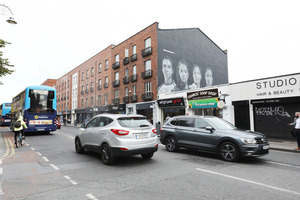
Aungier St, Dublin 2.

A mural for Lidl’s ‘Serious Support’ for women’s GAA

Name those players, anyone?

Also: artist?

#SeriousSupport?

Meanwhile, yesterday…

Leah Farrell/Rollingnews

U2 concert screen collage containing images of Catalan independence supporters and Charlie Chaplin in ‘The Great Dictator’; Above the same collage in Madrid (@2.25)

Having announced that their current European tour would be based on standing up for “democratic European values”, the group’s concerts on the tours have opened with a powerful video collage of historical images on the theme of people power, accompanied by Charlie Chaplin’s famous pro-democracy speech from the film “The Great Dictator”.

However, the images of a huge Catalan crowd waving pro-independence estelada flags that appeared in the first concerts (above) on the tour had been chopped out before Thursday night’s show in Madrid…

U2 censor Catalan independence images from visuals for Madrid concerts (ElNacional.cat)

Thanks Ruadhan

This afternoon.

United Nations, New York, United States.

Taoiseach Leo Varadkar addresses the Nelson Mandela Pea Summit.

Snow peas or sugar snap peas: will we ever reach consensus?

Taoiseach hails Good Friday Agreement in UN speech (RTÉ)

From top: A sit-in on O’Connell Bridge in Dublin city during the Take Back The City national day of action on  Saturday; RTÉ’s Audrey Carville; Paddy Cosgrave

This morning.

On RTÉ Radio One’s Morning Ireland.

Audrey Carville spoke to co-founder of the Web Summit Paddy Cosgrave in light of the Take Back The City protests which took place across Ireland on Saturday.

Mr Cosgrave was critical of Fine Gael for castigating the protesters as “criminals” while seemingly never speaking out about Irish farmers who’ve occupied farms to prevent them from being compulsorily purchased to provide factories or offices for foreign companies.

He was also critical of RTÉ’s coverage of the matter.

Audrey Carville: “Large crowds of people protested across the country on Saturday over the housing crisis. It was organised by the Take Back The City group as part of a national day of action over the shortage of housing. Rallies were also held in Sligo, Galway, Kildare, Limerick, Derry, Belfast, Drogheda, Maynooth, Bray and in Wexford.

“Speeches called for an end to evictions, increased provision of social housing and affordable rents. Well with us in studio this morning, one man who was at the Dublin city protest on Saturday, entrepreneur, co-founder and chief executive of the Web Summit Paddy Cosgrave. You’re welcome and good morning.”

“Will you tell us why you were there?”

Paddy Cosgrave: “I think one of the motivating factors was captured by the lead story on the front page of the Sunday Business Post yesterday which is this crisis is not just one affecting society, it’s having a very negative impact on the economy at large. And it’s impacting small businesses, that’s very obvious but perhaps what’s not so obvious is that multi-nationals are also being impacted and dramatically so, to the point that they’re prepared to raise this issue consistently over the last year with ministers of this country.

“On the march, I met, I walked with somebody who worked with Google, others from Indeed, Facebook, LinkedIn, and I think that Fine Gael may have underestimated what type, the nature of this crisis.”

Carville: “The Government has said protests don’t build houses and they question their impact. They’ve also said previously that homelessness here is no worse than anywhere else.”

Cosgrave: “Well I grew up on a farm. And when my next-door neighbour occupied a building that was in use in Dublin last summer for seven full days with the IFA [Irish Farmers’ Association] grain committee – that was the Department of Agriculture. It wasn’t stormed by heavy police officers, dressed in riot gear. They were left, peacefully there, to protest for seven days. Fine Gael never came out and spoke out against members of the IFA, farmers in this country as “criminals”, as “disgraceful”, words used by ministers over the last week. And I think that should tell you something about Fine Gael.

“Fine Gael have essentially decided that they think the protesters in the city are of working class background, that they’re from poor, disadvantaged areas and, as a consequence, they’ll kind of castigate them as criminals. But when farmers do it, when farmers occupy farms – all over this country, which they’ve been doing for years now – there’s not a word out of Fine Gael.”

“And I think that should tell you something about the operating basis of Fine Gael as a party in modern Ireland.”

Carville: “In relation to Fine Gael, they’re the main party in Government, it’s their job to put together a policy which will deliver housing for people here and they say they’re doing that, they tell us about the figures of house completions, they tell us about the money being invested. They’ve announced this Land Development Agency which they believe will be a big factor in solving this. You’re not convinced?”

Cosgrave: “Well I think if you want to understand Fine Gael’s priorities, you should look at the first act of business of this year, 2018. Heather Humphreys proposed a bill, called the Industrial Development Bill that, you know, there are people that desperately need places to live but the Government decided that the number one priority was to grant extraordinary powers to the IDA to compulsorily purchase farms around this country that foreign companies had identified as areas that they would like to build – factories or offices. That’s contained in the Industrial Development bill 2018, that was the first act of Fine Gael.

“And they prioritised that legislation in the interest of foreign companies to compulsory purchase farmers’ land in this country. It had to do with the case of Thomas Reid – a farmer, very close to the Leixlip plant, or Intel’s Leixlip plant. And I think, again, that’s very, very revealing. There’s land all over this country that can be compulsorily purchased for houses but that hasn’t been a priority for this Government.”

Carville: “But have you raised this with Leo Varadkar. He was a speaker at your MoneyConf conference this year.”

Cosgrave: “Have I raised it? I think thousands, tens of thousands of people have been raising it, the Central Bank has…”

Carville: “No, but have you raised it?”

Cosgrave: “…been raising it. The European Commission has been raising it…”

Carville: “Yeah but you’re here…”

Cosgrave: “The Economist…”

Carville: “Have you raised it?”

Cosgrave: “…has been raising it. Have I raised it? Yes, I took part in a protest on Saturday.”

Carville: “I know that. But you had personal access to Leo Varadkar – he was one of your keynote speakers at your MoneyConf event this year. Did you have a meeting with him…”

Cosgrave: “Absolutely. Have I tweeted about it? Have I tweeted him directly, yeah…”

Carville: “No that’s not what I’m asking…”

Cosgrave: “Absolutely.”

Carville: “…and you know. Have you had a face-to-face meeting. At that opportunity to raise it with the most senior politician in the country?”

Cosgrave: “I find this reprehensible. Have RTE covered the fact that this government has never said so much as a word about farmers in this country who’ve occupied farm after farm after farm – halting the for sale of those farms for years now.”

Carville: “Hmmm. But have you…”

Cosgrave: “Have you pointed out the hypocrisy of that? That a group of people from west, believed to be from west Dublin, are castigated as criminals and disgraceful. Why? Because Fine Gael knows they don’t vote for them.”

Carville: “But I’m asking you a simple question Paddy Cosgrave. No, no…”

Cosgrave: “…when farmers occupy properties illegally by the way, illegally, illegally…”

Carville: “I’m asking you a question, you’re in here this morning, making these points, raising your concerns on the back of what has been taking place over the past number of weeks. I’m asking you – as someone in your position, with direct access to the Taoiseach, at an event that you organised this year. Did you talk to him about this…face-to-face?”

Cosgrave: “Oh sure for years, for more than a year, I’ve been raising, for more than two years, I’ve been raising these issues directly with government, with special advisors to a number of ministers…”

Carville: “But not to Leo Varadkar.”

Cosgrave: “I’ve met in my house with the Minister for Housing – because these issues are not just mauling society, they’re affecting the entire economy, they’re shuttering small businesses, they’re forcing multi-nationals, for the first time, in almost the history of this state, to publicly and openly criticise a sitting government. That’s unprecedented.”

Carville: “And yet…”

Cosgrave: “Are there other examples of that? Can you cite another example of a multi-national in this country, publicly criticising a sitting Government?”

Carville: “And yet, I’m reading a report from yesterday’s Sunday Times where figures compiled by property group Green Reit, and a number of commercial property agents, show that eight tech companies, including some of those you mentioned – Amazon, Facebook, Google – who are here and well established here. And they’re looking to create space for an additional 20,000 workers and they’re well aware of the housing crisis.”

Cosgrave: “Sure and the…”

Carville: “So the impact on them is not questionable…”

Cosgrave: “You cite Amazon, this is essentially propaganda. Amazon themselves have, at a ministerial level, raised this issue. The question is, you know, 200,000 jobs. How many jobs is the country losing? How many jobs is the country losing? How many offices are Google and Amazon opening up across Europe – and they’re doing it and I know well that they’re doing it because of the difficulties in finding accommodation.”

Carville: “So how would you solve it? Have you any solutions?”

Cosgrave: “Absolutely, I think there are huge numbers of solutions. There’s nothing radical that’s needed. I think there are perfect examples, all across Europe, that have followed all sorts of policies for years – but those policies aren’t even discussed, they’re not even discussed in the national media, they’re not even discussed by this broadcaster.”

Carville: “Name one.”

Cosgrave: “I think that’s incredibly worrying. Let’s take Germany just as an example, just take tenants’ rights as an example, indefinite lifespan for tenancy contracts, what about the immediate ban of Airbnb? That’s being done in cities across Europe. Three years ago at this point, five years ago, Berlin initiated and indicated that they would start to regulate Airbnb and three years ago they instigated bans and heavy restrictions on Airbnb. That hasn’t happened here. It’s very easy to implement those.”

Carville: “Ok. Well thank you very much for coming in to talk to us this morning…”

Listen back here

Saturday: Sit Down Next To Me

Rollingnews

You can sign the Simon Community’s ‘homeless is not normal’ petition here.

Earlier: Below The Gaiety

Previously: ‘Homelessness Has Become A Business…And Socially Acceptable’

This afternoon.

Gavan Reilly, political correspondent with Virgin Media News, has tweeted a table (above) of which candidate councils across the country nominated to run for president and which councils put forward no candidate at all.

He tweetz:

These are my notes – afaik there’s only three who haven’t *actively* voted to ignore all candidates, but instead where no councillor actually tabled a motion to back someone in the first place.

Earlier: Laois Of Life?

Thanks Gavan Reilly and Namawinelake