Author Archives: Bodger

Meanwhile…

This afternoon.

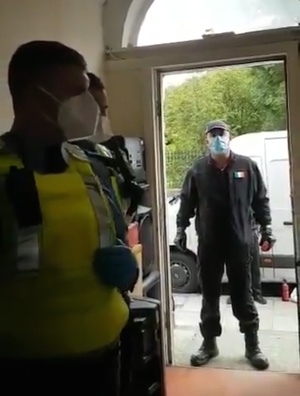
Further to yesterday’s eviction in Phibsborough, Dublin 7.

Nine tenants have returned to the property after being thrown out on Wednesday morning with all their possessions left on the pavement.

Some had been living in the house for years.

Following the government’s lifting of the ban on evictions during the pandemic, several men wearing all black – with small Irish tricolours stitched on to their tops – face coverings, caps and sunglasses’ entered the house, told the residents to leave and boarded up the front door and windows.

Uniformed Gardai were present throughout.

Via Irish Times:

The landlord, Gerry Ward, said he had been involved with the property since around 2004. He has been involved in a legal dispute over it since 2017 with a property fund, Beltany Property Finance.

“That has not been finally resolved, that has not been fully resolved,” he said, adding he had not been aware of the property’s repossession until he was contacted by the tenants.

A spokesman for Goldman Sachs, which controls Beltany, said the fund sold the property on June 2nd to an individual…

Anyone?

Nine tenants evicted from north Dublin property by men in masks and dark clothing (Jack Power, Irish Times)

Yesterday: Kicking Out Time

Earlier.

The Special Committee on Covid-19 Response

Before today’s debate on on the situation in meat processing plants, Nora Labo (above), Romanian Organiser of The Cork Operative Butchers Society branch of the Independent Workers Union.

Ms Labo told the committee:

“The Cork Operative Butchers Society branch of the Independent Workers Union has been supporting workers in meat plants and in the meat industry for a long time and has been in daily contact with workers of different nationalities employed in several meat plants around Munster for the duration of the pandemic thus far.

As the workforce in this industry is largely foreign, with limited English fluency, I emphasise that our union, even though it is small, has had privileged access to these workers’ experiences, as our team includes Polish and Romanian-speaking organisers, and the union constantly strives to provide translation for any other language which is necessary for organising this diverse workforce.

I personally have been in contact with Romanian workers in several plants each day since the beginning of the pandemic.

This union believes there is no intrinsic reason why working in a meat plant should be more conducive to contracting Covid-19 than working in any other environment.

We are convinced that the reason Ireland has witnessed so many worrying outbreaks in meat plants in the past months is due to the workers’ substandard employment and living conditions which are the result of the industry’s long-term disregard for the well-being of its staff.

These problems are aggravated by the unscrupulous practices of the work placement agencies through which many of the workers in this sector are employed.

Based on our membership a high percentage, perhaps 40% or 50% – we do not know – of these workers are employed through agencies.

I would like the committee to bear in mind that, in our view, these Covid-19 outbreaks are simply the most visible consequence of chronic issues that should be of great concern in their own right.

First, there is the question of overcrowded accommodation. Many meat plants are in rural areas where there is a shortage of suitable accommodation to begin with.

As most meat workers are paid the minimum wage, often with no overtime premium, their tight budgets force them into seeking shared accommodation, sometimes even with several families in the same house.

At the same time, being foreign and with a limited command of English is a real disadvantage in independently securing accommodation. Many workers we know are being housed by their employment agencies which, seeking to maximise profit from the accommodation they provide to their employees, crowd as many people as possible into each house they let.

This reckless behaviour on the agencies’ part also led to people being moved from one shared house to another during the height of the pandemic in an effort to keep each house full so as not to lose income. Our union has documented several such cases.

The workers housed by the employment agencies never get a proper contract for their paid accommodation, even after several years of living in the same place, so they can be moved around or evicted without notice, both of which have happened since March to workers we know.

It is obvious that this dismal housing situation favours the spread of Covid-19 among workers and, despite relating to conditions outside of work, is a result of low pay and dependency on the employer for accommodation.

Second, most workers need to provide their own transportation to get to work. As I said earlier, many meat plants are in quite remote areas and the employers make no effort to provide any transport. There is no public transport available.

On a tight budget, the workers car pool and they fill the cars to capacity. This has continued throughout the pandemic as most employers make no effort to facilitate the safe and socially distant transport option, either through a company bus or with financial assistance for private transportation, both of which would have been possible, while perfectly aware of how their staff get to work every day.

Third, many workers in this sector do not benefit from a sick-pay scheme with their employer and this is especially the case with all the agency workers we know. This means that these workers, while already on very low pay, know that when they are ill they will not be able to earn any money at all.

Of course, this logically leads to some workers being less cautious than they should ideally be after noticing early symptoms of what might or might not be a worrying condition.

We also know that many workers, after years in Ireland, do not have a GP, which can be seen as an indirect consequence of extremely difficult working conditions.

When working on minimum wage, one has to work excessive hours, often more than 50 hours a week, to get by. This limits the time available to find a doctor and the time to learn the basics of English to communicate with a medical professional. One has to pay for the doctor and often also for the translator when visiting the doctor.

A special case of this lack of access to healthcare, but of great importance, is that of a great number of workers, all Romanian, who were for years cheated out of their social security rights in Ireland by the employment agency which was hiring them to work in several meat plants in Munster.

This agency employed all these Romanian nationals as self-employed contractors declared in Poland, so all the workers’ contributions were sent to the Polish and not the Irish Revenue.

I emphasise it is our union that has uncovered hundreds of such cases and we have filed hundreds of complaints to the Workplace Relations Commission.

For many years, all of these workers have had no annual leave, no right to illness benefit, no rights to child allowance, had no PPS numbers, and were de facto invisible in Ireland.

While some of these workers were self-isolating on suspicion of Covid-19 in March, they had no access to a doctor, no GPs would take them and their agency tried to force them to apply for unemployment benefit instead of the Covid-19 illness benefit, taking advantage of the fact that the workers had no GPs and no English.

Our union is present in several plants where this agency operates in Munster and we have knowledge of other places in Ireland where the same practices are happening and where the same agency supplies workers.

When these workers have no legal existence in Ireland for years they are also not entitled to illness benefit and they are extremely vulnerable. Based on these observations I will emphasise one last point.

These workers are not just vectors for a virus. They are not just vectors for a disease. They are people with full lives. It is important to take into account all aspects of their lives when we think about how to prevent this disease.

For example, if Perspex screens are introduced and we do not take into consideration that the workers then must lift heavy crates above the Perspex screens, then their workload is greatly increased and, while the pace of their work has never slowed during the pandemic, such measures will not work.

The workers’ well-being, their workload, their mental health, their income and social and economic conditions have to be taken into account if we want to contain this disease.

We recommend unannounced inspections. However, we also recommend democratically elected workers’ health and safety committees in each factory and these should be consulted on any measures.

Thorough investigations should take place in all meat plants to see how workers’ contracts operate and how their accommodation is provided for by their employers.”

Earlier: A Lot To Process

Meanwhile…

UPDATE:

On the production rate…

“Production never slowed down. I have sources in killing, dispatch, packing, boning and all other parts of the meat plant. The volume processed in every meat plant that we are in contact with has increased even though there have been fewer workers. The companies could not source foreign workers at the height of lockdown and, when some workers got ill, others would just have to do more work.”

On instructions regarding PPE…

“In many meat plants, for instance, we know workers employed through agencies received a text message or email from their agency – very brief and often only in English – about the PPE they were going receive. Often, they came with no instructions in their own language as to whether the face mask was reusable, single use or essential information like this.

“Sometimes workers called me with a photo of the mask and asked me to tell them how to use it, could it be re-used or how long it was good for because no such instructions had been given by the employing agencies. In terms of translation and everything else it has been dismal. For some communities that have been in Ireland for longer, like the Polish community, perhaps the factories have some available translation or supervisors who are already from that background and speak the language.

“For some other recent arrivals, such as many Chinese workers in Munster, for example, there is little support. It is the same for Brazilians, East Timorese or other communities.”

On working while sick…

“We know of a situation in a food production plant, which is not a meat plant but a dairy one in west Cork, where during lockdown around May, some workers had very obvious symptoms and were not purposely trying to hide them but wanted to stay home. The employers, however, insisted that these workers continue coming into work.

“There was a significant walkout of all the factory employees on that shift in order to protest as to their own lack of safety…It is often not the workers who would willingly dissimulate their symptoms but is more likely the shift supervisors.”

On housemates of workers who test positive for Covid-19 going to work…

Continue reading →

Some Dublin schools are considering offering ‘breathing breaks’ to allow students go outside and take off their masks for a time.

This afternoon.

Via Today FM:

We visited three schools in Dublin this week to find out how preparations are going for the coming year.

Around 930,000 students are returning to school for the first time since March and, when they do, they will face a very different learning experience.

Kathy Jones, Principal of the Bremore Educate Together school in Balbriggan said students and teachers will have to do all they can to keep each other safe.

“We will have to build in movement breaks and breathing breaks for the students where they can go outside, maybe remove the mask for a little while and go back in,” she said.

Meanwhile, Michael McHugh from O’Connell Secondary School in Drumcondra said

“Teachers by their nature are innovative people and they will come up with strategies and ways of keeping children apart but again, children by their nature want to play and interact with each other.

“We will be staggering breaks and we will have bubbles and pods in classrooms to keep them apart as much as possible.”

If you tolerate this, etc.

Schools Might Allow ‘Breathing Breaks’For Masked Students (Today FM)

Getty

This afternoon,

Hillsborough Castle, Belfast, Northern Ireland.

Taoiseach Micheál Martin and UK Prime Minister Boris Johnson meet for a Bilateral Meeting on Brexit, Covid-19 and to announce festivities for the centenary of Northern Ireland next year.

Julien Behel Phoography/Maxwell/RollingNews

Later…


Stop gesticulating.

For pity’s sake

Julien Behel Phoography/Maxwell/RollingNews

Xtra-vision closed its 80 stores across Ireland four years ago

Via Reddit Ireland.

Xtra, Xtra!

Read all about it.

Ex-Xtra-vision staff recall popcorn snaffling, Golden Movie Ticket Pass madness and other oddities of working in the video rental behemoth.

Momalloyd writes:

‘Bringing home left over popcorn every night was a perk, until the audit department found out and lost their shit over it.

One of the stores I did cover shifts in had nearly everyone let go over that, even the manager. One guy was fired because there was security footage of him eating a single piece of popcorn as he was emptying the machine into a bin.

In the end the utterly useless union had to get involved to stop the madness, before it spread to other stores. Most people were offered their jobs back, but few took it.

Funny thing is, it was my store that was due to be audited that day, and for some reason they went to a different store first. So when they did get to our store and asked about the popcorn, we knew to shut our mouths.’

MorroCleawater writes:

‘it seemed every store had a different level of seriousness when it came to popcorn. I used to have a small box in the back for snacking away on throughout the day. We ran a quiet store though, although I expect every store was crazy quiet in those last few years.

The most fucked up shit my store had was when the company put quotas on pre-orders where every staff member needed to get 5 a day on the newest [insert generic AAA title here]. We only got about 10-15 customers in the store each day, and some staff only had 2-4 hour shifts.

If we didn’t make it “we’d be fired”. I obviously didn’t expect we would, but the stand-in manager at the time forced us all to fake pre-orders. He got in a lot of trouble for it iirc, but it didn’t matter when the whole company closed down like 3 months after.’

Richie131 writes:

‘I was let go for eating Xtravision popcorn! So were two other lads working in the same shop. I ended up taking them to the Labour Relations Commission on grounds of unfair dismissal, and I won. I always joke that I kicked em while they were down, they were already in receivership at the time.

Got a few grand out of them but I would’ve preferred to have my job back for the summer to be honest.. ‘

Momalloyd adds:

‘The whole concept of having to up sell confectionery with every sale was a totally unheard of. You would have up to six people working on a shift for absolutely no reason. You could just go into the music vault and pick out a CD to listen to. What a magical time.

That all came to an end when our DM found the stack of 100 loose CD’s in a pile by the sound system all scratched to shit.

Other dark times were when we were told we weren’t allowed tell a customer that a movie was bad. It was around the time they brought in the first Golden Movie Ticket Pass, the paper one. It was a disaster. They tried to force us to up sell them with no training. On top of that a local kid nicked a box of them from our store, and sold them outside.’

Meanwhile…

Balfe writes:

‘I once got into shit from the district manager after they reviewed security footage to discover me standing outside of the counter and watching practically an entire movie. Gotta admit, it was quite funny watching that footage in fast forward.’

Ah here

I Miss It Dearly (Reddit)

From top: Dwayne Johnson and Zac Efron in Baywatch (2017); The latest issue of Kerry’s Eye

Leave the kids alone

They’re not worth the Hasslehoff.

FIGHT!

Ballyheigue?

From top: Social Democrat TD Holly Cairns; Patricia King, General Secretary of ICTU.

This morning.

Special Oireachtas Committee on Covid-19.

Social Democrat TD Holly Cairns asked Patricia King, General Secretary of the Irish Congress of Trade Unions (ICTU) why it took a pandemic and workers to become infected with Covid-19 for the conditions in which meat plant workers live and work to be revealed.

She asked if the unions were aware of the conditions before Covid-19.

Patricia King said:

“There are a number of reasons for it. Firstly, affiliated unions of Congress, but particularly SIPTU, have represented workers in meat plants for decades, that’s number one.

But in some cases you will have a collective agreement under the terms and conditions but it’s not the norm and it’s not by any means the majority so we have argued strongly, for instance,

I sit on the Low Pay Commission , I’ve taken part in the public consultations where we’ve had exposure to workers coming in just from the street and offering public consultation their view as to what’s happening in their environment and in meat factories aswell. So we would be well aware but there is a very large body of opposition to having workers having any voice.

And there is a reason for that.

Because if you have a production pace at the level that they have that’s where the focus of those employers is and that production pace, I mean if you look at the top ten companies operating in this sector, you’re talking about the top one of having a turnover of €2.3billion in 2019 and the second one €2.2billion.

So you’re talking about big money to be made.

And their focus is on keeping those productions lines as fast and as lean as they can. And that means people, the model is working people as hard as they can for as little as they can for as long as they can.

That is the model.

And they’re not going to, they’re going to resist any infiltration by us in, to have discussions. And then they’re backed up by a law, or by the lack of legislation in this country which says, actually, if those workers want to make their voice heard collectively, there’s no law that says they can do that.

The balance of power here lies with the employers and it’s not a question that we haven’t been saying it. We’re blue in the face saying it. I’m three decades doing this for a living and I can tell you we’re blue in the face.

But we still haven’t succeeded in getting it across the value of having a balance in terms of this employer-worker relationship and that’s what we’re seeing. It takes a pandemic to demonstrate the fallout of this. But that, it has been around a long time.”

Deputy Cairns then asked Ms King to clarify that the unions did know about the conditions before Covid-19 “but the power of the beef lobby was too big to make those voices heard?”

Ms King replied:

“They don’t listen is the answer. They don’t listen.”

Pics via Oireachtas.ie

Meanwhile…

Here’s How.

The current affairs show presented by William Campbell (above) meets the man behind ‘Shared Ireland’, a popular podcast series offering a ‘diverse cross community, grass roots platform’ for those supporting a ‘shared 32 county Ireland’.

William writes:

Demographic changes and shifting opinions might bring a United Ireland faster than most people think. Are we prepared for the changes that would bring?

I talk to Niall Keenan founder and chairperson of Shared Ireland about the group’s efforts to talk to all shades of opinion to bring us to an agreed future.

Listen here

Shared Ireland

UPDATE:

Cousins Sara Feeney (left) and Ellen Glynn from Knocknacarra, Galways urvived 15 hours in the water. They were discovered by a local fisherman clinging to a lobster pot marker buoy, about two miles from Inis Oírr, and around 17 miles away from where they had been last seen.

Paddleboarding cousins recovering after sea rescue (RTÉ)

Earlier….

This morning.

More as we get it.

Two women missing after paddle boarding on Galway coast (RTÉ)