Author Archives: Chompsky

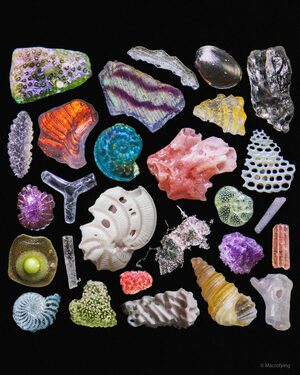
A stunning macro image of sand from a Mallorca beach by Cologne-based photographer Ole Bielfeldt – a colourful composition of minute but highly detailed fragments of coral, quartz and shells of which Bielfeldt sez:

Although to the naked eye this looks like very clean natural sand, pieces of micro-plastic, as seen in the last image, can be found when viewed under the microscope.

More of his tiny universes here and here.

colossal

Behold: the Tulip Nebula also known as Sh2-101 – a bright glowing cloud of interstellar gas and dust viewed along the plane of the Milky Way toward the constellation of Cygnus the Swan. To wit:

Nearly 70 light-years across the complex and beautiful Tulip Nebula blossoms about 8,000 light-years away, shown in a Hubble palette image that maps the glow of the nebula’s sulfur, hydrogen, and oxygen ions into red, green, and blue colors. Ultraviolet radiation from young energetic stars at the edge of the Cygnus OB3 association, including O star HDE 227018, ionizes the atoms and powers the emission from the Tulip Nebula. Also in the field of view is microquasar Cygnus X-1, one of the strongest X-ray sources in planet Earth’s sky. Driven by powerful jets from a black hole accretion disk, its fainter bluish curved shock front is only just visible though, directly above the cosmic Tulip’s petals near the top of the frame.

(Image: Carlos Uriarte)

apod

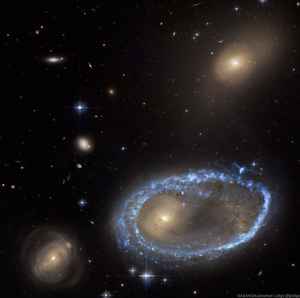
Behold: the immense 150,000 light years wide circumference of newly formed, extremely bright, massive stars forged by the violent birth of AM 0644-741, also known as the Lindsay Sharply Ring. To wit:

AM 0644-741 is known as a ring galaxy and was caused by an immense galaxy collision. When galaxies collide, they pass through each other and their individual stars rarely come into contact. The large galaxy’s ring-like shape is the result of the gravitational disruption caused by a small intruder galaxy passing through it. When this happens, interstellar gas and dust become compressed, causing a wave of star formation to move out from the impact point like a ripple across the surface of a pond. Other galaxies in the field of view are background galaxies, not interacting with AM 0644-741. Foreground spiky stars are within our own Milky Way. But the smaller intruder galaxy is caught above and right, near the top of the frame taken by the Hubble Space Telescope. Ring galaxy AM 0644-741 lies about 300 million light years away toward the southern constellation Volans.

(Image: NASA, ESA, Hubble, HLA; Processing: Jonathan Lodge)

apod

Behold: the Renault 5 Turbo 3 – an impressive ‘restomod’ of the classic 80s hot hatch and Group B racer.

Created by French custom house Legende Automobiles, the 400bhp four-cylinder Turbo 3 combines the best of the Turbo and Turbo 2 production vehicles, adding a slew of modern tech and materials including a full carbon fibre body, rear wheel arches even more flared than the outrageous haunches of the T2, digital instrument display, retro LED lights and dual-zone climate control system.

Price to be announced.

hiconsumption