

Saturday. Easons, Kilkenny.
(Thanks Michael Brett)






‘Thread paintings’ by 21 year old Victoria Rose Richards from Devon: tight straight lines and French knots emulating the ploughed fields and hedgerows of her rural home.

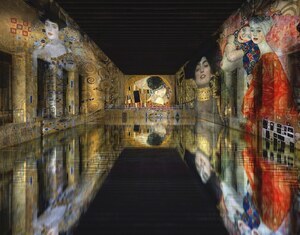
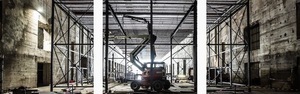


Bassins de Lumières – a 13,000-square metre former German and Italian WW2 submarine base at Bordeaux – soon to be the world’s largest digital art centre.
In April 2020, French art events management company Culturespaces will open the huge facility to the public, hosting immersive exhibitions of classical and contemporary art on the walls and beneath the surface of four water filled basins.






dudewithsign – it’s good knowin’ he’s out there, protestin’ the mundane for all us sinners.





A compilation of jolly scenes from the annual Krampusnacht festival (6th December) in which loons dressed as the bestial, demonic Krampus (St Nick’s opposite number, as it were) careen around towns and villages terrorising naughty children into goodness.


A lo-fi short by Mattias Pilhede and Sai Cheung featuring the philosophical ponderings of a spaceship’s door control system (something first considered by Douglas Adams) To wit:
In the far distant future, ships have Swedish accents because they are bought at IKEA.



If you follow the HBO series ‘Succession’, you’ll recognise this as Kendall Roy’s swanky condo, and if you like it you can buy it.
Only slightly less impressive than its onscreen version, the condo is a 297m³, 4-bed, 3-bath duplex in a 19th century cast iron building in Tribeca fitted out in oak, marble and Gaggenau appliances with a centrepiece 7m ceilinged ‘great room’.
Ownership also includes private storage, a 24-hour doorman, use of the building’s fitness centre, spa, resident lounge and courtyard.
Yours for €6.4 million.


A supreme, yet to be bested example of cosplay from 2016 featuring the two CGI characters from Dire Straits’ 1985 ‘Money For Nothing’ video.

Behold: the 2,000 year-old blast radius of N63A – a supernova remnant, still expanding. To wit:
As little as 2,000 years ago, light from a massive stellar explosion in the Large Magellanic Cloud (LMC) first reached planet Earth. The LMC is a close galactic neighbour of our Milky Way Galaxy and the rampaging explosion front is now seen moving out – destroying or displacing ambient gas clouds while leaving behind relatively dense knots of gas and dust. What remains is one of the largest supernova remnants in the LMC: N63A. Many of the surviving dense knots have been themselves compressed and may further contract to form new stars. Some of the resulting stars may then explode in a supernova, continuing the cycle. Featured here is a combined image of N63A in the X-ray from the Chandra Space Telescope and in visible light by Hubble. The prominent knot of gas and dust on the upper right — informally dubbed the Firefox — is very bright in visible light, while the larger supernova remnant shines most brightly in X-rays. N63A spans over 25 light years and lies about 150,000 light years away toward the southern constellation of Dorado
(Image NASA, ESA, Hubble, Chandra; Judy Schmidt)

An extremely pleasing rendition of Johann Pachelbel’s Canon In D performed by train horns and sundry station sounds collected by Pavel Jirásek.
