



Author Archives: Chompsky
Real World
at

Joshua Sokol writes in the New York Times:
Most of the world maps you’ve seen in your life are past their prime. The Mercator was devised by a Flemish cartographer in 1569. The Winkel Tripel, the map style favored by National Geographic, dates to 1921. And the Dymaxion map, hyped by the architect Buckminster Fuller, debuted in a 1943 issue of Life.
Enter: a brash new world map vying for global domination.
MORE: Can This New Map Fix Our Distorted Views of the World? (NYT)
Probably not, but still…
Sea View
at



The vision of Sri Lankan-based architect and 3D artist Thilina Liyanage, Ocean cabin is (or rather, would be) an oceanfront retreat ‘at the edge of the world’.
Accessed by a stairway wrapped around a massive rock. the cabin itself is an A-Frame supported by stilts featuring a living space with a sleeping mezzanine above. Clearly it’s all about the view and so, true to the axiomatic triplet of real estate, what really matters is location, location, location.
Hot Wheels
at


Behold: the Rolls Royce Phantom Tempus – an even more luxurious version of the current top of the range Roller.
Resplendent in Kairos Blue, the Tempus is decked out with a ‘Starlight’ headliner offering a scenic view of deep-space with swirling star motifs in the doors. The front dash features what the designers refer to as a “Frozen Flow of Time” – 100 hand-polished columns milled from a single aluminium billet, representing the 100 million year rotation of a pulsar star, if you don’t mind.
Only 20 will be made and they’re all spoken for.

Ballediohead
at
In a clip from a longer performance featuring interpretations of several of the band’s songs, (which spent just 24 hours on YouTube recently but may return), dancers from the Polish National Ballet perform to Radiohead’s ‘Reckoner’.
As you see, it works very well.

A recently-released-in-its-entirety 2006 session featuring five songs from ‘Get Behind Me Satan’ by the White Stripes (plus one Captain Beefheart cover) performed for the UK music show From The Basement.

https://vimeo.com/505637007
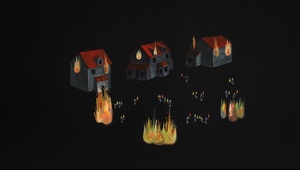
An award-winning atmospheric 2019 short by Agnès Patron exploring the emotional turmoil of a young boy as his mother’s attention switches to her new lover.
Masterful minimal storytelling.
Patron explains more here.

Behold: a spectacular view from the Hubble Space Telescope of nearby spiral galaxy M66. Open for business if you don’t mind the journey. To wit:
A spiral galaxy with a small central bar, M66 is a member of the Leo Galaxy Triplet, a group of three galaxies about 30 million light years from us. The Leo Triplet is a popular target for relatively small telescopes, in part because M66 and its galactic companions M65 and NGC 3628 all appear separated by about the angular width of a full moon. The featured image of M66 was taken by Hubble to help investigate the connection between star formation and molecular gas clouds. Clearly visible are bright blue stars, pink ionized hydrogen clouds — sprinkled all along the outer spiral arms, and dark dust lanes in which more star formation could be hiding.

(Image: NASA, ESA, Hubble, Janice Lee; Processing & Copyright: Leo Shatz; Text: Karen Masters)

Colum Cronin tweets:
“Intellectual is a parrot; wise man is a crow. One is repetitive; other is creative” (Mehmet Murat Ildan). New (to me) street art on Liberty Lane, Dublin. Anyone know the artist?