



IKEA’s frakta bag.
That’s åll.
Get designing.



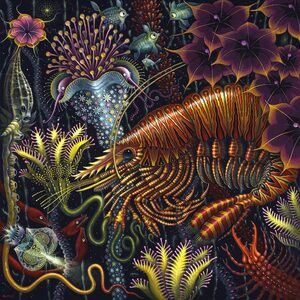

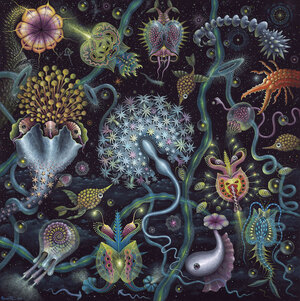
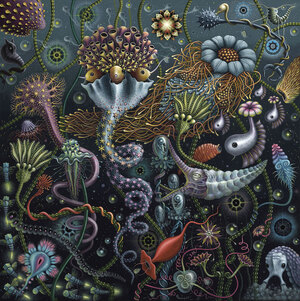


The densely populated undersea tableaux of LA-based artist Robert Stephen Connett. Of these paeans to biodiversity he sez:
In the shadow of a withering planet, I create worlds that are lush and thriving. I hope my work can encourage and uplift those who are disheartened by the climate crisis. However, creating a memory of a time when our world was stable is not enough. We all must do everything we can to lessen the causes of the crisis.
In fairness.



Behold: the 1954 Swallow Doretti – a two seater roadster made for the US market by a former motorcycle sidecar manufacturer that would eventually rebrand as Jaguar.
Fitted with the motor and gearbox of a Triumph TR2, the Doretti had tight handling, Italian pretentions and a top speed of 160 km/h.
Only 276 were made between 1954 and 1955 and this fully restored, factory correct survivor goes under the hammer next May.


A rather wonderful piece of mythical construction typography designed by German architect Johann Steingruber in 1773.
Explore it here.

Behold: the expanding debris cloud known as Cassiopeia A – a cosmic memorial to the fate of an ancient star. To wit:
Massive stars in our Milky Way Galaxy live spectacular lives. Collapsing from vast cosmic clouds, their nuclear furnaces ignite and create heavy elements in their cores. After a few million years, the enriched material is blasted back into interstellar space where star formation can begin anew […] Light from the explosion which created this supernova remnant would have been first seen in planet Earth’s sky about 350 years ago, although it took that light about 11,000 years to reach us. This false-colour image, composed of X-ray and optical image data from the Chandra X-ray Observatory and Hubble Space Telescope, shows the still hot filaments and knots in the remnant. It spans about 30 light-years at the estimated distance of Cassiopeia A. High-energy X-ray emission from specific elements has been colour coded, silicon in red, sulphur in yellow, calcium in green and iron in purple, to help astronomers explore the recycling of our galaxy’s star stuff. Still expanding, the outer blast wave is seen in blue hues. The bright speck near the centre is a neutron star, the incredibly dense, collapsed remains of the massive stellar core.
(Image: X-ray – NASA, CXC, SAO; Optical – NASA,STScI)



Budsies – give them a random drawing and some money, get a bespoke plushie and a happy child.
Seems fair.

(Thanks Colum Cronin)

Behold: the majestic disc of NGC 2841 – one of the most massive known galaxies, a mere 46 million light years away in the constellation of Ursa Major. To wit:
This sharp view of the gorgeous island universe shows off a striking yellow nucleus and galactic disk. Dust lanes, small, pink star-forming regions, and young blue star clusters are embedded in the patchy, tightly wound spiral arms. In contrast, many other spirals exhibit grand, sweeping arms with large star-forming regions. NGC 2841 has a diameter of over 150,000 light-years, even larger than our own Milky Way. The featured composite image merges exposures from the orbiting 2.4-meter Hubble Space Telescope and the ground-based 8.2-meter Subaru Telescope. X-ray images suggest that resulting winds and stellar explosions create plumes of hot gas extending into a halo around NGC 2841.
(Image: NASA, ESA, Hubble, Subaru; Composition & Copyright: Roberto Colombari)



https://vimeo.com/499129301
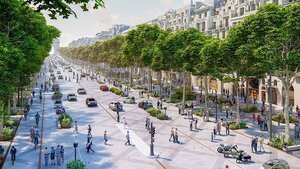
Behold: a taste of the recently announced €250 million plan to turn the world-famous 1.9km long Champs-Éysées into an ‘extraordinary garden’.
The revamp is scheduled to begin after the 2024 Summer Olympics, halving traffic, creating tunnels of trees and vastly improving the current Périphérique levels of pollution. Designer PCA-stream sez:
…the étoile intersection is reinvented as a public plaza geared towards tourists and Parisians who come to contemplate the Arc de Triomphe. on the avenue, the promenade experience makes a comeback and flâneurs will be able to stroll up and down the historic boulevard in an atmosphere greatly improved by the reduction in motor traffic.


