
Category Archives: History

Screen Shot 2015-01-28 at 13.17.34

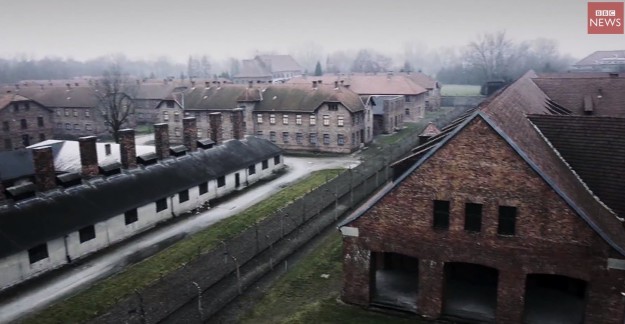
Extraordinarily haunting drone footage of Auschwitz-Birkenau by BBC News. To wit:

Drone video shows the Auschwitz-Birkenau concentration camp as it is today – 70 years after it was liberated by Soviet troops. The camp in Poland is now maintained as a World Heritage Site and is visited by thousands of tourists and survivors every year. Auschwitz was the largest camp established by the Germans during World War II. More than a million people – the vast majority of them Jews – died there between 1940, when it was built, and 1945, when it was liberated by the Soviet army.

Railway tracks into Auschwitz-Birkenau – Trains filled with victims from throughout occupied Europe arrived at the camp almost every day between 1942 and the summer of 1944.

Ruins of wooden huts at Birkenau – Birkenau (or Auschwitz II) was erected in 1941 solely as a death camp, the wooden huts are now in ruins with only brick fireplaces and chimneys remaining.

Entrance to Auschwitz I -The wrought-iron sign over the entrance bears the words Arbeit Macht Frei – “Work sets you free”. The brick-built buildings were the former cavalry barracks of the Polish Army.

Courtyard between blocks 10 and 11 at Auschwitz I – Block 11 was called “the Block of Death” by prisoners. Executions took place between Block 10 and Block 11 and posts in the yard were used to string up prisoners by their wrists.

fullist/BBCNews

(H/T: Kevin Whitty)

untitledFolly_sm untitledGrotto_2014 untitledStation_2014 untitledUFO_2103 untitledVehicle_2013 untitledVessel_2014
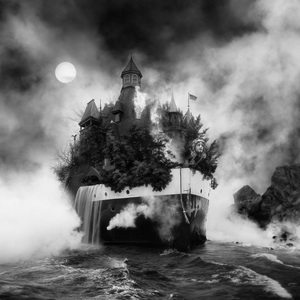
Composites (each of which was painstaking assembled over three months like a reverse jigsaw puzzle) drawn from snippets of up to 70 photographs found in the US Library of Congress Archives by artist Jim Kazanjian. Sez he:

My current series is inspired by the classic horror literature of H.P. Lovecraft, Algernon Blackwood and similar authors. I am intrigued with the narrative archetypes these writers utilize to transform the commonplace into something sinister and foreboding. In my work, I prefer to use these devices as a means to generate entry points for the viewer. I’m interested in occupying a space where the mundane intersects the strange, and the familiar becomes alien. In a sense, I am attempting to render the sublime.

More here

colossal

book-1 book-2 book-3 book-4 book-5 book-6
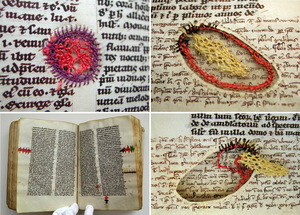
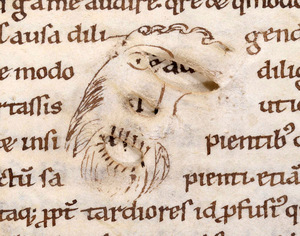
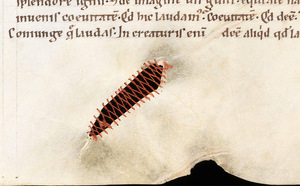
Investigations by Dutch book historian Erik Kwakkel into the art of creative parchment repair in the Dark and Middle Ages by scribes who – in order to deal with blemishes in the costly cow and sheepskin membranes they worked on – used cheeky doodles and imaginative embroidery to incorporate them into the texts in a style similar to the Japanese restoration art of kintsugi.

MORE: The Skinny On Bad Parchment (Erik Kwakel, Medieval Books)

Previously: Colours Of 1692

colossal

Screen Shot 2014-11-05 at 23.00.53 Screen Shot 2014-11-05 at 23.00.39 Screen Shot 2014-11-05 at 23.00.29 Screen Shot 2014-11-05 at 23.00.08
A collection of original WW2 British propaganda posters currently accepting bids at David Lay Auctions. Most guide prices are between £30 and £200 but the one on the top left (£800 – £1000 guide) is the most valuable. To wit:

ABRAM GAMES 1914-1996 “Blonde Bombshell” WWII ATS Recruitment Poster Printed for HM Stationery Office by Fosh & Cross Ltd. 1941 73 x 48.5cm Note: When this poster was first issued, Games was criticised for making the design ‘too glamorous’ and it was withdrawn. Games went on to design the official stamp for the 1948 Olympic games and the emblem for the 1951 Festival of Britain.

quipsologies