
Category Archives: Misc

cwqr_mbuoaejmky

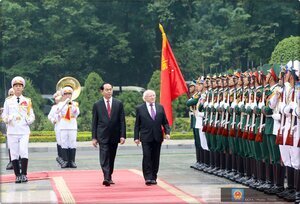
Vietnam president Trần Đại Quang and President Michael D Higgins in Vietnam

Earlier today.

President Michael D Higgins gave a speech at Vietnam National University in Hanoi.

During the speech, he said:

Most of you here are students, for whom many futures are possible, in an ever-more interdependent world for which a pluralist scholarship is essential.  You are invited to contribute to imagining and shaping a new form of globalisation appropriate for your generation and its future – one that can foster cohesion, social progress and a balanced relation between our human species and nature in all its forms.

This year, Ireland and Vietnam celebrate 20 years of diplomatic relations. However young the formal relationship between our two countries may be, it is one that is built on the solid bedrock of mutual esteem and authentic understanding.

There is so much shared experience in our respective histories; there are so many ways in which we Irish, when we acquaint ourselves with the history of Vietnam, can identify, in sympathy and imagination, with the aspirations of the Vietnamese people.

Ireland’s national journey and the journey of Vietnam are ones that chime: in your recollections we hear echoes of our own path.  Yours is a history of so much inflicted suffering by external powers, that while it must not disable your present, or deprive you of future possibilities, yet it would be so important for you never to be asked to assume some false amnesia in its regard. Your history in its fullness belongs to you and the world must learn from its imposed tragedies.

Both our cultures have their roots in ancient civilisations renowned for the value they placed on scholarly learning, spiritual cultivation and the arts. Both our peoples have endured the harmful experience of colonisation, and, in your case, the ambitions of four imperialisms. Both have suffered from the scourge of famine – “the terror of the hungry grass”, as Irish poet Donagh MacDonagh described it. Both of our nations have suffered, in cultural terms, from imperialist theories of culture which sought to justify the racial superiority of the coloniser over the colonised, and to rationalise the ruling of the world by a handful of imperial powers.

We recall the Paris Peace Conference in 1919, after that collision of Empires that was the First World War: a conference to which a young Ho Chi Minh sent a petition asking for the delivery of the independence that had been promised from France. He did not receive an answer from the presiding world powers.

Similarly, the doors in Paris remained closed to the delegation of Irish Republicans who travelled there in an attempt to garner support for the cause of independence from the British Empire. Both rejections were perceived by the Irish and Vietnamese leaders of the time as proof of the risks of placing trust in concessions from an imperial power.

It is important to remember that the Paris Conference was unfolding just a few short years after the Easter Rising of 1916, when a few thousand brave men and women rose to defy the power of the British Empire. This was a milestone event on the path to Irish independence, an event of which we, in Ireland, are celebrating the centenary this year. And we do so with what I have called a hospitality of narratives.

Both our peoples have led an unyielding and irrepressible struggle for independence. We both know, too, how difficult it can be to secure, vindicate and deliver on the promises of freedom, justice and equality that motivated the struggle for independence in the first place.  The decades following the heady atmosphere of the days of declared independence are the most challenging.

The globalised economic and trade structures to which Vietnam and Ireland have been opening, and in which they have been participating ever more actively and with success in recent times, are ones that create great hopes, suggest great opportunities for increased prosperity, security and social progress, but also ones that involve risk and serious challenges. Everywhere in our global system we can see how deepening inequality is threatening social cohesion, and how inter-generational justice is threatened as we witness our natural environment degrading at an alarming pace.

We should reflect deeply on the opportunities and the risks before us, risks that we share. No nation should ever be made to rush unthinkingly towards a model of development presented in the illusory guise of an ill-defined modernity. Is the modernity on offer simply an invitation to imitate the practice of others? Are current models of global trade and finance, production, extraction of resources, ones that truly advance the fundamental objective of human development?

Do those models protect the hierarchy of purpose that should exist – that must be restored – between morally purposive economic and social outcomes?  As to quantifying our achievements or failures: To what extent do growth rates as we currently define and measure them reflect the ability of our economies to respond to the basic needs of our most vulnerable citizens?

…The scale of the global challenges we face together requires, it is my deep conviction, not only a recovery of the genuinely idealistic impulses which drew our forefathers forward in their best and selfless moments towards a new world of independence. It also requires, of all of us and you now, new models, new paradigms for cooperation at national and international level, and also new scholarship, of such a nature as can generate balanced and respectful relationships between the peoples of the world, and between humans and the forms of life on their shared planet.

As places of learning, universities and institutes of technology have a crucial role to play in our transformational tasks, and we must ‘think long’.  As Vietnam’s much respected leader, Ho Chi Minh, once said:

“For the sake of ten years, we must plant trees, for the sake of one hundred years, we should cultivate people.”

…However great the global challenges we are facing may be, we can, in this century, if we set about it collectively and creatively, succeed in delivering the promise of sustainable development. Doing so is not some vague utopia, rather it will be immensely rewarding to see the fruits of one’s intellectual work delivered for the welfare of all.

It is a promise on which we must deliver urgently. Failure in relation to either of the interrelated challenges of sustainable development and climate change would be a disaster. It will result in the destruction of the prospects of millions to live a life of dignity.  Given our existing demographic projections, it will result in massive migratory flows, from poverty-stricken areas, first to cities that are unprepared, then on into the uncertainty of international migratory trails, to which we are currently making such a dismal response.

…The international community also faces the difficult and most urgent challenge of preventing human trafficking. This terrible plight of human trafficking affects countless numbers of men, women and children, who are often seeking to make better lives for themselves and fall prey to ruthless criminals.

The factors which contribute to this problem are, like most of the global issues we face today, very often complex, and while difficult to resolve, must be tackled. Extreme poverty and migration from rural areas are primary factors, but we also need to consider carefully the impact which major development projects – such as the building of dams or the development of certain industries – can have on rural communities and on the continuation of their traditional livelihoods.  We must be open to seeing how displacement occurs.

…Finally, but so importantly, may I say how crucial the United Nations’ work on disarmament and non-proliferation of weapons is. This is an area in which Ireland and Vietnam are aligned and actively engaged. It is work that is critical for a safer and more secure world.

There is no doubt that political leadership is fundamental to the achievement of such critical global objectives. I am very confident that the incoming UN Secretary General António Guterres, with his exceptional experience of the work of the UN on the ground, will continue the good work of UN Secretary General Ban Ki-moon in leading the world onto a more sustainable path.

We are all but migrants in time and space – transient travellers who must do our best to pass on to the next generations, a hospitable ground, on which they can flourish – let us try to do it together.

Read the speech in full here

Pic: MOFAVietNam

img_1042-1024x768

The problem with the “vinyl boom” of recent years has been that the demand has squeezed supply, with remaining vinyl factories being pressed (heh) to deliver more and more stock as demand for LPs returns.

That much has been explained in this article.

Imagine the relief to labels and suppliers, then, that the invention of injection-moulded vinyl records presents, unveiled recently by Dutch CD manufacturers Symcon.

Writes FACT Magazine:

In conventional vinyl manufacturing, the plastic is pushed on the grooves at an angle – but the injection-moulding method injects plastic straight into the record’s grooves, which copies the grooves on the stamper more accurately.

The injection-moulding method also promises to cut costs by reducing the energy used in the process by up to 65%, as it doesn’t require the huge amounts of steam currently used to heat up the PVC puck before it’s pressed between two stampers. The new system also applies no pressure to the stampers, which can currently only be used for up to 2,000 records before they become worn out.

Symcon says that injection-moulded records could be turned around in just two weeks, drastically reducing the current timeline of 12 to 16 weeks from cutting floor to shop.

There are still some hurdles to overcome, however.

Vinyl records are slightly more durable than the injection-moulded samples Symcon has made so far, and the material used for injection-moulded records is more expensive, at €0.45 per record compared to around €0.35. Testing the sound quality also isn’t easy – the conventional quality system for vinyl is not directly compatible with injection-moulded records.

Two weeks!

Madness.

Vinyl of the Future

screen-shot-2016-11-08-at-11-34-38

https://www.youtube.com/watch?v=FykmwprjrJo

Congratulations to Joe Schmidt and the Ireland team for achieving an historic win over the All Blacks.

An equal non-congratulations to the IRFU, EirSport and whoever else was involved in not showing the match live on television to the vast majority of sporting fans.

The selfish manipulation of live television coverage is in stark contrast to the honesty and heroism of the players on the field.

John Gaffney,
Fivemilebourne,
Co Leitrim.

SCRUM!

Victory over the All Blacks (Irish Times letters page)

screen-shot-2016-11-08-at-11-09-20

screen-shot-2016-11-08-at-11-09-04

screen-shot-2016-11-08-at-11-06-47

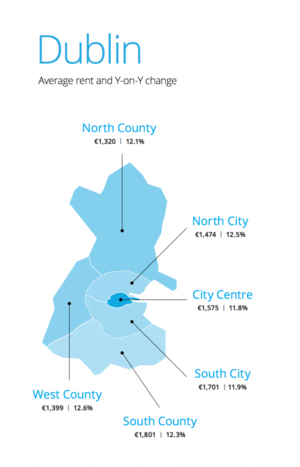
From a Daft.ie report published today

Daft.ie has published its report on rental market trends for the third quarter of 2016.

It finds:

The average rent nationwide rose by almost 4% in the third quarter, equalling the largest three-month increase seen in the second quarter of the year.

Combined with other recent increases, it means that the annual rate of rental inflation in Ireland is now 11.7%, the highest recorded by the Daft.ie Report since its series start in 2002.

Read the report in full here

Previously: Certainty In A World Gone Daft

vote-agus-votail-for-pinned-tweet
2

It’s election 2016!

Maria Ryan, of the National Library of Ireland, writes:

We are currently running a competition which aims to engage with the general public.

“Remembering 1916, Recording 2016” is our largest project to date and we want to reflect the participatory nature of this year by asking the public to help us select sites for inclusion in the NLI Web Archive.

In short, we are looking for people to nominate websites which record the events of 1916 and websites which reflect life in Ireland in 2016.

We are asking you to nominate websites under the following two categories:

What website best remembers the events of 1916?

What website best records Irish life in 2016?

The shortlisted websites will be archived and made available for generations to come in the NLI’s web archive. We would love to hear what suggestions your readers may have.

Vote here

Web Archive Public Call (NLI)

screen-shot-2016-11-08-at-09-55-06

Loitering Theatre writes:

This weekend (as part of the Tulca Art Festival Galway, Ireland) artists Loitering Theatre filmed anti-war activist Margaretta D’Arcy in the moments shortly after her spaceship’s emergency crash landing on Silverstrand beach in the West of Ireland.

D’Arcy had been travelling into the future on a mission to ascertain the results of the forthcoming US election, when the time calibration failed on her ship.

In a scene eerily reminiscent of the final scene in 1968 sci-fi blockbuster Planet of the Apes, D’Arcy disembarked from her spaceship to find herself in a post-apocalyptic nightmare:

While D’Arcy looked on at the giant half-buried remains of the Statue of Liberty in the sand, other Irish citizens seemed oblivious as they continued to walk dogs and play with their children on the beach.

Heston’s Folly (Loitering Theatre)

Previously: Margaretta D’Arcy on Broadsheet

7881538-3x2-700x467Michael Taft

From top: Hillary Clinton and Donald Trump: Michael Taft

There is a difference between someone who is Trump and someone who is not Trump. The mature response is: support Clinton, oppose Trump.

America-born Michael Taft writes:

I suppose it would be expected of a progressive discussing the US Presidential election to describe Donald Trump negatively: a bigot, a liar, a tax avoider, a sexual predator, a charlatan who connives at arm’s length with the most profoundly anti-American groups (such as the Ku Klux Klan). But what’s the point?

We know all that and more – and we have Donald Trump to thank for that; he’s the one who’s provided the conclusive evidence.

What’s far more interesting is why so many people are voting for him. No doubt, this will become an industry in the future with books, articles, PhDs, earnest documentaries and pop-analysis.

I won’t pretend to have the answer (in any event, there are many answers which provoke even more questions). But I do know many of the people who are voting for him.

I grew up with them, went to school with them, played baseball with them, drank many beers with them. They are good people, caring people. I’m sure if you met them you would enjoy their company; just ordinary folk trying to meet their monthly bills.

But something has snapped. The ties that traditionally bound Americans in a social contact have been cut. These people grew up in the American dream and now they have woken in a place that they weren’t prepared for and weren’t supposed to be in.

The most dismal statistic is that the life-expectancy of whole swathes of the white working class is now falling. Poor health, poor wages, poor life-expectancy. The inclusive ties of community have been replaced by bleak networks despondency and anger.

Of all that was depressing about Trump’s rallies, to me the most depressing were the chants ‘Build the wall! Build the wall!’ Never mind that America became great because it tore down walls, creating a land of many cultures, languages, religions and national origins – a land for, and of, all people. Woody Guthrie said it best:

“This land is your land, this land is my land”

OK, there was always a bit of myth about this; the reality was more fraught, more tense with many injustices. But the mythic parts are important, too – it says something to us about us. And walls are not about us.

People build walls when they are afraid, lack confidence, live in fear, when the social order of cooperation that is so natural to us breaks down. Walls are the ultimate sign of weakness, yet this is the foundation for ‘Making America Great Again’.

Do Trump supporters recognise this weakness? No, not now anyway. That is the tragedy which they don’t deserve.

I know Europeans flinch at Trump’s language but I know the cadences, the syntax, the rhythms; it is a direct language. So much of the oppressive apparatus in America today comes with a ‘corporation-speak’, a ‘bureaucratic-speak’. People know this language and are sick of it.

Trump’s speeches are not written by committee where each sentence is parsed for its impact on this or that focus group. His speech is the speech of ordinary people. Ever read a written transcript of an ordinary conversation – it’s almost unreadable; so much is left to the unspoken word, the unfinished sentence, the wave of the hand, the angle of the head? That’s how Trump speaks. People understand.

But this is the allure and the danger of the demagogue. He or she cannot be neatly categorised on classical ideological graphs. They can act left-wing or right-wing. They can speak a progressive or reactionary language.

The most effective are able to weave these seemingly opposed perspectives into a unitary anti-establishment movement. They identify the elite, mobilise people against that elite and if they are successful, they end up becoming the elite. This is almost the inevitability of a desperate populism led by a persuasive demagogue.

There’s a lot of superficial commentary on the potential voting patterns of the rust-belt or the white working class or the ‘ordinary middle class’ (which means something different in the US than in Europe).

The polling data suggests something much more nuanced and differentiated: by region, by gender, by age, by educational achievement. Three-minute news pieces require neat summations; in many cases they miss the point.

But there’s one point that cannot be missed. Many of the people voting for Trump come from social constituencies that were once part of the greatest and most progressive coalition in the 20th century: the New Deal.

This was the new social contract that emerged out of the wreckage of the Great Depression and lasted for decades.

In the New Deal – which spread over a generation – equality spread as surely as electrification and water supplies, the welfare state was born, pro-labour legislation was implemented, financial interests were subordinated and the productive economy was privileged. Houses and motorways were built, art was created for the public, music classes were funded for schools and civil rights legislation was passed despite fierce opposition.

But the Democratic Party today has moved far from that heritage. Like social democracy and the Left throughout Europe, it proved incapable of fending off neo-liberalism, accommodated itself to capital (how so much different to President Franklin Roosevelt’s Second Bill of Rights), so intellectually debased itself it had no response to the financial crash.

Today, we are living with the results of the collapse of that great coalition and the Democratic Party’s inability to form a new one suited to modern times (though Senator Bernie Sanders gave us an insight into what that new coalition could look like).

How should progressive Americans respond today? Elect Hilary Clinton. Why? Because Hilary Clinton can forge a progressive America? I wish that were the case but I doubt it.

However, this is a defensive battle. Imagine if Trump won the Presidency? It’s not the successes that should worry us. It’s what happens if he fails his supporters. They have built the wall but they are still poor; they have kept out the ‘outsider’ but they still feel afraid. What happens when disillusionment with Trump sets in, when they see through the rhetoric to find another, more fundamental betrayal?

Don’t think they will automatically turn to a progressive and democratic alternative. They might retreat into a long-term apathy. Or worse, they might turn to even more reactionary forces which promise an even truer and more uncompromised politics. If Trump were elected America might spiral into an even more vicious cycle.

That’s why Clinton must win. I’ve come across the trope that, at root, there is no difference between Trump and Clinton. This betrays a profound ignorance of the fundamental issues at stake.

There is a difference between someone who is Trump and someone who is not Trump. The mature response is Senator Bernie Sanders’ response: support Clinton, oppose Trump.

And the mature strategy is Senator Bernie Sander’s strategy: support Clinton, win the White House and immediately start transforming the Democratic Party from the bottom up.

This is a lesson we should learn in Europe. How so much easier to set oneself apart to remain untainted. The real work of democratic mobilisation is so much harder and much more long-term. It is not the instant gratification that can be found in the supermarket aisle or the heated denunciations on social media.

And in America, this democratic mobilisation will need to include Trump supporters – those who are searching for a new social contract. Because they vote Trump today doesn’t mean they have stopped searching.

But it will need to speak directly, honestly. It will need to project a more authentic and liberating Americanism, rooted in a profoundly progressive history.

We must rebuild that coalition, fit for the 21st century. We must start that work now. And the first step is to elect Hilary Clinton today. The next step starts tomorrow.

Michael Taft is Research Officer with Unite the Union. His column appears here every Tuesday. He is author of the political economy blog, Unite’s Notes on the Front. Follow Michael on Twitter: @notesonthefront