

Category Archives: Misc

newsocracy

anne-marie-291x300

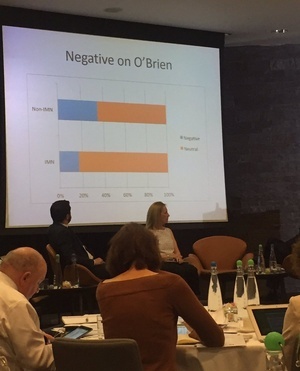
From top: A visual from the Newsocracy Conference in Limerick last Friday; Anne Marie Mcnally

Journalism as we know it and as it should be is in extreme danger in this country.

Anne Marie McNally writes

On Friday last I spoke at a conference in Dublin hosted by MEP Nessa Childers. The title of the event was ‘Newsocracy- Safeguarding Journalism and Exploring owner Influence’ and the theme was (obviously!) the relationship between media ownership and unbiased Journalism.

The panel was made up of representatives from media outlets and other agencies including Facebook, the Broadcasting Authority of Ireland, the National union of Journalists, academics from the field of communications, and journalists from various backgrounds.

By a country mile the overwhelming message from the speakers was that Journalism as we know it and as it should be is in extreme danger in this country.

Possibly the most worrying part of the day came when Professor Roddy Flynn from DCU’s School of Communications presented the findings of a research piece which examined the treatment of four of the biggest news stories of recent times across various media outlets.

Two of those stories centred around your favourite redacted personality with a penchant for litigation.One was the reporting of the Moriarty Tribunal findings and the other was the Siteserv/IBRC and Catherine Murphy story.

The results were interesting to put it mildly.

In relation to the Moriarty Report, a study of 140 articles published about the Tribunal in Independent News and Media (INM) titles and a further 227 in non-INM titles between March 23 and April 2, 2011, showed that, in general, INM titles were more likely to focus on Michael Lowry than on Denis O’Brien with the difference being reported as ‘statistically significant.

Similarly in relation to the reporting of the Siteserv/ Catherine Murphy story, the study found that the frames used to report the story differed significantly between INM tiles and non-INM titles with the former tending to frame the story in the ‘abuse of privilege and right to individual privacy’ context while others chose the ‘public good’ frame more regularly.

Given that the circulation figures for INM titles far outstrip all others this is a worrying, if not surprising, reality in our news media and surely has repercussions for the democratic process if media is to truly be considered the Fourtht Estate of any healthy democracy.

We, of course, are also aware of the campaigns waged by INM titles on perceived ‘political rivals’ including Sinn Féin and Lucinda Creighton in recent times representing yet another worrying departure in news media in this country.

After Professor Flynn had dropped that particular nugget of academic proof on the difference in reporting based on ownership into the conference, the tone continued apace.

Daniel McConnell, the Political Editor of the Irish Examiner and former Irish Independent Political Correspondent, delivered a speech entitled ‘No Country for Brave Men’ which was a fascinating insider’s insight into the politics of newsrooms and the changing landscape of Journalism as a profession.

Daniel spoke about precarious working conditions for young graduates entering the profession and how even the type of reporting we receive on specialist subject such as the Courts, has become dumbed down by virtue of the fact that new entrants are very rarely trained into specialities and are more often than not just stuck on a beat that’s available rather than tailored to any particular skill set.

Gemma O’Doherty followed up in her now trademark fashion of burning the establishment to the ground in what was a cutting and incisive speech on the often toxic relationship between our National Broadcaster, politics and the issue of looming litigation and/or influence.

I had gone along to speak on the importance of Social Media in political campaigns and had always intended to make the point that despite my being an evangelist for Social Media, I still very much value and understand the importance of using the medium in harmony with traditional media.

I pointed out that during the so-called ‘constitutional crisis’ caused by Catherine Murphy’s speech it was only this online outlet, Broadsheet.ie, which stood by and held firm in the belief that Article 15:12 of the Constitution protected them to report the utterances of a national legislator in the national Parliament while every other (more adequately resourced) media outlet in the country cowered in the face of threats from the redacted one on high.

I know, having been in the maelstrom of that particular crisis, that it was not journalists who were the problem, it was overly-cautious legal teams wielding control over media outlets.

On that basis I’ll end this piece in the same way I ended Friday’s speech – it is not brave journalists we need – we have them – it is brave media outlets prepared to give voice to those journalists.

Anne Marie McNally is a founding member of the Social Democrats. Follow Anne Marie on Twitter: @amomcnally


johncummins

John Cummins – Road To Euro 2016

A spoken word contribution to the Euro 2016 build up by hairy, Dublin-based self styled.’poetician’.

John is a previous holder of the All Ireland Slam Poetry Championships, where he beat a callow, smooth chinned pre-‘rick a day poet named John Moynes.

FIGHT!

2015-09-23_bus_13084427_I1

profjoebarry

From top: A Dublin pharmacy; Joe Barry.

There is unanimity that criminal drug suppliers have to be taken on.

But who will take on the legal drug suppliers?

Professor Joe Barry writes:

The recent killings in North Inner City Dublin have sparked much debate about illicit drugs, their control and the harms they wreak in many communities.

It is timely to examine the demand for and supply of all classes of psychoactive substances and how we are addressing them in Ireland.

In terms of legal status there are three broad categories: illegal substances, including heroin, cocaine, cannabis and a range of related substances; medicines intended for use on prescription only such as tranquillisers, anxiolytics and anti-depressants; and alcohol.

The first category are illegal for supply and personal consumption, with a wide range of sanctions. The second category are, in theory, controlled by being prescription only.

Alcohol is in a class of its own, with minimal regulation for adults in terms of supply.

In reality the above three categories have much more in common than separates them. The annual report of the national drug related deaths index from the Health Research Board tells us that there is approximately one overdose death per day in Ireland from combinations of these substances.

Demand for psychoactive substances is fairly high in Ireland. We have an international reputation for alcohol. Psychotropic medication is dispensed in large quantities to Irish people, not all of which is taken by the person for whom it is prescribed. Medicines are often shared or sold on.

There is a market for prescription drugs and many pills taken now have arrived in Ireland by unknown routes. The rapid rise and even more rapid demise of Headshops in 2010 has resulted in a supply of pills onto Irish streets that has not washed through yet.

Why do we take psychoactive drugs? To make us happy, to celebrate or make us feel good, to loosen our inhibitions, to erase or temporarily shut out traumatic experiences, to help us cope with life’s difficulties and for many more reasons.

For many, dependency patterns develop and severe personal and family disruption can ensue. Problems arising from psychoactive substances are usually passed to the health and social care services to address.

The ‘polluter pays’ principle does not apply in Ireland.

In general, public health thinking in relation to psychoactive substances broadly supports the view that the less psychoactive substances taken in any society the better.

The American ‘war on drugs’ has failed and the public health approach is often referred to as the harm reduction model.

It is in addressing supply-side issues as part of this harm reduction approach and advocating for certain policies to reduce supply that public health practitioners come into conflict with vested interests.

Suppliers of illegal drugs are open to criminal sanction. To a lesser extent users of illegal drugs can be also but events in the North Inner City have shown that things are not so straightforward.

Major suppliers are both reviled and feared. Users are caught in the middle and also experience stigma on an ongoing basis.

Suppliers of alcohol are a mixed bunch. Publicans and specialist off-licence holders in effect run small(ish) businesses, in every part of Ireland.

The large supermarket chains are small in number but, through ever expanding outlets, this limited number of large companies are eating into the market share and have become the dominant retailers.

On the production side we have the large transnational corporations flexing their very considerable financial muscles continuously; buying respectability and attempting to make themselves indispensable to Irish Sport and the Arts and lobbying our politicians at home and at the EU.

The extent of this lobbying is now being flushed out in to the open but so far it has been very successful at preventing any public health alcohol legislation making its way onto our Statute Books.

The third source of supply of psychoactive substances is the Pharmaceutical Industry. This industry is arguably more influential than the Alcohol Industry. It is a beneficiary of Ireland’s low corporation tax rate, it makes huge profits and has resisted efforts by the Irish State to supply medicines at more affordable prices.

Because of this behaviour it is now very much under the spotlight. Part of its profits comes from psychoactive medicines which cumulatively cost the State enormous sums; these drugs are very heavily and successfully marketed.

On the supply side, therefore, we have three types of major operators; criminal operators who make vast profits and two categories of Transnational Corporations who also make vast profits but who have so far resisted attempts by our legislators to pursue the common good.

They seem to operate on the basis that they are ‘too big to fail’ and that our country will be the loser if they are regulated more tightly.

There is unanimity that criminal drug suppliers have to be taken on. I hope that there is a growing realisation in the 32nd Dáil that the legal drug suppliers must be taken on also through effective regulation.

We see where light touch regulation in respect of the banks has landed us. Let us learn from those mistakes.

Joe Barry is Professor of Population Health Medicine at Trinity College Dublin.. Follow Joeon Twitter: @BarryProf

Heartbeat

Saturday June 10: This Greedy Pig & Radiomade Present: Heartbeat with Clu, Lumigraph & more @ Tara Street, Dublin  (€15)

Nialler9 writes:

This Greedy Pig & Radiomade join together to present a showcase of Irish electronic music on Tara street including live sets from Lumigraph and White Collar Boy; DJ sets from Clu, mark Alton, Daire Carolan, This Greedy Pig & Dylan Higgins. The YouAreListening.To installation will use live police scanners and ambient music in a structure built by Algorithm. Ticket giveaway at Nialler9 (link below)…

Nialler9’s Dublin Gig Guide June 7-13 (Nialler9)