

Um.
Neil O’Donoghue writes:
“Two different estate agents, same day, 15k difference. Smells like bubble…”
Everyone stay cool.



Um.
Neil O’Donoghue writes:
“Two different estate agents, same day, 15k difference. Smells like bubble…”
Everyone stay cool.

https://soundcloud.com/liam_geraghty/getting-hitched-in-ireland
“People have redefined what marriage means to them. Marriage is more popular than ever – which is unusual – you might think that with, perhaps, the demise, a little, of the Catholic Church and people turning towards a more secular society that that wouldn’t be so, but actually people are still looking for that commitment and we do marriage very well in Ireland!”
Dr. Lorraine Mancey O’Brien, Director at Irish Institute of Celebrants
A playback of Liam Geraghty on the business of getting hitched in Ireland for ‘The Business’ on RTÉ Radio 1 at the weekend.
Hmmm.
FIGHT/decree nisi!
Top pic: Marriage Equality wedding fair last year with from left: Ed O’Leary and Joanna Charles, Rachel McCaffrey and Nikki Kavanagh, Mark Burns and Anthony Maher.
Rollingnews
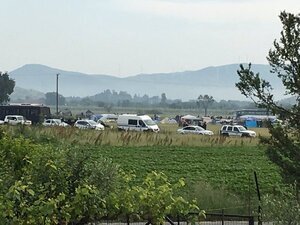
Police arriving at the makeshift refugee camp in Idomeni this morning
You may recall a post from March, written by Emma Spence, from Glasgow, Scotland, in which she described the conditions of the makeshift refugee camp at Idomeni, at the border of Greece and the Former Yugoslav Republic of Macedonia.
She wrote it just before the EU/Turkey deal was struck in late March, around the time the border became shut indefinitely to those hoping to cross and continue into Europe.
There are reportedly around 8,000 people currently seeking refuge based at the camp.
But, this morning, the Greek authorities have started to evacuate the camp and move those living there to other army-run camps in Greece.
Damian Mac Con Uladh, an Irish journalist who lives in Greece, spoke to Audrey Carville on RTÉ’s Morning Ireland this morning about the evacuation.
Audrey Carville: “Damian, you like many other journalists, they’re not allowed in or near the camp this morning while this process is going on, why not?”
Damian Mac Con Uladh: “Well the Greek government clearly don’t want too much attention to be drawn to the actual operation. They’ve only allowed journalists from the state TV and from Greece’s news agency although there are some foreign journalists in there. There is a small number in there, some of them are undercover and they intend to report on this operation which has begun this morning and is expected to take a few days.”
Carville: ‘Yeah because there are thousands of people there, aren’t there? Can you take us through generally what’s been happening at the camp today?”
Mac Con Uladh: “Well, news kind of came through in the last two or three days that the site would be evicted. There’s about 8,500 refugees on the border at Idomeni, on the border with Macedonia, and the government says they will be taken to what they say are better-run camps in northern Greece. This has been their position for a long time but most of the refugees are quite reluctant to go to these camps – fearing that once they’re out of public view, they’ll be forgotten about and their chances of moving on to Europe, of rejoining their families in other parts of Europe become more and more difficult. This morning we hear there’s about 1,500 police in the area of Idomeni, including riot police. About 600, up to now, six buses have left the camp with about 350 refugees, taking them to the camp near the city of Thessaloniki.”
Carville: “And what were conditions like at Idomeni, Damian? Were they similar to ‘The Jungle’ at Calais?”
Mac Con Uladh: “Well certainly in the last few days, yes. The weather’s been quite bad in Idomeni so the camp has kind of reverted to these very muddy conditions that characterised it earlier in the Spring. There are NGOs there trying to do, they’re trying to make the best of a very bad lot for the people there but the Government’s argument – that the camps that they will be taken to are better – is disputed by many NGOs. They’ve visited these camps – many of which are run by the army and conditions there are also quite bleak. Some of them are quite remote, the food being provided there is sub-standard in many cases and this is something that the refugees know about and they fear that once they go there, and they’re out of the public view, their plight will become even more difficult.”
Meanwhile, this weekend…

A screening of Caoimhe Butterly’s documentary The Sea Between Us, filmed in Lesbos, Greece, will take place at The Sugar Club on Lower Leeson Street in Dublin at 1.30pm on Saturday.
It will be followed by a 12-minute sequence entitled “The Border” that reflects the impacts of border closures and the narratives of some of those who have been stuck at Idomeni; a Q&A with Ms Butterly; and a panel discussion with Ronit Lentin, Hassina Kiboua and Ellie Kisyombe, chaired by Betty Purcell.
Pizza and drinks will be provided at the event while tickets (€13) can be purchased here or at the door. All proceeds will go towards grass-roots refugee support projects in Greece.
Also on Saturday, people who have volunteered with refugees across Europe and elsewhere will meet at 12 noon in Houricans pub, beside The Sugar Club – before the film screening – to share their experiences and ideas about how Ireland can respond to the humanitarian crisis.
Listen back in full to Damian Mac Con Uladh’s interview here
The Sea Between Us – Fundraiser (Facebook)
Related: Idomeni: Greek riot police move in to clear refugee camp (The Guardian)
Pic: Jeanne Carstensen

Ah here
Ted writes:
PewDiePie roasts Irish game commentator Jacksepticeye. Customary Irish potato joke at 1:17..
Fight!.

Colin Brady writes”
My girlfriend’s father’s best mate Pat Good wrote this song for the Irish football team 26 years ago. The cover alone is fantastic (drawn by my gf’s dad Gerry Lawes and has Jack Charlton shaking hands with auld Pope JP) but the tune is a gas reminder of the glory days.
He’s followed it up all these years later…

….with the new tune Swedes, Sprouts & Spaghetti (ooh la la).
Euro 2016 songs to broadsheet@broadsheet.ie marked ‘For Euro Consideration’

From top: waiter carrying tray: Michael Taft
How can we generate economic wealth and create well-paying jobs if indigenous business is over-concentrated in the low paid hospitality and retail sectors?
Michael Taft writes:
Here is one part of a presentation I made to the Nevin Economic Research Institute’s Labour Market Conference held earlier this month in the University of Limerick.
This may seem a bit abstract; it certainly doesn’t seem as urgent as other issues such as health or housing. However, this has far-reaching implications for long-term economic growth, household prosperity, and business competitiveness.
There is a narrative about Irish indigenous enterprise (which I shall simply refer to as Irish business) which has been championed by many, notably Dr. Conor McCabe, that Irish business and capital has historically focused on the finance and property sectors, content to service foreign-owned capital but which has, with some exceptions, avoided the high-value added sectors upon which we could build a strong Irish export base.
The following adds to this analysis by analysing what market sectors Irish business is active in.
Market sectors exclude agriculture and ‘non-market’ service (e.g. public administration, health, education, recreation & leisure).
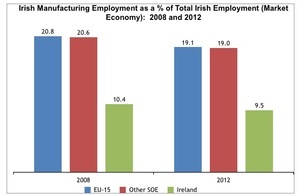
The chart (above) compares Ireland with the EU-15 and our peer group – other small open economies which, like us, have small domestic markets and are reliant on exports.
Irish business is a poor performer when it comes to manufacturing. Whereas one-in-five European workers in the indigenous sector are employed in manufacturing, it is only 10 percent here.
Unfortunately, the EU data is, so far, limited to the period between 2008 and 2012 so we are looking at many countries at the bottom of the business cycle, especially Ireland. Still, Irish manufacturing is weak.
Why should this matter – if we can excel in other sectors? Professor Ha-Joon Chang puts it this way:
‘. . . the manufacturing sector is still – and will always be – the main source of productivity growth and economic prosperity. It is a sector that is most open to the use of machines and chemical processes, which raises productivity. It is also where most research and development, which generates new technologies, is done.
Moreover . . . it raises productivity in other sectors, mainly because the services sector is using more advanced inputs produced in manufacturing– computers, fibre-optic cables, routers, GPS machines, more fuel-efficient cars, mechanised warehouses and so on. Knowledge-intensive services sell mostly to manufacturing firms, so their success depends on manufacturing success. ‘
Manufacturing’s contribution to the Irish economy is, per employee, considerable.
Using Forfas data – which is based on exporting companies – direct expenditure in the manufacturing sector (total wages plus Irish materials and services purchased) came to €170,000 per employee. In contrast, direct expenditure in the traded services sector was €93,000 per employee.
Manufacturing has an 83 percent higher impact in the economy per employee.
Unfortunately, the total size of the Irish manufacturing is small which limits this benefit.
However, there are other sectors where Ireland performs strongly – and these, unfortunately, are sectors which are low-wage and low value-added.
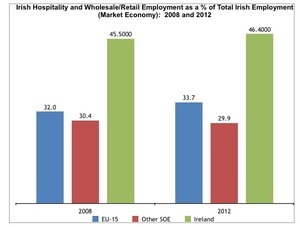
Irish levels far exceed the proportion in other European countries. Indeed, over 17 percent – or more than one-in-six – in Ireland are employed in hotels and restaurants.
While it is understandable that this sector would be higher than our peer group (such as Finland) given greater tourist numbers, there is an over-concentration in Ireland.
For instance, Spain, Greece and Italy all have higher levels of tourism as measured by nightly accommodation occupancy per capita, than Ireland (between 11 and 21 percent higher), they have between 9 and 12 percent of their total market employment in working in the hospitality sector.
Compare that to Ireland’s 17 percent.
This concentration in employment is mirrored in business investment. In the EU-15, investment in the combined hospitality and wholesale/retail sectors makes up 15 percent of total indigenous investment; in other SOE countries it makes 12 percent. In Ireland it makes up 20 percent (in 2008, it made up 25 percent).
Here’s a little factoid to chew on: in 2008, there was more Irish investment in the hospitality sector than in the manufacturing sector.
This raises important questions.
How can we generate economic wealth (e.g. value-added) if indigenous business is over-concentrated in the hospitality and retail sectors? How are we going to generate well-paying jobs, given these sectors are low-paid? How are we going to build a strong Irish export platform as distinct from the modern, foreign-sector?
It also raises questions regarding the Living Wage.
It is easier to introduce a Living Wage in an economy where the traditional low-paid sectors make up a smaller proportion of the indigenous sector; where any price rises can be absorbed by consumers working in higher-paid sectors such as manufacturing. It is harder when those low-paid sectors make up such a high proportion – approaching 50 percent – of total employment as it does in Ireland.
We hear a lot about Irish business – which is sometimes conflated with foreign-owned firms.
We hear claims that the indigenous needs better tax treatment (a corporate tax rate of 12.5 percent isn’t good enough? Employers’ social insurance at half the level of other EU countries isn’t good enough? ).
We read stories about Irish entrepreneurs.
What we don’t get is a fact-based analysis of the state of Irish business –that it is concentrated in low-paid, low-value added and – in the case of wholesale/retail – non-traded, or non-export, sectors.
Hopefully, the incoming Minister is aware of this flaw. Hopefully.
Michael Taft is Research Officer with Unite the Union. His column appears here every Tuesday. He is author of the political economy blog, Unite’s Notes on the Front. Follow Michael on Twitter: @notesonthefront
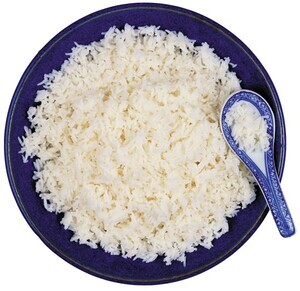
There’s always someone crying halt
And saying your diet’s at fault
And giving advice
About how to serve rice
Just take it with a pinch of salt.
John Moynes
Pic: Shutterstock





MORE to folly
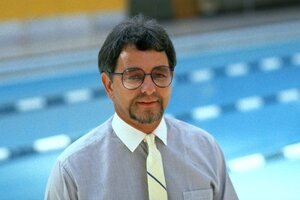
From top George Gibney, Irvin Muchnick
You may recall two previous posts about former Irish swimming coach George Gibney.
One post detailed how Gibney – who was charged with 27 counts of indecency against young swimmers and of carnal knowledge of girls under the age of 15 in April, 1993 – sought and won a High Court judicial review in 1994 that quashed all the charges against him.
The judicial review was secured after a landmark Supreme Court decision, during which Gibney’s senior counsel Patrick Gageby argued that the delay in initiating the prosecution against Gibney infringed his right to a fair trial.
Mr Gageby’s sister Susan Denham was on the bench of the Supreme Court that day.
The second post was a timeline of events concerning Gibney, the allegations made against him and how he eventually went to live in America after the charges against him were dropped.
The timeline explained how American journalist Irvin Muchnick has been attempting to obtain the US Department of Homeland Security’s immigration file on Gibney – in an effort to understand how Gibney was able to get a visa and then a green card to live in the States, given the previous charges against him.
In July 2015, following his FOI request to the US authorities for the file, Mr Muchnick received just four pages of Gibney’s file.
On April 17, 2016, the Sunday Times, reported that further documents released to Mr Muchnick show that Gardaí gave Gibney a certificate of character – issued on January 20, 1992 – to support his application for an American visa.
The certificate given to Mr Muchnick was reported to be partially redacted with the name of the issuing officer and its contents obscured.
According to the Murphy Inquiry – which was set up to look at abuse in swimming in 1998 – a parent from a club other than Trojan Swimming Club, where Gibney coached, was told by an assistant coach of Trojan in November 1991 that the gardai and the ISPCC were informed of the allegations in relation to Gibney.
However, later the ISPCC said it had no record of any such complaint in 1991 or in 1992. And, the Murphy Inquiry states the first record on the Garda file is dated December 15, 1992.
Mr Muchnick is still trying to obtain Gibney’s full immigration file and, last Friday, he appeared before Judge Charles Breyer, a Senior United States District Judge of the United States District Court for the Northern District of California, about the matter.
Mr Muchnik wants to know who assisted or sponsored Mr Gibney in successfully attaining a Green Card. More than 100 American swimming coaches have been jailed and/or banned for life from the sport in the past few years for offences against boys and girls.
Mr Muchnick reports:
At last Friday’s case management conference for Muchnick v. Department of Homeland Security, in his San Francisco federal courtroom, Judge Charles Breyer stated that he would review in camera 19 disputed documents from George Gibney’s U.S. Citizenship and Immigration Services file, and render a decision. (In camera review, which our side had requested, means the judge will inspect the records privately in his chambers. The assistant U.S. attorney handed over to the court unredacted copies of the documents.) Judge Breyer did not say when he would rule.
More as we get it.
Judge Breyer Brings George Gibney FOIA Dispute Close to Resolution (Irvin Muchnick, Concussion Inc)
Previously: Unreasonable Delay
The Chief Justice, Her Brother And How George Gibney Got Away
