Category Archives: Misc

1 2

This morning. (5.30am)

Wilton, Cork city.

Diarmuid McCarthy writes:

Comical scenes this morning, three drunks get car stuck in public lawn, main drunk is in his 50’s + 2 youths. Dig car deep into grass down to the body. Decide best course of action is to empty my rubbish bin all around the tyres to get traction. Rubbish is spun all over the place. Cars are destroyed with dirt and rubbish. They then try to break into neighbor’s car.

Guards come and the two youths scamper. Old lad is too drunk to run. Guards start telling them that his car will be repossessed if the others don’t come back. Starts shouting their names to come back or his car will be taken. Tells the guards ‘That’s awful bad form if they don’t come back’.

Guards leave with yer man and other two still on the loose. I go out to clean the rubbish and start taking photos of the car. Two young fella turn up and start taking selfies by the car. Totally oblivious I am five yards away on the phone to the guards.

Guards ask the aul lad who owns the car or did they steal it, he says he does. They ask was he driving, he says no. They ask how the car got on the lawn. He says he drove it there.

Guards come and pick the other two lads up. All in all not a bad way to start a Wednesday morning. Smell of rubber is unreal around the place though….


Screen Shot 2016-04-13 at 09.27.35

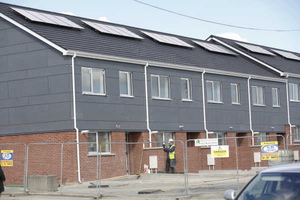
Modular housing in Ballymun

In a post yesterday Social Democrat Fingal County Councillor Cian O’Callaghan asked a series of questions about modular housing.

Further to this, building and construction forum BRegs Blog have compiled fact-laden responses to Mr O’Callaghan’s questions [below].

Meanwhile, during a report on RTÉ’s Six One news last night journalist Mark Coughlan reported that the modular homes could end up costing €243,000 per unit, more than twice the €100,000 figure originally earmarked..

Grab a tay.

Cllr Cian O’Callaghan: How much faster will these homes be delivered than conventional housing?

BRegs:  They will not be any faster than conventional housing as the houses being built at Ballymun are conventional housing. The housing at Ballymun has taken six months to complete which is average for traditional housing of this scale.”

Time was saved in the design stage by side-stepping planning laws (there was no public consultation), side-stepping procurement rules and side-stepping building control laws by starting on site before it was legal. There will be costs and delay for all of this in any future phases.

O’Callaghan: What was the final cost of the rapid build homes at Ballymun and what is the full breakdown of these costs?

BRegs: According to Dublin City Council (DCC) the final account has not been agreed yet. It is unclear who will be liable for costs of the programme overrun of at least four months. This could be very expensive if DCC made changes to the contract after it was awarded.

The original contract figure, agreed by DCC and the Department of the Environment, of €5,340,775.00 for the 22 houses equates to a cost of €242,762.50 per house.

This figures excludes any site purchase cost, planning application costs, development levies, or developer’s profits. Comparable, index construction costs are €100,000 – €140,000 for this type of social housing.

Although we are not aware of site costs in Ballymun, 29 ‘rapid’ units are planned for a site in Drimnagh which was purchased by DCC for €3.5m. This suggests a per unit site cost of €120,000, and eventual total cost including site of over €360,000 per temporary unit.

O’Callaghan: “At what point was the idea of lower cost modular homes replaced with rapid build housing? Why? What is the rationale for the construction of hybrid modular/ wet build housing?

BRegs: Only Dublin City Council (Housing and Residential Services) can answer this question. It appears that only one tender was received for the ‘modular housing’ from Western Building Systems Ltd. who were awarded the contract .

The bar for who was allowed to tender was set very high at a €10m turnover. The tender also demanded a four-week construction programme in bad weather which was seen by many to be totally unachievable. This may have been the deciding factor if the tender proposed ‘rapid-build’ although there is nothing rapid about the housing at Poppintree in Ballymun.

O’Callaghan: What is the guarantee on these homes? What is their expected life span? Is it any different to conventional housing?

BRegs: The tender documentation specified a 60-year life span. The Certificate of Compliance and Completion from the Assigned Certifier is thought by some to be a guarantee. DCC Tender documents require the builder to sign-off on all statutory regulations.

This is of concern as it suggests no independent oversight or inspections of the quality and safety of the units provided. DCC could sue the contractor and/or the Assigned Certifier if there is a defect, if they are still around and they can prove a case.

O’Callaghan: Will a cost effectiveness analysis be undertaken to compare rapid build housing with other methods of housing delivery?

BRegs: There should be but there probably will not. Proper modular housing is more expensive than traditional housing but its inherent advantage is in being able to supply housing rapidly to meet short-term emergencies and being reusable at other locations.

There could be economies of scale if they set up the contracts to maximise value and spent adequate time designing the units and prioritising quality and value for money.

Government departments are reluctant to provide details of PPP’s and public tenders, even though all tenderers are party to this information. A reluctance to provide accurate cost information puts all other future tenderers at a competitive disadvantage, and makes public scrutiny of ‘value for money’ impossible.

O’Callaghan: What is the estimated cost per unit when larger economies of scale and competitive tendering is introduced to the process?

BRegs: There is no guarantee that there will be any economies of scale. In fact there is a risk that parceling together big contracts will reduce competitiveness and maintain high costs because only a few large bidders will be able to take part (similar to the vulture funds purchasing the large NAMA portfolios).

The successful contractor will then be able to squeeze lower prices on the sub-contractors because he will control the market. This risks reducing quality while increasing the margin for the contractor.

It is unlikely that the cost of ‘rapid’ housing will reduce by 50% to resemble average costs of more traditional forms of construction, even if built at significant volumes.

O’Callaghan: What capacity level within the sector in Ireland is needed to reach an optimum level of delivery in terms of cost effectiveness? Is the goal to reach this optimum level of delivery and if so when?

BRegs: There is plenty of capacity in the smaller domestic builders and trades, if they can compete. Standard models of procurement on smaller sites can yield significant economies due to increased competitiveness.

The high threshold of turnover specified in the next four projects, between €7m and €12m, precludes participation by a large proportion of willing and able small to medium sized contractors.

O’Callaghan: “Given the fire safety problems that emerged with a rapid build school in North County Dublin; what measures are in place to ensure that such problems do not occur with rapid build housing?”

BRegs: The quality control and safety checks in the Ballymun housing is controlled by the contractor, because that is the way that DCC has set it up.

The houses will be inspected and certified privately by people engaged by the builder. The rapid build school that had fire safety problems was built by the same company that is providing the rapid houses in Ballymun.

Our current system of ‘reinforced self-certification’ is just that – self-certification by contractors of their own work with no independent oversight.

Recent experience of defective ‘rapid’ build schools suggests that in the event of a defect later on the state, remarkably, will bear the costs of repairs.

Thanks BRegs Blog

Previously: Rapid Questions

Rollingnews

caoimhinbyconkelleher

Caoimhín O’Raghallaighplaying Carlow and Cóbh this month

Here’s what you may need to know…

1. Plying his craft on a 10-string violin known as the hardanger d’amore, Caoimhín treads the world’s stages as part of a variety of duos, as well as with trad outfits The Gloaming and This Is How We Fly.

2.
Among these stages have been the Sydney Opera House, London’s Royal Albert Hall, and the Lincoln Centre in New York..

3.
O’Raghallaigh recently became the artist-in-residence at the National Concert Hall, Dublin and will be working with collaborators on monthly live shows ’til June. All the info here.

4.
Among a spate of upcoming gigs with The Gloaming and his NCH residency are a smattering of once-offs, including a May 14 show in Visual Carlow with Iarla O’ Lionáird, and a solo show on May 23 at Cobh’s Sirius Arts Centre.

Verdict: A unique instrument with rich, droning tones is Caoimhín’s tool of trade, and his mastery of it is testament to a true artistic calling, as he, among others including his The Gloaming bandmates and contemporaries, write a new chapter in trad’s history.

Caoimhín O’Raghallaigh

SeanadChamber_800-750x400anne-marie-291x300

From top: Seanad Eireann; Anne Marie McNally

Are you are one of the lucky ones who can cast your vote in the upcoming Seanad election?

Make it count.

Anne Marie McNally writes:

It’s almost election time again. No matter what Bill and Ben decide in the big room of chats, there will be an election in the coming weeks – an election to elect national legislators who will preside over the passage of legislation that will impact on both the country as a whole and your life personally.

The catch here is this; unless you are one of a handful of elite graduates from select institutions then you will not get the chance to that vote in that election.

Yes, you guessed it, it’s the Seanad election.

To be clear, even if a General Election is called we will still have to go ahead with the current Seanad election and then following the General Election there would be yet another Seanad election with the same process. The Seanad election MUST take place within 90 days of a General Election being called.

Two years ago there was a referendum put to the people as to whether to keep or abolish the Seanad. The third (& seemingly most favoured option) which was not put to the people was to maintain the Seanad with dramatic reforms to the institution itself and to the process which ‘elects’ the institution.

Two years since that referendum we stand poised to have another run of the Upper House with absolutely zero changes to either the institution or the electoral process associated with it.

Of the 60 members who will sit in our Upper House, 11 will be nominated by the Taoiseach (whomever that may be!) six  will be elected from the University Panels – consisting of just two universities – the National University of Ireland and the University Of Dublin (Trinity).

Each of those two institutions will elect three members to make up the six University members of the Seanad.

Feeling represented yet?

The remaining 43 ‘panel’ members of the Seanad will run on the panel where they supposedly have ‘knowledge and practical experience’ on the subject of the panel.

It’s not clear if being a rejected General Election candidate qualifies you but it appears so judging by the candidates for the upcoming panels).

The panels are as follows:

-Cultural and Educational Panel
-Agricultural Panel
-Labour Panel
-Industrial and Commercial Panel
-Administrative Panel.

Now here’s the real rub…you may be thinking ‘OK I didn’t attend either Trinity or NUI but I can choose my legislators on the general panel elections…’

Not unless you are either (a) a member of the incoming Dáil (b) a Member of the outgoing Seanad –the irony! Or (c) an elected Councillor on either a city or county council.

So unless you’re one of a very select few who went to either of the ‘chosen’ Universities or an elected official (or a Senator vacating your seat!) then you will not have the opportunity to have any say whatsoever in the election of the 60 people who will sit in the Upper House of our Oireachtas.

Now you may console yourself by saying things like ‘ah sure they’ve no power anyway’ and for the most part you wouldn’t be far wrong however if we want an Oireachtas and a legislature that is truly representative of the citizens and that is for and of the citizens then we cannot sit back and allow the Seanad to continue in its current form.

We should not accept that 60 undemocratically elected people will spend the next few years (or months depending on the political landscape) coasting along on very nice salaries and expense accounts while being cushioned by the ‘there’s not much we can do anyway’ argument.

That’s why when you (if you are one of the very few lucky ones who can) cast your vote in the upcoming Seanad election then vote for someone who is not satisfied to hide in the shadows for the next lifespan of the Seanad.

Elect someone who is prepared to stand up and challenge the status quo both inside and outside the Upper House,

Someone with genuine background on the panel they are running on or someone on the University panels who has raised their voice for change against the odds rather than the high-profile politician who’s using a branch of our democracy as a stepping stone or a layover on their political career.

Anne Marie McNally is a founding member of the Social Democrats. Follow Anne Marie on Twitter: @amomcnally

CcOu3Z1WIAA9JKh

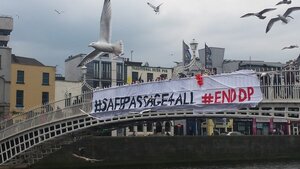
A banner placed on the Ha’penny Bridge in Dublin in February, calling for safe routes for people seeking refugee protection

Lecturer in Geography at University College Cork Piaras Mac Éinrí writes:

I don’t want to go into too much detail so as not to identify any parties, but I heard some truly disturbing stories today about the Department of Justice and Law Reform’s handling of such issues as family reunification for Syrian refugees.

A case in point: the woman in Syria who wanted to join her family in Ireland and who was obliged to travel at extraordinary personal danger and expense in order to obtain an identity document for onward travel, only to be informed that it would not be acceptable.

Assurances were given by Frances Fitzgerald, inside and outside the Dáil, that Ireland would be generous about such matters.

The reality is that a paltry number of individuals and families (I think approximately 20 individuals) have been accepted from Lebanese refugee camps in the past several months, while the bigger relocation programme, announced with much fanfare and whereby 4,000 people were to be accepted from overcrowded ‘hot spots’ in Greece and Italy, appears to be completely blocked.

A particular feature of the Department’s current approach seems to be that, even when people are brought in through UNHCR-brokered programmes, it is all done in virtual secrecy.

I met one Syrian family in Mallow a few weeks ago, as I wrote on Facebook at the time, as they had accidentally met up with friends of mine here who had themselves lived in Aleppo.

There are eight Syrian families in Mallow now – there is no security issue, or need for confidentiality, or anything else. Yet it has taken weeks to put them in touch with people who can help them, speak their language, provide them with the most basic assistance.

What is this about, if it is not an obsessive concern with control and an excessive wish to block anyone from civil society from offering help and support?

I have no doubt where much of the fault lies.

In all the changes which have taken place in government (and governance) in this country in the past half-century, one department remains virtually untouched. The Department of Justice has ‘captured’ virtually every minister appointed to it over the decades (I was told today that, for all of his faults, the only exception was Alan Shatter – he initiated a one-off programme of his own for Syrians and the civil servants hated it).

Their securocratic obsessions and slavish subservience to British policy (in the name of protecting the Common Travel Area), as well as their stubborn refusal to engage with other stakeholders, shows that nothing has changed.

My own experience as a civil servant in the 1980s was of dealing with a close-minded, bigoted, sometimes racist and utterly intransigent mindset.

Contrast this with the change in other departments, who now engage actively with other stakeholders – Foreign Affairs and the development policy community are a case in point.

Remember the Hungarians who came in 1956.

They were treated so badly by official Ireland that the vast majority could not wait to move to Canada, a country which offered them a real welcome.

Ironically, the camp where they were (literally) detained, Knockalisheen in Co. Clare is, perhaps not surprisingly, now a Direct Provision Centre. A kind of ‘no-place’ for invisible people.

The Department hasn’t changed since then; as far as I am concerned they have blood on their hands.

But ordinary Ireland has and stands ready to accept refugees in some numbers and make them welcome.

The twin new dangers now are that an absence of government makes ongoing paralysis ever more likely and a possible Brexit will lead to new talk of border controls and craven assurances from our securocrats that even greater care will be taken to prevent ‘undesirables’ from entering this jurisdiction in case they might attempt to use it as a back door to the other place.

I know that the big picture must be addressed and the war must be stopped. This will require greater efforts from the international community than have been evident to date.

In the short term, with Russia pursuing its own agenda, the USA convulsed by the run-up to the presidential elections and an incumbent lame duck and the EU fragmented and divided in several ways, there is little to hope for.

Already there are signs of multiple breaches of the ceasefire supposedly in place.

But, in the meantime, we have a role to play in our own small way and Ireland is in flagrant dereliction of its duty.

Please write to your TDs, if nothing else.

If you have the time and the energy, join an NGO/activist group, tell your students or school pupils about the situation, contribute funds to people providing support.

Syrian refugees in Ireland now (Piaras Mac Éinrí, Facebook)

Thanks Mark Malone

279287

What you may need to know:

1. When a mad scientist threatens New York, a group of mutated turtles and a talking rat emerge from the shadows to protect their home.

2. You know, for kids.

3. They can’t all be winners.

4.
Back in 1987, the first animated series was produced in Dublin by Jimmy Murakami.

5. Of course they were “hero turtles” back then. It was assumed that the word “ninja” would result in kids killing each other with nunchucks and katanas.

6.
Broadsheet prognosis: Leonardon’t.

Release Date: June 3.