


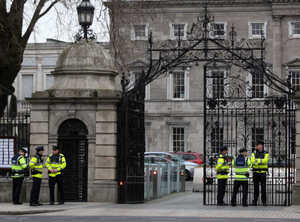
This afternoon.
Kildare Street, Dublin 2
Increased security and Garda presence around Leinster House following the explosions in Brussels, Belgium this morning.
Sam Boal/Rollingnews



This afternoon.
Kildare Street, Dublin 2
Increased security and Garda presence around Leinster House following the explosions in Brussels, Belgium this morning.
Sam Boal/Rollingnews

From top: Construction at Poolbeg, Dublin; Michael Taft
Strange things are going on
As the economy gains momentum, investment is actually declining
Michael Taft writes:
During the Cold War, lack of reliable information about Soviet Union politics forced Western analysts to seek out alternative signs and portents: the removal of portraits, the rearranging of chairs, positions at the reviewing stand for May Day parades, the choice of capital letters in official titles, how many times a Politburo member’s name was mentioned (or not mentioned) in the official press.
This was called Kremlinology. The Germans had another term for this – Kremlin Astrology due to its vagueness and ambiguity.
The Irish economy is not a million miles away. The official data is there aplenty but it is telling us less and less about what’s really going on. For instance, we have the fastest growing economy in Europe. But as we saw here, employment growth is rapidly falling off. What does that tell us?
Here’s another sign and portent: investment. In this post I charted the long-term investment deficit – a deficit that didn’t get much attention in the general elections debate (scratch that; it got no attention at all). Yet investment is the fundamental driving force in long-term sustainable growth.
When we look at recent investment level we find an even stranger thing going: as the economy gains momentum, investment is actually declining. Just as we did previously, we will look at investment excluding Intellectual Property (IP).
IP inflates investment numbers without necessarily contributing to growth. Multi-nationals are re-locating IP activity into Ireland from tax haven locations. But to what extent this is making any real contribution to growth-generating activity is open to question. In 2013 70 percent of industrial R&D investment came from just three companies.

In the first three quarters in 2015 investment rose by 28 percent over the first three quarters in 2014. This is consistent with high economic growth. However, when you strip out the IP – which has minimal impact on real economic growth – investment actually fell by over 8 percent.
This was during a period when GDP and GNP growth was enjoying double digit numbers.
We can get a sense of this by looking at the raw numbers:
Total investment rose by €6.8 billion
Construction investment rose by €270 million
Machinery and equipment fell by €1.8 billion
Intellectual Property rose by nearly €8.6 billion
When you strip out IP, investment in the economy fell by €1.8 billion over this period.
Not all economic activity in IP is due to accountancy practices or transfers by multi-nationals.
There is real activity here bringing benefit to the economy. But how much? It is difficult to even guess. However, this gives us some idea.
IP makes up 20 percent of all investment in the EU-15
IP makes up 47 percent of all investment in Ireland
So go figure.
We should expect investment to rise in the future (when IP is stripped out), mostly due to a rise in construction investment. Investment in dwellings remain depressed, both in the private and public sphere as we are aware of.
However, a key category is the machinery and equipment items – tangible assets. If this category continues to fall or stagnate this is a sign of a business sector that is not expanding.
In short, despite growing GDP we have falling investment and falling employment growth. And here’s one more curve, as pointed out by a good friend who keeps an eye on these things.
In the first two months of the year, income tax rose by nearly 9 percent over the first two months of last year, consistent with rising employment and weekly income. However, PRSI receipts fell by 6 percent.
This seems contradictory as PRSI is levied on PAYE and self-employed income.
There are a couple of explanations for this – notably that the Department re-allocates these monies later in the year. This would mean lower income tax revenue but higher PRSI revenue to the extent that they dovetail. We’ll keep a watch on that.
In fact, you have to keep an eye on so much and not trust headline numbers. You have to read what’s below the numbers. You have to read the runes, the entrails, the signs and the portents. You have to become an ‘econologist’.
Michael Taft is Research Officer with Unite the Union. His column appears here every Tuesday. He is author of the political economy blog, Unite’s Notes on the Front. Follow Michael on Twitter: @notesonthefront


They drew a spaceship.
Alan O’Regan writes:
Seen in the Liberties [Dublin 8]. Been there for weeks. Free career advice too.
Just your average day in tallaght. The View from the 77a. @JOEdotie @broadsheet_ie pic.twitter.com/lLCSKbyKls
— collie ennis (@collieennis) March 22, 2016
Wait for it.
Anyone?

Cars blocking a JCB from entering a field to work on a site earmarked for Travellers who were left homeless following a fire at a halting site in Carrickmines last October
Travellers—Ireland’s only indigenous ethnic group—have existed for centuries, though there is no academic consensus on when the community became distinct. They have their own language known as Cant, which seems to be a mix of Irish, English, Hebrew, Latin and Greek.
Historically, they lived in caravans in encampments on the side of the road or in fields. But today, most of Ireland’s 30,000 travellers live in houses permanently or reside in halting sites, especially built to accommodate mobile homes. Here, they exist in an uneasy balance, neither properly settled nor free from a long history of marginalisation and discrimination that has led to high rates of poverty.
Many halting sites, including the one in Carrickmines, are supposed to be temporary. The living conditions in them are often poor, with overcrowding, poor sanitation, little access to water and electricity.
Despite underperforming at school and an unemployment rate of over 80%, travellers seem to have borne the brunt of austerity: between 2008 and 2013 the community experienced cuts of 85% on housing and education schemes.
Their health is also woefully poor: traveller men live 15 years less than settled men and women live 11 years less than settled women. The suicide rate is six times higher than the rest of the population; the infant mortality rate is of 14.1 per 1,000; in the settled population average is 3.9 per 1,000.
And travellers make up a disproportionate percentage of the prison population. Men are between five and 11 times more likes to be imprisoned than settled men while traveller women are 18-22 times more likely to be behind bars.
How Ireland’s traveller community remains on the margins (The Economist)
Previously: Worth The Licence Fee

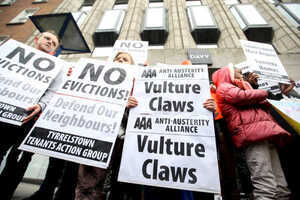


This morning.
Dawson Street, Dublin 2
Tenants and supporters of residents of the Cruise Park housing estate in Tyrrelstown, north Dublin, who are facing eviction, gathered outside Davy stockbrokers before marching on the Dáil in protest at their treatment by property vulture funds.
The Tyrrelstown Tenants Action Group was set up after the Sunday Business Post reported that over 200 families renting in the estate could be evicted due to a deal between Goldman Sachs and indebted property developer Twinlite
Twinlite’s loans held on the estate were sold to the European Property Fund (EPF), owned by Goldman Sachs and administered in Ireland by Davey stockbrokers.
Sam Boal/Rollingnews

Last night.
On RTÉ2’s Republic of Telly with hosts Kevin McGahern and Joanne McNally and newcomer Edwin Sammon.
Sarah Neville writes:
Ever wondered what goes on during the ad breaks of ‘Today with Maura & Dáithí’? Republic of Telly had the full scoop…
Republic of Telly is on Monday nights at 9.55pm on RTÉ2.


A selection of Irish-made baby gifts from The Irish Workshop a platform for shoppers to buy directly from the workshops of Irish makers, designers and craftspeople.
1. Baby Blankets made from 100% lambswool by Foxford Woolen Mills in Co. Mayo
2. Blue Hippo made by Textile Artist Paula Byrne in Dublin. Limited edition
3. Little ABC Frame made by Little Tree Crafts in Dublin. Personalised
4. Celtic Ted designed by Celtic Gent in Dublin. Limited edition
5. Welcome Little One made by Bog Buddies in Co. Roscommon. Can be personalised
Charmiane Kenny, of The Irish Workshop, writes:
Ireland comes to life for St.Patrick’s Day, but it also creates life on St.Patrick’s Day. The data suggests that nine months after St. Patrick’s Day the average number of births in Ireland increases by about 10%. Now, how many of these Paddy’s Day Babies are called Patrick and Patricia? Perhaps we’ll tackle that question next year. Above are our top picks for Irish-designed baby gifts at the Irish Workshop:

Karl Deeter, of Irish Mortgage Brokers
You may recall how, back in April 2012, Karl Deeter, of Irish Mortgage Brokers, claimed that 25 per cent of people who were in mortgage arrears were lying or ‘strategically defaulting’.
This morning Mr Deeter joined Ruth Coppinger, Socialist Party TD for Dublin West, on Today with Seán O’Rourke this morning on RTÉ Radio One, to talk about social housing.
Grab a tay…
Karl Deeter: “The idea of social housing I agree with, I agree with helping poor people. I think that when people are down on their luck they should receive assistance. What I’d be saying is that the underlying performance of it matters. So, in the same way that we say we should have hospitals, that the hospital performance matters, I’m saying we need to do the same on housing and not just see more of the same as being a solution. And really the point I would be making is that people who are not well-off are not a static group. You don’t necessarily become poor and then stay that way for life. But the tenancy right to a social house stays with you for life, once you get one. And effectively it becomes a brand of middle class welfare because in many instances you’ve got people who aren’t well off who can’t access social housing but you’ve got people who are moderately well-off who are earning above average wage, living in these social houses, receiving what is effectively a very subsidised rent.
Sean O’Rourke: “But is there not, for many years, a differential rent scheme whereby people pay according to their means?”
Deeter: “Of course it has and when you look at the figures though, let’s just examine them, look at the two-bed houses – average rent on those is €62 a week. The average rent overall is about €59 a week. The highest rent being charged in all of Dublin city and lmost likely for a five or six-bed house is €228 a week which is about €990 per month. Now what I would say then, is when you look at the five-bedroom houses and six-bedroom houses on average, it’s €80 a week or €117 a week. Which is a price so good that you simply, it can’t be matched anywhere.
If you were to charge these rents, and look at it from an investment perspective, in other words that we want to see people to be getting good value for money and be sustainable and build more, you’d have to build these houses for about €40,000 which is just not achievable.”
O’Rourke: “So is it your belief then that the rent charged to people who are there, who maybe moved in initially on the basis of need and inability to buy their own houses that, if they become well-off or if they become better off shall we say, that they should be charged the market rate?”
Deeter: “I don’t see an argument for middle class welfare and that is very distinctly the point I’m making. I don’t believe you should take people who can afford to pay more for something and give them subsidies. Now people say ‘oh but they are means tested and there’s differentiations, etc’ but that, to me, still doesn’t get to the root nub of the issue.”
O’Rourke: “So would you..”
Deeter: “There’s a lot of people who are well able to afford more than the rent because, let’s not forget, and this is where the proof of it all lies. Many people in social houses get mortgages and buy those homes, ok? And they end up paying more on that mortgage than they were paying on that rent. So a) I already know from having done hundreds of these types of loans, there’s a greater affordability there…”
O’Rourke: “Should there be a threshold in which people are told, either buy or vacate?”
Deeter: “I’m not saying there should be because this is really more of a thought experiment. I’m saying that if we’re going to have a serious conversation about social housing that we should be wondering why we are basically accruing benefits to some people while there’s other people who are locked out. In a way you’ve got some people who are doing quite well and they’re almost like bed blockers in housing.”
O’Rourke: “We’ll come to Ruth Coppinger in a moment but are you saying or suggesting Karl Deeter that this might be a way of securing extra money to invest in the development or in the building of new social housing?”
Deeter: “I absolutely am saying that like the money has to come from somewhere and I think there’s a wider social housing conversation that needs to be had about increasing things like local property tax to fund social housing, rather than Part V which, in the last four years, in its best year it only delivered 16 homes. As well as that you could reduce perhaps, by having a better-run section, the numbers of evictions. Because there’s another thing that people don’t talk about. They come on and say ‘oh look at the market, there’s loads of people being evicted.’ The actual eviction figures for Dublin City Council, ok, show that within Dublin City, the city council evict more people in the banks or building societies in 2011, in 2012, in 2013 and I’m talking two or three times more. Other than 2015, it was the first time the banks evicted more people than Dublin City Council so there’s a lot of things in it that we never discuss. I’m saying we need to have this conversation.”
Listen back here
Previously: Karl Deeter: Up To 25% Of Those In Mortgage Arrears Are Lying
