Category Archives: Misc

eskies

The Eskies in happier times

Money, gear and a family-sized pack of travel beard trimmers.

All gone.

Ed Cahill writes:

I know you don’t normally do this, but everyone’s favorite gentlemen’s gypsy folk band The Eskies had some gear and their European tour takings to date stolen in Milan yesterday,

Full story from the guys here. There’s a GoFundMe page up and running [see link below] and it’d be great if people could show the love. Up The Parish

Help The Eskies (Gofundme)

Previously: You May Like This: The Eskies

Screen Shot 2016-03-16 at 12.52.19Screen Shot 2016-03-16 at 12.40.36

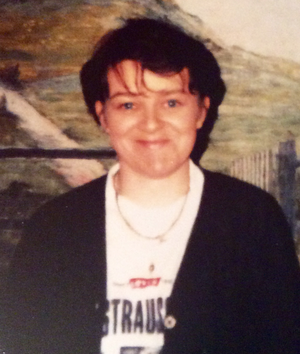
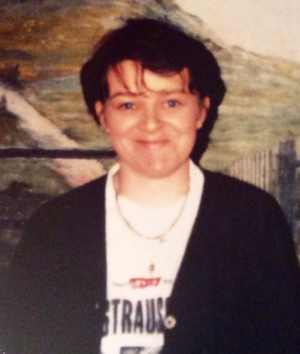
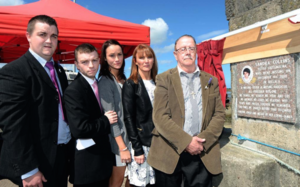
From top: Sandra Collins; Sandra’s brothers and sisters David, Patrick, Mary, Bridie and stepfather Joe at the unveiling of a plaque in honour of Sandra in Killala, Co. Mayo in August last year

Sandra Collins was pregnant and ten days shy of her 29th birthday when she was last seen outside a chipper in Killala, Co. Mayo, at around 11pm on the night of Monday, December 4, 2000.

At the time of her disappearance, Sandra was a full-time carer of her aunt Ann O’Grady, who suffered from arthritis and whom Sandra lived with in Killala since 1988.

Sandra’s mother, stepfather and siblings lived about 15 kilometres away in Crossmolina.

On Friday, December 1, 2000, Sandra’s GP confirmed to Sandra that she was pregnant but Sandra asked for another test to be carried out. Sandra phoned her GP on Monday, December 4, 2000, for the result of the second test which was positive.

Throughout the morning and early afternoon of that Monday, Sandra was seen, looking upset and agitated, while making – and possibly receiving – numerous phone calls from a phone box in Killala.

Later that evening on December 4, 2000, Sandra had left her aunt’s house at around 7.30pm to buy sausages in a local shop – for her and Ann – and called into an elderly neighbour, William Johnston, to see if he needed anything from the shop.

Sandra went to Birrane’s shop – a five minutes’ walk from Ann’s house – where it’s understood she bought firelighters, bread, milk and sausages.

Then, hours later, at around 11.05pm, Sandra walked into the Country Kitchen chipper on George Street in Killala where she bought a large bag of chips. She was last seen leaving the chipper at around 11.15pm.

The whereabouts of Sandra between 7.30pm/7.45pm and 11.15pm are unknown.

Five days after she disappeared, on Saturday, December 9, 2000, a pink fleece belong to Sandra, and worn by her on the night she went missing, was found by the Old Pier in Killala – with a packet of sausages in one of the fleece’s pockets.

Two pieces of paper were also found in one of the pockets – one with the phone number of Martin Earley and the other which had numbers of abortion clinics in Britain.

Although her body has never been found, Sandra’s family believe she was murdered; that some people from the area know who killed her; and that the fleece – and sausages – were placed at the pier to make it look like Sandra had taken her own life.

Plasterer Martin Earley, from Ballina, was charged with Sandra’s murder in December 2012. Mr Earley, by then aged 50 and a father-of-three, denied the charges.

After an 18-day trial at a Castlebar sitting of the Central Criminal Court in 2014, Mr Justice Patrick McCarthy directed the jury to acquit Mr Early due to insufficient evidence.

During the trial, the court heard Mr Earley had initially denied having had a relationship with Sandra but, in 2001, admitted to gardai that he had had sex with her on December 1, 2000 – three days before she disappeared.

It also heard that Sandra had spoken to Mr Earley by phone on the day she disappeared and asked for £1,000 from him to have a termination.

The trial also heard evidence from Michael Granahan who said Mr Earley, in March 2011, told him he had met Ms Collins in Killala on the night she went missing and that they had argued before she fell into the water by the pier in Killala.

Mr Granahan said Mr Earley said he didn’t jump in to save Sandra as he couldn’t swim.

Mr Early was married with an 11-month-old child at the time of Sandra’s disappearance.

Sandra was the eldest of six children in her family.

Her mother Eleanor and father Francie – who died in 1978 – had three children, Sandra, James and Bridie. Eleanor met and remarried Joe Collins in the mid-Eighties and they had three children, Patrick, David and Mary.

James died at the age of 26, following a workplace accident in a factory in June 2000, just six months before Sandra disappeared.

Since her disappearance, Sandra’s mother, father and aunt have also died.

Eleanor died of cancer, aged 53, in 2004, Ann O’Grady died, aged 47, in 2009 and Joe Collins died, aged 70, also of cancer, on February 22 last.

Today, Sandra’s brother Patrick, who shares the same birthday as his late mother, turns 29.

He says it was his father’s dying wish that Patrick and his siblings find Sandra’s remains.

Patrick says:

One day after Christmas, when Daddy’s condition had deteriorated, he said to me, ‘will you promise me something?’ and I said, ‘I will’. He said, ‘Will you find her?’. And I said, ‘Who? the nurse? do you want me to get the nurse?’. And he said, ‘No I’m not talking about the nurse. I want you to promise me to find Sandra. If I die, and I’m not here, don’t you ever give up looking for her, until you find her. I want her bones.’”

“On the night he died, we held his hand until he took his last breath at quarter to three in the morning in Mayo General Hospital. We told him we loved him, we held his hand until literally the life was drained out of him. We told him we loved him and to tell Mammy, James and Sandra that we loved them and to help us and give us the strength to find Sandra.

We just want to find her, we don’t want to send anybody to jail. I don’t want to ruin anybody’s life. If the person that murdered Sandra knocked on the door and said, ‘hello’ and I answered the door and they said, ‘here’s your sister’ and she was in a bag and they walked off their way, I would walk off my way. Then I could ring the funeral director and wake her here, like we have wanted to do for so long.”

He added:

I believe there’s people in Killala covering for Sandra’s killer. Do they know what they’ve done to me and my family, how they’ve destroyed us? I’m begging for them to come forward, anonymously if they wish. There’s no need for anyone to get into trouble.”

“Have they lost anyone belong to them? Then gone home and tried to keep this fight going, and felt the pain of being in grief and not being able to move forward? Going to bed every night, wondering will it be tomorrow, will I find her tomorrow?”

“When I sit down and I actually think about it, it takes my breath away to think that this day 65 years ago my granny was bringing my mum into the world and, 29 years ago, Mammy was here and she was pregnant with me. Mammy was here, Daddy was here, James was alive, Sandra was alive, my aunt whom Sandra minded was alive. That’s six people who’ve died and they’re all gone. This house was full. ”

I’m not out for vengeance. I don’t know which is worse – Sandra being murdered and being taken from us forever or the fact that they’ve hidden her body and we’ve been on this search for the past 16 years. We need to bring her home.”

“It doesn’t even have to be all of her. I know that might sound strange to people but if we got one finger or a thumb. Is there a swinging brick where a heart should be?We do believe that Sandra’s killer has feelings, that these people have feelings.”

Anyone with information may call the missing person’s helpline, 085 2092119 or contact Patrick via Broadsheet@broadsheet.ie


90412298rory

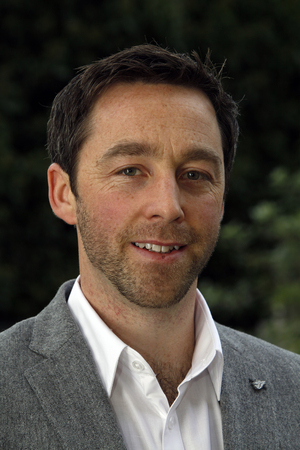
From top: The Cruise Park housing estate in Tyrellstown in West Dublin, whose developers’ Ulster Bank loan was bought in 2014 by a Goldman Sachs vulture fund; Dr Rory Hearne

Homeowners and tenants need protection from vulture funds such as those owned by government advisors, Goldman Sachs.

Dr Rory Hearne writes:

There needs to be an immediate suspension of the sale of Irish housing loans to the vulture funds and emergency legislation to protect tenants and those in mortgage arrears from eviction.

There is also a need to investigate the role of Goldman Sachs, the vulture fund involved in evicting residents of Tyrrelstown, in advising the Irish government.

Goldman Sachs is a multi-billion dollar US multinational investment fund company. It is involved in more ways than we realise in Ireland. Beltany Property Finance is the Goldman company involved in the Tyrrelstown development and it bought the loans in 2014 from Ulster Bank.

Goldman also played a key role in advising successive Irish governments on the restructuring of the banks from 2008 to 2013 (for which it was paid  €8million), and it is still contracted by the Department of Finance to advise it on the potential sale of AIB.

Surely there are potential issues of ‘conflict of interest’ and the profiting from ‘insider knowledge’ here?

Goldman could have gained intimate knowledge of the properties and assets held on the loan books by the Irish banks such as Ulster Bank. Goldman, as other vulture funds, tend to make significant profits from buying these ‘toxic’ or ‘distressed’ loans at discount prices and then selling them on when the markets rise – as is going on now in Ireland.

Questions need to be asked about why Goldman Sachs remains in such a prominent position advising the Irish government on the restructuring of the Irish banks. Especially given this clear conflict of interest where Goldman can profit from this intimate knowledge it gains of the restructuring of these very same Irish banks.

Is it because of the close relationship between Goldman Sachs and governments?

For example, Mario Draghi, President of the European Central Bank, is a former employee as was the Treasury Secretary in the US. And then there is Peter Sutherland, recently retired Chair of Goldman Sachs, who is a leading member of the political establishment in Ireland.

Haven’t we seen disastrous outcomes from this close relationship between politicians, financial institutions and property before?

Goldman Sachs was actually charged by the US Securities and Exchange Commission for its role in causing the 2008 financial crisis – directly linked to its role in the subprime housing mortgage market.

Goldman, profited from, and played a role in causing, the 2008 financial crash and the 2010 European debt crisis. Rolling Stone magazinehas called Goldman “the giant vampire squid” for its vampire like profit squeezing from economies and the devastating impact on ordinary people’s lives.

And yet it continues to hold huge influence over governments?

It begs the obvious question. Why would you ask a financial investment fund, who have consistently shown that they will always act in ways that are most profitable to them, for advice on an economic and social crisis like our banking and housing crash?

You only ask investment funds like those if you want to know how to maximise the interest from vulture funds in buying up distressed properties and assets.

And this is the heart of the explanation of the current situation in Tyrrlestown and our ever worsening housing crisis.

It is the thinking that underpinned the decisions taken when the Irish housing market and banks collapsed and the scale of the losses and mortgage arrears crisis became apparent.

Government and policy makers focused on removing the ‘problem’ of toxic housing loans from the bank’s balance sheets in order to save the banks and help them return to profitability and ‘healthy status’ as soon as possible.

This was the priority in policy decisions. The impacts on home owners and renters living in the houses and any future housing crisis, was a distant consideration.

Policymakers knew (thanks to the advice from the likes of Goldman) that the non-bank funds buying these loans (bundles of mortgages) would be mainly interested in high rates of profit and making that as quickly as possible by selling off the property as soon as the housing market would recover.

So the result was the ‘pillar’ Irish banks (and European financial system) were ‘saved’ by the taxpayer bailouts and the sale of distressed toxic loans (i.e. developer’s loans –land and thousands of houses like Tyrrlestown) to various vulture funds and subprime housing companies.

The price for this policy is now being paid by the families losing their homes in Tyrrelstown and the tens of thousands more who will face a similar situation in the coming months and years as receivers, banks and vulture funds all look to profit from a rising property market.

The other associated price for this approach is the escalation of rents and the homeless crisis which arises, in part, from the failure to introduce rent control. Rent control would have reduced the interest of vulture funds in buying up Irish distressed property and that explains the political coolness towards it.

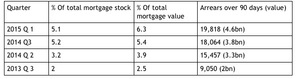
The scale of the increase in ownership of Irish housing, particularly mortgages in arrears, by non-bank vulture funds is staggering. My analysis of central bank figures shown in the table below reveals that these ‘non-bank entities’ (vulture funds) now hold 47,461 mortgage accounts.

And of these 19,818 are in arrears of more than 90 days, with 13,050 of these in arrears over 720 days. Therefore, these funds hold almost 25 per cent of all mortgage accounts in arrears of more than 720 days.

Their increasing role is shown by the fact that they have doubled their holding of the total Irish mortgage stock in just two years from just 2% of the total stock in 2013 to 5% in 2015 (6.3% in value terms).

graphThe growth in Non-bank entities (vulture funds) in holding Irish housing 2013-2015

Something can be done to change this and protect people in their homes from the vulture funds. It requires the government temporarily suspending all further sales and repossessions of housing and loan books including Irish residential property by either NAMA or the banks.

A new housing and homes agency should be immediately set up to purchase these distressed properties and work on solutions that protect the tenants and homeowners in their homes.

Furthermore, emergency legislation is needed to strengthen tenant’s rights to enable them stay in their home, and rent control is required to avoid economic evictions of tenants.

Finally, the Department of Finance and other government contracts with vampire vulture squid, Goldman Sachs, should be ended immediately.

Dr Rory Hearne is a policy analyst, academic & social justice campaigner. His column appears here every Wednesday. Rory is an independent candidate for the Seanad NUI Colleges Panel. He writes here in a personal capacity. Follow Rory on Twitter: @roryhearne

focus

At the Aviva Lansdowne Road Nua

Daniel Eastbury writes:

Three Ireland announced before this year’s RBS 6 Nations that it was giving Focus Ireland a million Euro marketing campaign entitled “Together we can Tackle Homelessness”. Reflecting on the campaign to date, Irish rugby star and Three ambassador, Johnny Sexton, alongside Irish head coach Joe Schmidt and former team kit man Rala gave their thoughts to Roisin McDonnell of Focus ireland.

Focus Ireland

10500282_474106419391785_6585497208089379174_n

OTHERKINI Was Born

01. Claiming equal influence from punk-rock’s grandfathers and ’90s alt-rock among other elements, Otherkin are a Dublin four-piece garnering a name for hard graft: at present, they’re touring Europe.

02. New single I Was Born very definitely skewers toward rock ‘n’ roll’s poppiest excesses, if not veering into garage-rock territory. Video directed by Finn Keenan.

03.
The band emerged in 2013 and quickly landed themselves on the Irish festival circuit, including Longitude, Electric Picnic, Hard Working Class Heroes and Other Voices, the following year. 2014 also saw them garner attention with the release of single Ay Ay, which landed them on Irish indie Rubyworks.

04.
The single is out on April 8, the same night as a headline show in Whelan’s in Dublin. Support from FANGCLUB and Wolff.

Verdict: Fans of classic power-pop and garage-rock will lap these lads up, even if their jams are a tad over-polished on record.

OTHERKIN

90411828
anne-marie-291x300

From top: Gerry Adams and Mary Lou McDonald with new Sinn Féin TDS on the plinth at Leinster House last week. Party members take the industrial wage and give the remainder to the party; Anne Marie McNally

Politicians not taking the full TD salary while diverting the rest to their political coffers are misleading the public.

Anne Marie McNally writes:

Politics in Ireland – it’s a mess. For myriad reasons but not least the bamboozling political funding process that throws up so many questions with very few straight-forward answers thus leading to another bona-fide reason to mistrust the political system in Ireland.

There’s a widely held view that there is golden pot at the end of the Dáil rainbow and a trough within which snouts are firmly placed.

This view is not helped by elected politicians who try to make a virtue from the fact that they’ll supposedly only claim half their salary. What those politicians aren’t so quick to tell you is that what they mean by that is that they WILL take their full salary but they’ll choose to give half of it to their political party.

It’s the equivalent of you saying that you are refusing to take your thirty or forty grand per year salary because you’ve chosen to give half of it to the local boozer on nights out.

You take the money and you do what you choose with it, that’s really irrelevant to the person paying your wages and in the case of politician’s that’s the tax payer.

The average industrial wage argument is does not and should not apply to political salaries. You are not paying average industrial workers; as citizens you should be expecting highly competent/qualified individuals willing to work 24/7 on the issues affecting the quality of people’s day to day lives. It’s no small thing.

The fact that in far too many instances we don’t get that quality of representation should not be used as a tool to denigrate the nature and the purpose of the role. Like any other profession the salary must be commensurate with the level of work involved and the importance of the role. If it is not then you are less likely to attract the best qualified people towards it.

I would personally argue that the salary is in no way a deciding factor for those of us who believe public service is a vocation rather than a career but the point remains that appropriate remuneration for what should be, if done correctly, an extremely tough job.

What level that ‘appropriate remuneration’ should be set at is an entirely different conversation but in the meantime it is important that citizens are not misled by politicians who give soundbites about not taking the full salary whilst taking the full salary and diverting some of it to a cause of their choice – in most cases their political party coffers.

Even less clear to the public is the way in which Electoral Acts funding works or even what it is and who is or isn’t entitled to it.

Any registered political party that achieves at least 2% of the national vote is entitled to party funding. Every percentage increase above that 2% increases the amount awarded.

Independents, whether part of a grouping or not, do not receive such funding. Any party that did not meet the 30% Gender quota target but achieved above 2% will have their funding halved – this applies to Renua for example.

Every elected Oireachtas member is entitled to ‘Leaders Allowance’ – Independent TDs are paid it directly while it is paid to Party Leaders in respect of every TD elected for that party, again the amounts differ depending on how many TDs the party has or whether or not it is in Government.

If a TD leaves their party between elections, the party continues to receive funding for them but the TD in question gets nothing – this clause can be more powerful than any Whip in keeping backbenchers silent when they disagree with party policy.

Expenses, allowances and all the rest is a conversation for another day but my point here is that citizens shouldn’t be misled by politicians who try to use the confusing nature of the Irish political funding model to convince them that they are only taking the ‘average industrial wage.’

Anne Marie McNally is a founding member of the Social Democrats. Follow Anne Marie on Twitter: @amomcnally

frenchpatrol

This morning.

Michale O’R writes:

218 years ago the bold men of the rising hoped for assistance from the French that materialised too late for the 1798 rebellion. 100 years after the the Easter Rising, the French patrol vessel Flamant (above) is escorted up the Liffey by the tug Shackleton. Things could get rowdy, this weekend…