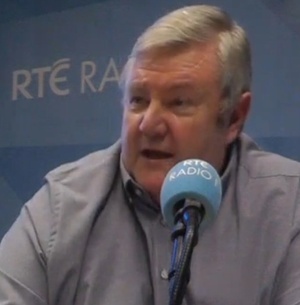
This morning.

Botanical Terrace, Iveagh Garden Hotel, Dublin.

Wellbeing coach, author and motivational speaker Alison Canavan (above left) and Vegan food blogger, author and fashion stylist Holly White (right) at the launch of Vitality 2019.

Vitality is Ireland’s largest natural health and wellbeing event, taking place on September 28-29 in the RDS Simmonscourt.

Vitality will bring together “leading Irish and international experts in natural health, nutrition, fitness, wellbeing and sustainability”.

*stares at cigarette*

Leah Farrell/RollingNews

From top: Derek’s Summer reads part 2; Derek Mooney

Leadership: In Turbulent Times by Doris Kearns Goodwin

Published late last year, this book from the doyen of American presidential biographers, Doris Kearns Goodwin, asks whether the leader make the times or do the times make the leader.

She does this by considering the backgrounds and life stories of the four US presidents she has written most about: Abraham Lincoln, Theodore Roosevelt, Franklin D. Roosevelt, and Lyndon B. Johnson and examines how they each came to recognise the leadership qualities within themselves and how they went on to use these in office.

It’s a fascinating examination of how political leadership once worked and suggests that it could be that way again. The other reason this is on my list is because I am a fan of Goodwin. I’d happily buy an anthology of her notes to the milkman, if published.

Alarums and Excursions, Improvising Politics on the European Stage by Luuk van Middelaar

The best critique I have read of this book is that it’s “…neither a partisan defence of the European Union nor a pessimistic prophecy of doom, but a cool analysis of the role of European institutional structures and of key personalities.” From what I have read of this so far, it is a far summation of Van Middelaar’s approach.

A former adviser to Herman Van Rompuy while he was the EU Council President, Van Middelaar writing is far more vibrant and engaging on paper than his former boss was in person.

First published in Dutch and then in French the title comes from an Elizabethan stage direction that prepared actors for an onstage skirmish and to make battle noises. “Alarums and excursions” according to the author, conveys “the feverish mood when action becomes imminent”. Not a light read, but an essential one for anyone interested in EU affairs.

Twitter and Tear Gas, The Power and Fragility of Networked Protest by Zeynep Tufekci

Published about two years back, this book from Zeynep Tufekci of the University of North Carolina, sometimes described as a scholar-activist, has been widely hailed as the definitive work on the power of influence of social media in modern protest movement. In the book Zeynep considers how the social media and the internet both helped demonstrations in places such as Turkey, Mexico and Egypt get off the ground but also makes them harder to sustain.

The headline on the Washington Post’s review of her book sums its message up well: “Twitter and Facebook helped spark protest movements then they undermined them.”

The Psychology of Social Media by Dr Ciarán Mc Mahon

The second book on social media on this list is this short and well researched volume from Dublin based psychologist Dr Ciaran MacMahon. It does – to use the hackneyed phrase – exactly what it says on the tin. It explains how and why so much of our daily lives have come to be saturated by popular and absorbing social media platforms.

Ciaran does this by first posing a series of questions and then answers each in precise detail with reference to various examples. The Psychology of Social Media explores how so much of our everyday lives is played out online, and how this can impact our identity, wellbeing and relationships.

It looks at how our online profiles, connections, status updates and sharing of photographs can be a way to express ourselves and form connections, but also highlights the pitfalls of social media including privacy issues.

An Act of God by David Javerbaum,

The good news about this book, it that you kind don’t have to buy it to enjoy it. The second fiction book on my list, it is less a book and more a multi-platform experience. It is a book, originally published in 2015, as The Last Testament: A Memoir, which has since been turned into a hilarious stage play. Both of these in turn are anthologies of the best posts from the twitter account: @TheTweetOfGod.

Written by a former head writer at The Daily Show with Jon Stewart it is God’s latest instalment of the Testaments (and Qur’an) based on his experiences of mankind over the last few centuries. Written in biblical verse (how else could God write?) he opines, over 400 pages, on every aspect of universe from updating the Ten Commandments to Simon Cowell and Caitlyn Jenner. You can get a flavour of the style from checking out the currently pinned tweet:

In an ideal scenario the President of the United States and the worst human being in the world would be two different people.

Future Politics: Living Together in a World Transformed by Tech by Jamie Susskind,

Possibly the heaviest and most demanding read on the list. It also carries the burden of being reviewed and highly recommended in the Irish Times last December by, Finance Minister, Paschal Donohoe. Notwithstanding this, Susskind’s book follows on from the two other volumes dealing with Social Media and is a must-read for anyone interested in the great political debate of the 21st century: how will digital technology transform society and politics?

Susskind approaches the debate with both the expertise of a lawyer and a deep understanding of the digital world. His analysis is informed by the maxim that “how we govern, store, analyse, and communicate our information is closely related to how we organise our politics”.
As much of our daily lives are governed by algorithms as they are by laws made in parliaments.

The issues of data collection, privacy and freedom are so closely intertwined in today’s world that discussion of one has significant consequences for the other, yet these are largely in the hands of private big tech firms. Yet, Susskind’s outlook is not dystopian, not least because challenges policy makers and opinion formers on how free societies can still retain control.

Yesterday: My Summer Political Reading 2019 (Part 1)

Derek Mooney is a communications and public affairs consultant. He previously served as a Ministerial Adviser to the Fianna Fáil-led government 2004 – 2010.  Follow Derek on Twitter: @dsmooney

Minister for Health Simon Harris

This morning.

Via RTE:

Correspondence obtained by RTÉ News has revealed that a private secretary to the Minister for Health wrote on 6 June to the woman whose case exposed the latest CervicalCheck crisis.

The letter to ‘Sharon’ says that: “The Minister for Health, Simon Harris, T. D. has asked me to thank you for your correspondence concerning CervicalCheck and would like to again apologise for any distress this delay has caused you and reassure you that this is a priority for his Department and the Health Service Executive (HSE).”

Last weekend, the department said that it became aware of the existence of an IT issue on 25 June through information supplied by the Health Service Executive.

Minister Harris has said the matter was first escalated to him last Wednesday evening, 10 July.

Minister’s office wrote to woman at centre of latest CervicalCheck issue on 6 June (RTÉ)

Previously: ‘I’m Still Kind Of Flabbergasted’

Rollingnews

On Monday afternoon, despite the tempting display of pastries piled on the counter, Luigi Massone’s café, Scoff, on Ranelagh’s main street was empty save for two small tables of customers.

Pointing behind him, just hours after new higher parking charges came into force in the Dublin 6 village, Massone said: “Look, the place is empty. It’s lunchtime. They changed a lot of rules. The business of everybody has gone down.”

Parking tariffs rose across the city on Monday. However, Ranelagh and Rathmines are among the districts most affected, seeing a 70 per cent increase in charges from €1.60 to €2.70 per hour…

‘Look, the place is empty’ – rise in parking charges hits Ranelagh businesses (Irish Times)

Oh.

Last night.

Prime Time on RTÉ One.

Emma Kennedy of Kennedy Analysis explains the amount of water that will be recovered through fixing leaks in the coming years will be offset by the projected growth in Dublin’s demand to the consternation of Independent TD Michael Fitzmaurice (top).

Shannon pipeline not needed if Dublin water leaks fixed, study claims (Irish Times)


From top: German Defence minister Ursula von der Leyden (left) with Joan Burton at an EU summit in Dublin Castle in 2013; Shane Heneghan

The last European summit in Brussels had a solution. A neat, gender balanced package was cooked up to occupy four of the main top jobs in the European Union.

The initial English language media reporting of this spoke as if the appointments- particularly that of the proposed new head of the Commission, Ursula von der Leyen- are a done deal. They are not.

It’s worth looking at the treaty in regard to the appointing of a new head of the commission. Article 17.7 of the Lisbon Treaty states-

“Taking into account the elections to the European Parliament and after having held the appropriate consultations, the European Council, acting by a qualified majority, shall propose to the European Parliament a candidate for President of the Commission. This candidate shall be elected by the European Parliament by a majority of its component members.”

This text has been interpreted generously by the Parliament to mean that the Council (the EU heads of government meeting in Brussels) should nominate one of the main groups “spitzenkandidaten” or lead candidates from the European election campaign.

A request that is very easily circumvented as European elections, by their very definition, cannot be conclusive.

But in nominating Von Der Leyen, the current German defence minister,- a name that has never been mentioned with regard to one of the main jobs in Brussels they have shown a certain level of contempt for the notion that the European Elections should perhaps influence the future direction of Europe.

If successful, Von Der Leyen would be the first Commission President not to have served as a Prime Minister of a member state since the 1980s and would arguably be one of the lowest ranking people ever to get this job.

She is widely regarded as being one of the weaker ministers (despite now being Merkel’s longest serving minister) in the current Berlin government – owing her success more to loyalty to Frau Merkel than ability and her appointment (just like that of Spanish Foreign Minister Borrell) to the Commission, opens up an extra slot for any upcoming reshuffles.

But the wheels are coming off the wagon.

Ms Von Der Leyen was in Brussels recently for hearings with the various different political groupings to get their support in Parliament. Both the Greens and the far-left groups have firmly said they will not be supporting her.

For the first time ever, the centre-right and centre-left groups do not have an overall majority by themselves in the European Parliament.

In principle, this deal was cooked up by representatives of these two groups plus the new liberal centrist group “Renew Europe” formed by President Macron and together, in theory, these groups should get her over the line.

However, it should be noted that the European Parliament does not have nearly as tight a whipping system as national parliaments.

The Socialist group is believed to be split along national lines, with even the German SPD having their doubts.

Greek Socialist MEP Eva Kalli is thought to have said that von der Leyen was tougher than former German finance minister Wolfgang Schäuble during the Greek economic crisis.

Even in von der Leyen’s own centre-right grouping there are those taken aback that their spitzenkandidat, in the form of the hapless Bavarian, Manfred Weber, is being overlooked.

To be elected, Ms von der Leyen needs an absolute majority- that’s the support of 376 MEPs. Jean Claude Juncker got 440 in his equivalent vote in 2014 and despite his nomination being considerably less controversial or unpredictable than this one, this number still fell somewhat short of what he was expected to get.

One scenario floating around Brussels is that von der Leyen may get less than 400 votes and preside over a handicapped Commission.

While the Commission remains the sole body that can initiate law at EU level, the vast majority of them can be both amended and rejected by Parliament and many in this very divided chamber may revel in the ability to throw a spanner in the works over the next five years.

The debate on Ms von der Leyen’s nomination starts today at 5pm Irish time in the European Parliament. Followed by a vote – by secret ballot.

Should the unthinkable happen and Von Der Leyen fail to be approved this will require someone else to be nominated at yet another summit.

Shane Heneghan is a Brussels-based writer and academic. Follow Shane on Twitter: @shaneheneghan

Pic: Getty


Yesterday.

Lenny Traynor, from Ballyfermot (permission given), interacts with a mural of Brendan Grace in the Liberties, after the comedian’s funeral in the Church of St. Nicholas of Myra, Francis Street, Dublin.

Yesterday: Meanwhile, in The Liberties

 Eamonn Farrell/Rollingnews


From top: Taoiseach Leo Varadkar and Minister for Finance Paschal Donohoe; Michael Taft

We are getting a lot of frighten-the-horses commentary about our debt: ‘mountain of debt’, €42,000 of debt per every man, woman and child; one commentator referred to our debt as ‘scarifying’.

Should we be concerned about our debt? Yes. But we need to put it in context to avoid over-reactions and missed opportunities.

It has been a wild ride, debt-speaking.

Irish debt levels fell from 86 percent of GNI* in 1995 to 28 percent in 2006. Then it jumped to a massive 166 percent in 2012 only to fall again to 102 percent in 2019.

The trajectory of Eurozone debt, however, was more boring. This year Irish debt will be 16 percentage points above the Eurozone average.

There’s one interesting caveat: Irish debt levels only exceed Eurozone levels because of our bank debt.

The Irish bailout of financial institutions (which stands at €47.4 billion in total in 2018) increased the debt by 30 percent, measured as a percentage of GNI*.

Actually, this understates the impact as we suffered higher interest payments as a result of the bail-out. Were it not for bailing out senior creditors, Irish debt would be below the Eurozone average – even after a savage crash and recession.

This is cold comfort, however. Regardless of the source, regardless of the justice (and with the bank debt on government books, there is little justice), debt is debt and we are liable for it.

We will be carrying this burden for a long time. However, what it does point to is that the economy itself is capable of quick recovery in debt levels.

For instance, in the last seven years Irish debt has fallen by 64 percentage points. No other Eurozone country can match that reduction. And while some have complained that we have not significantly reduced deficit levels since 2015, the same cannot be said for debt levels – which have fallen by 23 percentage points.

Let’s get one thing out of the way. Much commentary focuses on the actual amount of debt – the ‘scarifying’ €200 billion debt. There are complaints that this has not come down since 2014. This is not the key metric, however. Increasing growth reduces the burden of the debt.

For instance, between 1995 and 2007, debt fell dramatically – from 86 percent to 28 percent of GNI*. However, during this same period the actual amount of debt increased by 14 percent – from €41 billion to €47 billion.

A similar trend occurred at Eurozone level – falling debt ratio while the actual debt increased.

Looking forward, the Government is projecting debt will fall from over 100 percent of GNI* to less than 85 percent by 2023. However, there are two caveats: the Fiscal Council’s warning that Government projections are unreliable; and Brexit.

While it is difficult to correct for unreliable projections, we have some projections for Brexit. The ESRI and the Central Bank have both modelled the potential impact of a ‘hard’ or ‘disorderly’ Brexit on growth and debt levels, with the Central Bank projections being the more pessimistic.

This graph – taken from the Fiscal Council’s recent fiscal assessment report – shows that the economy will avoid a recession, though the more pessimistic Central Bank projection shows growth crashing towards zero. Further, both projections show the economy bouncing back in a relatively short period, even higher than the baseline growth.

However, debt levels will take a hit compared to current projections – the baseline.

Under the ESRI projections, debt will top out in the first year of a hard Brexit and then start to decline. The Central Bank projections, however, are bleaker with debt still rising in 2023.

However, based on the trajectory of the deficit, even under the Central Bank projections, debt will start to fall after 2023.

What should be the response? First, it shouldn’t be what the Fiscal Council is tentatively suggesting:

‘A question worth considering is what level of adjustment to the structural primary balance would be required to stabilise the debt ratio. . . . Based on the [Fiscal Feedback] model, this could be achieved with a front-loaded adjustment of almost €4 billion in 2020 or with a cumulative adjustment of €5 billion phased evenly over the three years 2020–2022.’

This puts us back into pro-cyclical policy territory – taking money out of an economy that is already losing money.

The Government seems set to let the deficit rise without any fiscal response. This would be done in the expectation that the Brexit hit is temporary and that the economy will resume its upward trajectory. This is a more responsible approach.

But we can go further.

First, strengthen the economy’s ability to respond to the crisis by introducing pay-related unemployment benefit in the next budget. If jobs are lost (and this is highly likely) then, at least, ensure that affected households can retain most of their purchasing power. This would help maintain consumer demand and, so, keep businesses in business.

Second, introduce a net assets tax. This would have little impact on demand but would raise revenue to protect the deficit/debt line.

Third, establish sectoral committees across those sectors likely to be hit (e.g. food manufacturing and other UK-facing sectors) with employer and employee representatives.

Special measures for badly hit enterprises should be conditional on support from both groups – but especially employees. This, in effect, would establish sectoral collective bargaining and would ensure that everyone who is affected has a role in developing and overseeing the  response.

Fourth, proceed with the carbon tax but return the revenue to households. A per capita payment would benefit average-to-low households and redistribute from the higher income groups. Not only would this be a tool for reducing inequality, it would boost demand during the downturn.

Fifth, take €2 to €4 billion from the Government’s substantial cash balances and invest it on a once-off basis into public housing construction – especially cost rental.

This would be all the more necessary if the Central Bank’s more pessimistic projections come to pass.

As well as addressing the housing emergency, this will create employment, raise revenue and reduce unemployment costs, and support the productive economy with lower rents.

And it wouldn’t impact on the debt (cash balances have already been borrowed).

And, finally, ditch the €3 billion tax-cut promise. Even in the best of times this would be folly; when the economy is suffering from a slow-down, this would be reckless.

Yes, we should be concerned about the debt. Therefore, we should be concerned to avoid pro-cyclical responses which will only embed high debt levels in the future. We need to avoid reactive and self-defeating policies.

Prudence knows no fear.

Michael Taft is a researcher for SIPTU and author of the political economy blog, Notes on the Front. His column appears here every Tuesday.

Leah Farrell/ Rollingnews

 

If you have to say out loud a word
You’ve seen written but still haven’t heard
Just give it a go
A mistake, you should know
Will at worst sound just faintly absurd

John Moynes

Broadsheet.ie